
Modern organizations depend on a wide range of technology products to run applications, connect employees, store information, protect systems, and support daily operations. As IT environments grow, managing these products without a clear structure becomes difficult.
A well-designed classification framework helps organizations organize infrastructure products according to their function, deployment model, business purpose, security needs, and lifecycle. It can also make procurement, budgeting, asset management, and infrastructure planning more consistent.
This guide explains the main categories of enterprise infrastructure products, different ways to classify them, important evaluation criteria, and a practical framework organizations can adapt to their own technology environments.
What Is Enterprise IT Infrastructure?
Enterprise IT infrastructure is the collection of technology resources that supports an organization’s applications, data, communications, users, and business operations. It can include physical hardware, software-based infrastructure, cloud resources, security systems, and management tools.
Common components include:
- Servers: Computing systems that run applications, databases, services, or other workloads.
- Networking equipment: Devices that connect computers, systems, users, and locations.
- Storage systems: Technology used to store, protect, and provide access to organizational data.
- Data-center equipment: Physical infrastructure such as racks, power systems, and cooling equipment.
- Cloud infrastructure: On-demand computing, storage, networking, and related resources delivered through cloud environments.
- Security infrastructure: Products that help protect systems, networks, applications, and data.
- End-user infrastructure: Technology that supports employees and other users, including computers and connectivity equipment.
- Infrastructure management tools: Platforms used to monitor, administer, configure, and maintain IT resources.
Together, these components create the technical foundation on which many business services operate.
What Is Product Classification?
Product classification is the process of organizing products into logical groups using defined characteristics.

Organizations can classify infrastructure products according to several factors:
- Function: What the product does, such as computing, networking, storage, or security.
- Technology: The technical architecture or technology used by the product.
- Deployment model: Where and how the product is deployed.
- Business purpose: The business activity or operational requirement it supports.
- Security requirements: The level and type of protection associated with the product.
- Lifecycle stage: Whether the product is being evaluated, deployed, actively supported, replaced, or retired.
- Scale: The size or capacity required for the intended environment.
Using consistent criteria helps teams create a product catalog that is easier to understand and maintain.
Major Categories of Enterprise IT Infrastructure Products
The following categories provide a practical starting point for organizing infrastructure products.
| Category | What It Includes | Main Purpose | Example |
| Compute | Servers and processing systems | Runs applications and workloads | Rack server |
| Networking | Switches, routers, wireless systems | Connects systems and users | Network switch |
| Storage | SAN, NAS and storage platforms | Stores business data | Storage array |
| Security | Firewalls and security appliances | Protects infrastructure | Security firewall |
| Data Center | Racks, power and cooling systems | Supports physical infrastructure | Rack enclosure |
| Cloud | Compute, storage and networking services | Provides scalable resources | Virtual machine |
Classification by Product Function
One of the simplest ways to organize infrastructure products is by their primary function.
- Compute products: Provide processing resources for applications, services, and workloads. Typical examples include physical servers and virtual machines.
- Network products: Provide connectivity between systems, users, devices, and locations. Examples include switches, routers, and wireless infrastructure.
- Storage products: Provide capacity for storing and retrieving data. Examples include storage arrays, NAS systems, and SAN environments.
- Security products: Provide protective capabilities for infrastructure and data. Examples include firewalls and security appliances.
- Backup and recovery products: Help create recoverable copies of data and support restoration after loss or disruption.
- Monitoring products: Collect and present information about infrastructure performance, availability, and operational conditions.
- Infrastructure management products: Help administrators configure, manage, automate, and maintain technology resources.
- Power and environmental infrastructure: Supports physical IT equipment through power protection, distribution, cooling, and environmental controls.
Functional classification is particularly useful when creating procurement catalogs or infrastructure inventories.
Modern technology environments increasingly support specialized digital applications, including AI-powered solutions. For example, readers interested in how artificial intelligence is being applied within healthcare and dentistry can explore our guide to AI dentistry and DentalX for additional context.
Classification by Deployment Model
The same type of technology product can operate in different environments.
On-Premises Infrastructure
On-premises infrastructure is deployed within facilities controlled by the organization. It is commonly used where an organization manages its own physical equipment and infrastructure environment.
Private Cloud
A private cloud provides cloud-style infrastructure resources for a dedicated organization or environment. It can be operated within an organization’s facilities or through an appropriate hosting arrangement.
Public Cloud
Public cloud infrastructure provides computing, storage, networking, and other resources through a cloud provider’s environment.
Hybrid Infrastructure
Hybrid infrastructure combines different environments, such as on-premises systems and cloud resources. It can support organizations that operate workloads across more than one infrastructure model.
Colocation Infrastructure
Colocation involves placing an organization’s equipment in a specialized facility that provides physical infrastructure services such as space, power, cooling, and connectivity.
Classification by Business Role
Infrastructure products can also be grouped according to the role they play in supporting business operations.
- Core infrastructure: Essential technology that supports fundamental IT services and workloads.
- Supporting infrastructure: Technology that assists core systems with management, connectivity, monitoring, or other functions.
- Security infrastructure: Products dedicated to protecting systems, networks, users, and information.
- Business continuity infrastructure: Resources that support continued operations when normal services are disrupted.
- Disaster recovery infrastructure: Technology and resources used to restore systems and data after significant disruption.
- End-user infrastructure: Products that directly support employees and other users.
This classification gives business and IT teams a clearer view of why a product exists rather than simply what the product is.
Classification by Infrastructure Layer
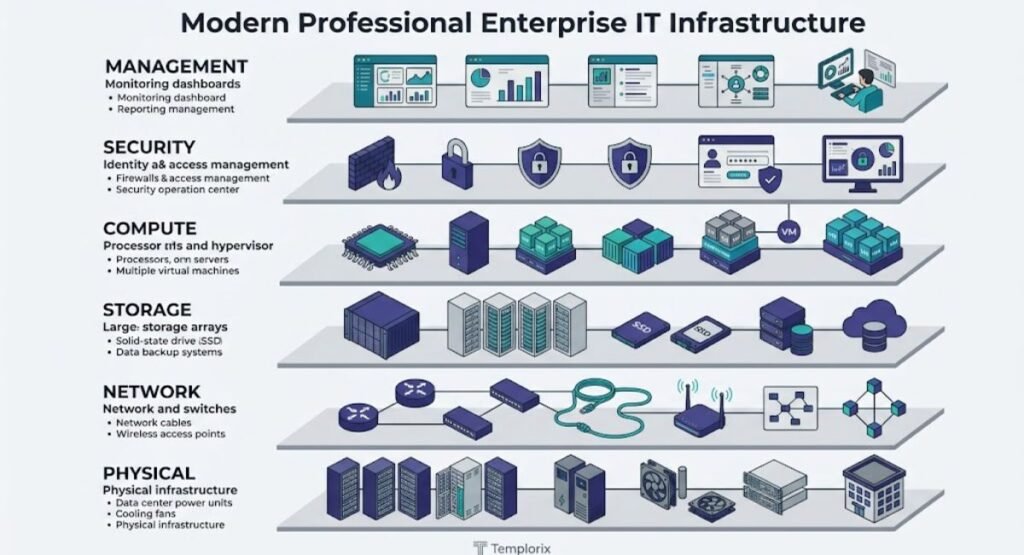
A layered approach can make a complex environment easier to document.
| Infrastructure Layer | Description | Common Products |
| Physical | Hardware and facility components | Servers, racks, UPS |
| Network | Connectivity components | Routers, switches |
| Compute | Processing resources | CPUs, servers, virtual machines |
| Storage | Data storage resources | NAS, SAN, SSD systems |
| Security | Protection mechanisms | Firewalls, security appliances |
| Management | Administration and monitoring | Monitoring platforms, management software |
Layer-based classification is useful when teams need to understand dependencies between different technology components.
How to Build a Product Classification Framework
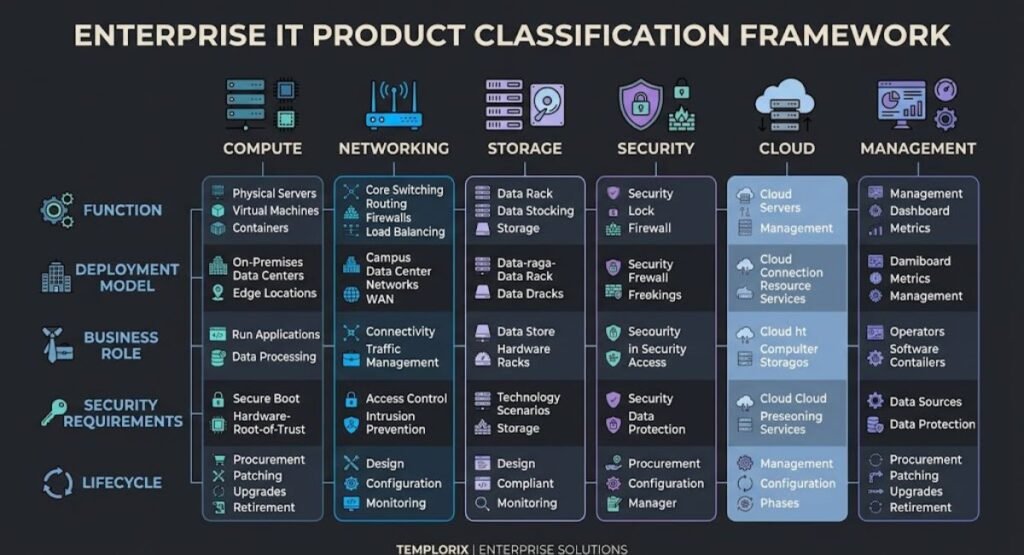
Organizations can create a practical framework by following a structured process.
- Identify infrastructure requirements: Determine what technology resources the organization needs to support its operations.
- Define product categories: Establish logical groups such as compute, network, storage, and security.
- Establish classification criteria: Decide which characteristics will determine where products belong.
- Document technical specifications: Record relevant capacity, compatibility, performance, and configuration information.
- Identify business functions: Connect infrastructure products to the business activities they support.
- Consider security and compliance requirements: Identify applicable protection, governance, and compliance considerations.
- Evaluate deployment models: Record whether resources operate on-premises, in cloud environments, or across multiple environments.
- Define lifecycle and support requirements: Document acquisition, active use, maintenance, replacement, and retirement stages.
- Create a standardized product catalog: Store classification information in a consistent format that teams can use.
- Review and update the classification regularly: Update categories as technology, business requirements, and infrastructure environments change.
The framework should be detailed enough to be useful without becoming unnecessarily complicated.
Important Criteria for Classifying IT Infrastructure Products
Classification should consider more than product names. The following criteria can help organizations evaluate and organize infrastructure resources.
- Performance: How effectively the product handles required workloads.
- Scalability: How easily capacity can increase as requirements grow.
- Compatibility: How well the product works with existing systems and technologies.
- Security- How the product supports protection and risk reduction.
- Reliability- Its ability to operate consistently under expected conditions.
- Availability- Its ability to remain accessible when required.
- Manageability- How easily IT teams can administer and monitor it.
- Supportability- The availability of maintenance and technical support.
- Lifecycle- The product’s position from acquisition through eventual retirement.
- Cost- The financial impact of acquiring, operating, maintaining, and replacing the product.
Using these criteria can make comparisons more consistent across different infrastructure categories.
Example of an Enterprise IT Product Classification Framework
The following example shows how a generic organization could structure product information.
| Product | Category | Function | Deployment | Business Role | Lifecycle |
| Rack server | Compute | Application processing | On-premises | Core infrastructure | Active |
| Network switch | Networking | Connectivity | On-premises | Core infrastructure | Active |
| Storage array | Storage | Data storage | On-premises | Core infrastructure | Active |
| Firewall | Security | Network protection | On-premises | Security infrastructure | Active |
| Cloud virtual machine | Cloud/Compute | Application processing | Public cloud | Supporting infrastructure | Active |
| Monitoring platform | Management | Infrastructure monitoring | Hybrid | Supporting infrastructure | Active |
Benefits of a Standardized Classification System
A consistent classification approach can provide several practical benefits.
- Better procurement: Teams can compare products using consistent categories and requirements.
- Easier asset management: IT resources can be organized into understandable groups.
- Improved budgeting: Spending can be analyzed by infrastructure category and business requirement.
- Stronger security planning: Security-related products and dependencies become easier to identify.
- Easier infrastructure comparison: Products can be compared using common criteria.
- Better lifecycle management: Teams can identify resources that require maintenance, replacement, or retirement.
- Improved documentation: Standard categories make technical records easier to maintain.
- Greater operational consistency: Different teams can use the same terminology when discussing infrastructure.
- Better scalability planning: Classification helps organizations understand where additional capacity may be needed.
Common Mistakes to Avoid
A classification framework can become less useful when its structure is inconsistent or unnecessarily complicated.
- Using inconsistent product categories: Different teams may use different names for similar products.
- Classifying products only by brand: Brand names do not explain the technical or business function of a product.
- Ignoring deployment models: The same product category can operate in very different environments.
- Failing to document technical requirements: Missing specifications can make comparison and procurement more difficult.
- Mixing hardware and services without clear definitions: Products and services should have understandable classifications.
- Ignoring lifecycle status: A classification system should show whether resources are active, under review, or approaching retirement.
- Creating overly complicated categories: Excessive detail can make the framework difficult to use.
- Failing to review the framework: Technology environments change, so classifications should be reviewed when requirements change.
Professional Considerations
A useful infrastructure classification guide should focus on clear definitions, practical examples, and transparent limitations. Infrastructure requirements can differ significantly between organizations because business operations, existing technology, security requirements, budgets, and deployment strategies are not identical.
Organizations should validate technical specifications, security requirements, compliance obligations, support arrangements, and procurement criteria before selecting or categorizing infrastructure products. A classification framework should support decision-making rather than replace detailed technical or organizational assessment.
About the Author
Zain UL Abideen is an SEO specialist and digital content professional who focuses on creating clear, practical resources covering technology, business, digital tools, and professional workflows. His approach emphasizes structured information, useful explanations, and reader-focused content designed to make complex topics easier to understand.
Conclusion
A structured classification system helps organizations organize infrastructure products by function, deployment, business role, technology layer, and lifecycle. This makes infrastructure information easier to manage, compare, document, and plan across IT and business teams.
The right framework depends on an organization’s requirements, technology environment, security needs, budget, scalability goals, and lifecycle practices. A simple and consistently maintained structure can provide a practical foundation for better infrastructure management.
(FAQs)
1. What is enterprise IT infrastructure?
Enterprise IT infrastructure is the collection of technology resources that supports an organization’s applications, data, communication, users, and operations.
2. Why is IT infrastructure product classification important?
Classification creates a consistent structure for organizing, managing, comparing, and planning technology resources.
3. What are the main categories of enterprise infrastructure products?
Common categories include compute, networking, storage, security, data-center, cloud, management, and end-user infrastructure.
4. How should organizations classify infrastructure products?
Organizations should classify products using factors such as function, deployment model, business role, security requirements, scale, and lifecycle.
5. What factors should be considered when evaluating infrastructure products?
Important factors include performance, scalability, compatibility, security, reliability, availability, manageability, supportability, lifecycle, and cost.