
A collective intelligence framework is a structured approach to combining the knowledge, perspectives, and contributions of multiple people to solve problems or make decisions. It helps a group move beyond individual opinions by defining how information is shared, ideas are evaluated, disagreements are handled, and decisions are reached. The framework works best when participants have a clear objective and the process encourages useful contributions rather than simply collecting more opinions.
A collective intelligence framework provides a structured way to organize that process. It helps people contribute knowledge, evaluate ideas, coordinate their efforts, and make better-informed decisions together.
For businesses, project managers, researchers, and technology teams, collective intelligence can support problem-solving, innovation, risk management, and organizational learning. However, simply putting people in a meeting or creating a shared workspace does not guarantee intelligent group decisions.
How to Build a Collective Intelligence Framework
A practical framework can follow these steps:
- Define the problem: State the decision or challenge the group needs to address.
- Bring together relevant perspectives: Include participants with different, useful knowledge and experience.
- Collect input systematically: Use structured questions, workshops, shared documents, or other suitable methods.
- Evaluate ideas against common criteria: Compare evidence, feasibility, risks, and expected outcomes.
- Make the decision process clear: Explain who decides, how disagreements are resolved, and how conclusions are recorded.
- Review the outcome: Measure whether the decision solved the original problem and identify lessons for future work.
For example, a product team planning a new feature could collect feedback from engineering, customer support, design, and sales. It could then compare proposals against customer need, delivery effort, risk, and strategic value before selecting an approach.
Collective intelligence vs. individual intelligence
Individual intelligence describes a person’s ability to understand information, reason, learn, and solve problems.
Collective intelligence concerns what a group can accomplish through the interaction of its members. A group may have access to more knowledge than any one member, but its performance depends on how effectively that knowledge is shared and used.
For example, a project manager may understand scheduling, an engineer may identify a technical constraint, and a finance specialist may recognize a budget risk. A structured process can bring these insights together before a decision is made.
Collective intelligence vs. collaboration
Collaboration means people work together. Collective intelligence focuses on whether their combined efforts produce effective understanding, judgment, or problem-solving.
A team can collaborate frequently without learning from one another. A collective intelligence approach deliberately creates ways to gather independent perspectives, evaluate evidence, resolve differences, and improve decisions.
How Does Collective Intelligence Work?
Collective intelligence develops when individual contributions connect through a process that helps a group produce a useful result.
A typical process includes five activities:
- Contribution: Participants share information, observations, skills, or ideas.
- Communication: Members explain their reasoning and clarify different perspectives.
- Integration: The group organizes contributions and identifies connections, gaps, and disagreements.
- Decision-making: Participants evaluate alternatives and select an appropriate course of action.
- Learning: The team reviews the outcome and uses feedback to improve future decisions.
Technology can support these activities through shared documents, project management platforms, knowledge bases, discussion tools, and AI-assisted analysis.
Teams can strengthen their analytical skills through practical business intelligence exercises that help them interpret data and compare possible explanations.
However, technology alone cannot create collective intelligence. Teams also need clear objectives, relevant expertise, reliable information, fair participation, and appropriate decision-making rules.
Research published in Science in 2010 identified evidence of a general collective intelligence factor across the performance of groups on different tasks. The researchers also reported associations with social sensitivity and a more balanced distribution of conversational turns. These findings support paying attention to group interaction, rather than relying only on the abilities of individual members. They do not mean that every diverse group will automatically outperform every individual.
Key Components of a Collective Intelligence Framework
An effective framework should address the following components.
1. A clearly defined shared goal
Participants need to understand the problem they are solving and what a successful result looks like.
Instead of asking a project team to “improve project performance,” define a more specific objective, such as identifying the three main causes of recurring schedule delays and recommending actions to address them.
Clear objectives keep discussion focused and make results easier to evaluate.
2. The right participants and expertise
Select people according to the knowledge and experience required to solve the problem.
Depending on the task, participants may include project managers, technical specialists, customers, analysts, frontline employees, or external experts.
Different perspectives can reveal overlooked risks and opportunities. Nevertheless, diversity is useful only when contributions are relevant, and the group has a way to evaluate them fairly.
3. Balanced participation and psychological safety
People should be able to share ideas, question assumptions, and raise concerns without being dismissed simply because of their role or seniority.
Managers can encourage balanced participation by collecting written ideas before meetings, inviting quieter members to contribute, and asking participants to explain their reasoning.
This helps reduce the risk that a few confident voices will determine the outcome before the group has considered the available evidence.
4. Information sharing and knowledge management
Useful information must be accessible to the people who need it.
Teams can maintain shared records of decisions, assumptions, customer feedback, technical findings, project risks, and lessons learned.
A common information source reduces duplicated work and makes it easier to identify conflicting facts. Access controls and appropriate data-handling rules are also important when information is confidential.
5. Clear roles and decision-making rules
Collective input does not mean every decision requires unanimous agreement.
Before beginning, clarify who contributes information, who evaluates options, who makes the final decision, and who is responsible for implementation.
For example, a project team may recommend a response to a schedule risk while the project manager remains accountable for approving the action.
6. Suitable technology and AI support
Digital tools can help distributed teams share information, maintain records, organize contributions, and coordinate tasks.
AI tools may assist with summarizing documents, grouping similar suggestions, identifying recurring themes, or comparing scenarios. Their outputs should be checked against reliable evidence, especially when a decision has significant financial, legal, operational, or safety consequences.
7. Feedback and continuous improvement
A framework should improve through use.
After a decision is implemented, review whether the outcome matched expectations, which assumptions proved incorrect, and what the group should change next time.
Without feedback, teams may repeat the same mistakes even when they have extensive experience and information.
A Practical Collective Intelligence Framework: Seven Steps
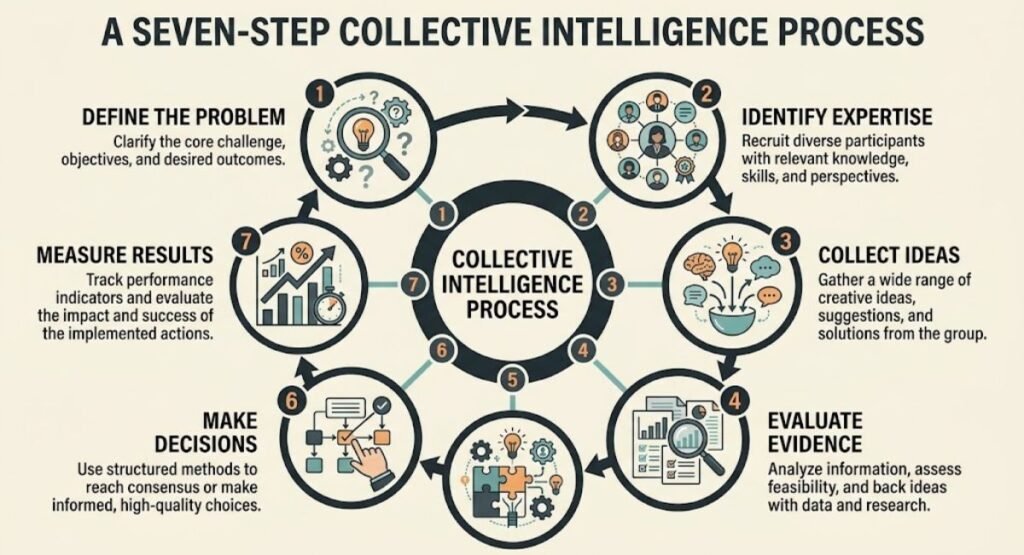
The following seven-step process is an article-specific practical framework informed by collective intelligence and organizational design principles. It is not a formally standardized academic model.
Step 1: Define the problem and desired outcome
Purpose: Establish a common understanding of the issue.
Start by writing a clear problem statement. Describe what is happening, why it matters, what information is available, and what decision the team needs to make.
For example, a construction project may repeatedly miss milestones because of delayed materials, incomplete drawings, or limited site resources.
Action: Agree on the question to answer and define measurable success criteria.
Common mistake: Beginning a discussion with a vague objective that encourages unrelated ideas.
Step 2: Identify the people and knowledge required
Purpose: Ensure that the group has access to relevant perspectives.
Identify who understands the problem, who will be affected by the decision, and who has authority to approve or implement it.
For a project delay, the team might include the project manager, procurement specialist, site engineer, supplier representative, and scheduler.
Action: Assign participants according to expertise and responsibility. Invite additional contributors only when their input adds value.
Common mistake: Inviting too many people without giving them a clear role.
Step 3: Collect independent ideas and evidence
Purpose: Gather useful information before group discussion shapes everyone’s opinions.
Ask participants to submit their observations, proposed solutions, and supporting evidence independently. This can reduce the tendency to follow the first suggestion made by a senior colleague.
Action: Use a short questionnaire, shared document, or structured idea submission form. Separate verified facts from assumptions and opinions.
Common mistake: Treating the loudest suggestion or the first proposed solution as the best one.
Step 4: Organize and evaluate contributions
Purpose: Turn raw ideas into information the team can compare.
Group similar suggestions, identify missing evidence, and evaluate each option against agreed criteria.
For a project team, useful criteria might include cost, implementation time, safety, resource availability, and effect on the critical path.
Action: Create an option matrix and record the evidence supporting each alternative.
Common mistake: Selecting an attractive idea without checking feasibility or unintended consequences.
Step 5: Combine insights and resolve disagreements
Purpose: Use different perspectives to develop a stronger understanding of the problem.
Ask participants to explain conflicting findings. Determine whether disagreements arise from different assumptions, incomplete data, competing priorities, or genuine uncertainty.
The goal is not to eliminate every disagreement. It is to understand which differences matter to the decision.
Action: Document areas of agreement, unresolved questions, and the evidence needed to resolve them.
Common mistake: Forcing consensus when the available evidence supports more than one reasonable option.
Step 6: Make a transparent decision and assign responsibility
Purpose: Convert collective analysis into action.
Choose the decision method before finalizing the discussion. Depending on the situation, this could involve expert judgment, a designated decision-maker, voting, or an agreed evaluation score.
Record the selected option, the reasons for choosing it, the main risks, and any rejected alternatives that deserve further monitoring.
Action: Assign an owner, deadline, required resources, and a clear definition of completion.
Common mistake: Ending a productive discussion without identifying who will do what next.
Step 7: Test the decision, measure results, and improve
Purpose: Learn whether the decision solved the original problem.
Where practical, begin with a small pilot or controlled test. Compare the results against the success criteria established in Step 1.
For example, a project team could test a new supplier escalation process on selected activities before applying it across the project.
Action: Review the results, record lessons learned, and adjust the process where necessary.
Common mistake: Assuming a decision was successful simply because it was implemented.
Real-World Examples of Collective Intelligence
The following are illustrative scenarios, not claims about the documented results of particular companies.
Example 1: Project management and risk identification

A project team is preparing for a critical delivery milestone. The project manager reviews the schedule, the procurement specialist flags a supplier delay, and the site engineer identifies an installation constraint.
Each person contributes information that the others may not possess.
The team records the risks, assesses their likelihood and impact, agrees on mitigation actions, and assigns owners. It then reviews the risk register during project meetings.
What to measure: Number of material risks identified before they cause delays, action completion rates, and changes in milestone performance.
Project teams can document identified risks, issues, assumptions, and dependencies in a RAID report to improve follow-up and accountability.
Example 2: Improving a business decision
A company notices that customer retention is declining. Sales representatives hear complaints about pricing, support staff report recurring service issues, and analysts identify a pattern in customer records.
Instead of allowing one department to define the problem, management combines the evidence and checks whether the explanations are consistent.
The company may discover that several factors contribute to the decline and prioritize the issues that have the strongest supporting evidence.
What to measure: Retention rate, customer complaint patterns, time to resolve recurring issues, and the effect of implemented changes.
Example 3: Distributed teams using AI-assisted analysis
A remote team needs to compare several potential product improvements. Team members submit customer feedback, technical constraints, cost estimates, and usability observations.
An AI tool helps organize the feedback into themes and prepares a summary for review. Team members verify the summary, challenge unsupported conclusions, and evaluate the options against agreed criteria.
The team then documents its decision and assigns implementation responsibilities.
What to measure: Time spent organizing information, completeness of the evidence review, decision quality, and implementation outcomes.
The example illustrates a possible workflow, not a guarantee that AI-assisted decisions will be more accurate.
Benefits of a Collective Intelligence Framework
When designed and used appropriately, collective intelligence can help organizations:
- Improve decision quality: Decisions can draw on evidence and expertise that one person might overlook.
- Identify risks earlier: Frontline employees and specialists can contribute information from different parts of a process.
- Encourage innovation: Participants can combine ideas from different disciplines and experiences.
- Retain organizational knowledge: Shared records preserve lessons and reasoning that might otherwise disappear when employees leave.
- Strengthen coordination: Clear responsibilities help translate discussion into practical action.
- Support organizational learning: Reviewing outcomes allows teams to improve future decisions.
These benefits depend on the problem, the quality of information, the participants, and the design of the decision process. Collective intelligence is not a substitute for expertise, accountability, or sound management.
Challenges and Limitations
Collective intelligence can fail when the process is poorly designed.
| Challenge | Why it matters | Practical response |
| Groupthink | Members may agree to avoid conflict | Collect independent opinions before discussion |
| Dominant voices | Some perspectives receive more attention than others | Use structured turn-taking and written input |
| Conflicting priorities | Departments may optimize different outcomes | Agree on shared goals and evaluation criteria |
| Poor information | Incorrect data can mislead the group | Verify important claims and record assumptions |
| Information overload | Too many contributions make analysis difficult | Group ideas and prioritize relevant evidence |
| Slow decisions | Excessive discussion can delay action | Set deadlines and define decision authority |
| Privacy and confidentiality risks | Shared information may expose sensitive data | Apply access controls and data-handling policies |
| Overreliance on AI | Automated summaries may contain errors or bias | Check source material and retain human accountability |
A larger group is not automatically a smarter group. Adding participants can increase available expertise, but it can also raise coordination costs. Choose the smallest group that includes the necessary knowledge, affected perspectives, and decision authority.
How to Measure Collective Intelligence
There is no single universally accepted operational score that every organization can use to measure collective intelligence. A practical approach is to measure the quality of the process and the results it produces.
Consider these indicators:
Participation balance: Are relevant members contributing, or does most discussion come from a few people?
Evidence quality: Are decisions supported by verified information and clearly stated assumptions?
Decision quality: Does the selected option meet the criteria established before the decision?
Decision speed: How long does the group take to reach a decision, and is that time reasonable for the level of risk?
Implementation success: Are actions completed, and do they achieve the intended outcome?
Learning over time: Does the team use previous results to improve its next decision?
For example, a project team could track the time needed to approve risk responses, the percentage of mitigation actions completed on time, and the number of major risks discovered before they affect delivery.
Use a baseline for comparison. Faster decisions alone do not prove better collective intelligence; speed matters only when considered alongside accuracy, risk, and outcome quality.
Collective Intelligence vs. Traditional Teamwork
| Area | Traditional teamwork | Collective intelligence approach |
| Primary purpose | Complete shared tasks | Combine contributions to improve understanding and problem-solving |
| Participation | May depend on assigned roles or meeting dynamics | Deliberately gathers relevant perspectives |
| Knowledge sharing | Often occurs through routine communication | Uses structured methods to collect and integrate knowledge |
| Decision-making | May rely on a manager or informal consensus | Uses explicit criteria and a defined decision process |
| Technology | Supports coordination and task completion | Can also help organize, compare, and analyze contributions |
| Measurement | Focuses on tasks, deadlines, and team delivery | Also examines contribution quality, decision outcomes, and learning |
These approaches overlap. Traditional teamwork can be highly intelligent, and a collective intelligence process still requires people to work together. The distinction is the deliberate design of how group knowledge becomes a result.
How AI Can Support Collective Intelligence

AI can assist collective intelligence by helping people process information that would be time-consuming to review manually.
Possible uses include:
- Summarizing long discussions and documents.
- Grouping similar suggestions and customer comments.
- Identifying patterns that deserve further investigation.
- Comparing scenarios using supplied assumptions.
- Organizing knowledge in searchable systems.
- Helping distributed teams prepare structured decision records.
AI should support reasoning rather than replace it. A generated summary may omit a minority opinion, misinterpret a technical detail, or present an uncertain conclusion too confidently.
Organizations should verify important claims against original records, protect confidential information, check for bias, and assign responsibility to a human decision-maker. They should also establish rules about which data can be entered into external AI systems.
The best approach depends on the task. Some decisions benefit from automation, while others require expert judgment, consultation, or direct human oversight.
Best Practices for Implementing the Framework
Start with a real problem instead of introducing a complex process across the entire organization.
A RASCI roles and responsibilities matrix can help teams clarify who performs each task, who approves decisions, and who provides support.
- Choose a manageable pilot. Select a recurring decision, such as project risk reviews, customer complaint analysis, or product prioritization.
- Define success in advance. Identify the outcome, the baseline, and the indicators that will demonstrate improvement.
- Match participants to the task. Include relevant expertise without creating unnecessary coordination.
- Give everyone a clear way to contribute. Use written input, structured meetings, or asynchronous collaboration where appropriate.
- Document evidence and decisions. Keep a record of assumptions, alternatives, approvals, and action owners.
- Select tools according to need. Use existing collaboration and project management systems before adding unnecessary software.
- Review the results. Compare outcomes with the baseline and adjust the process based on evidence.
For a small team, a shared document and a short structured discussion may be enough. A large organization may need formal governance, access controls, documented decision rights, and consistent reporting.
The goal is not to maximize meetings, tools, or participants. It is to make the group’s knowledge more useful.
Conclusion
A collective intelligence framework helps teams turn individual knowledge into coordinated decisions. It works best when participants share a clear objective, contribute relevant evidence, evaluate ideas fairly, and understand who is responsible for acting on the final decision. Technology and AI can support the process, but neither replaces sound judgment, reliable information, or accountability.
To get started, choose one recurring business or project problem and test the seven-step process on it. Record the baseline, invite the right contributors, document the decision, and review the outcome. Use what you learn to improve the next decision rather than assuming that more collaboration automatically produces better results.
(FAQs)
1. What is a collective intelligence framework?
A collective intelligence framework is a structured method for combining people’s knowledge, skills, and perspectives to improve group problem-solving and decision-making.
2. What are the main components of collective intelligence?
Key components include a shared goal, relevant participants, balanced contribution, reliable information, clear decision rules, suitable collaboration tools, and feedback.
3. How can organizations implement collective intelligence?
Organizations can define a specific problem, involve relevant experts, gather independent input, evaluate evidence, document decisions, assign responsibility, and measure the results.
4. How is collective intelligence measured?
Organizations can assess participation balance, evidence quality, decision outcomes, decision time, implementation success, and improvements over repeated tasks. The right measures depend on the problem.
5. What is the difference between collective intelligence and collaboration?
Collaboration means working together. Collective intelligence focuses on how effectively a group combines its contributions to produce useful judgment, learning, or problem-solving.