
A program manager is responsible for coordinating multiple related projects and activities that support broader organizational goals. While a project manager typically focuses on delivering a specific project, a program manager looks at how different projects work together and whether they are producing the intended overall outcomes.
This role requires a combination of leadership, communication, planning, risk management, and strategic thinking. A program manager may work with project teams, executives, business leaders, customers, and other stakeholders to keep priorities aligned. This guide explains what a program manager does, the skills and responsibilities involved, career requirements, common challenges, and practical ways to become more effective in the role.
What Is a Program Manager?
A program manager oversees a group of related projects or initiatives and coordinates them toward shared organizational objectives. The role is broader than managing the schedule and deliverables of one individual project.
For example, a company introducing a new digital business platform might have separate projects for software development, employee training, data migration, cybersecurity, and customer communication. A program manager can coordinate these projects, manage their dependencies, monitor risks, and keep the overall initiative aligned with business objectives.
The exact responsibilities can vary depending on the organization, industry, and type of program. However, the central focus is usually coordination, alignment, governance, and delivery of broader outcomes.
What Does a Program Manager Do?
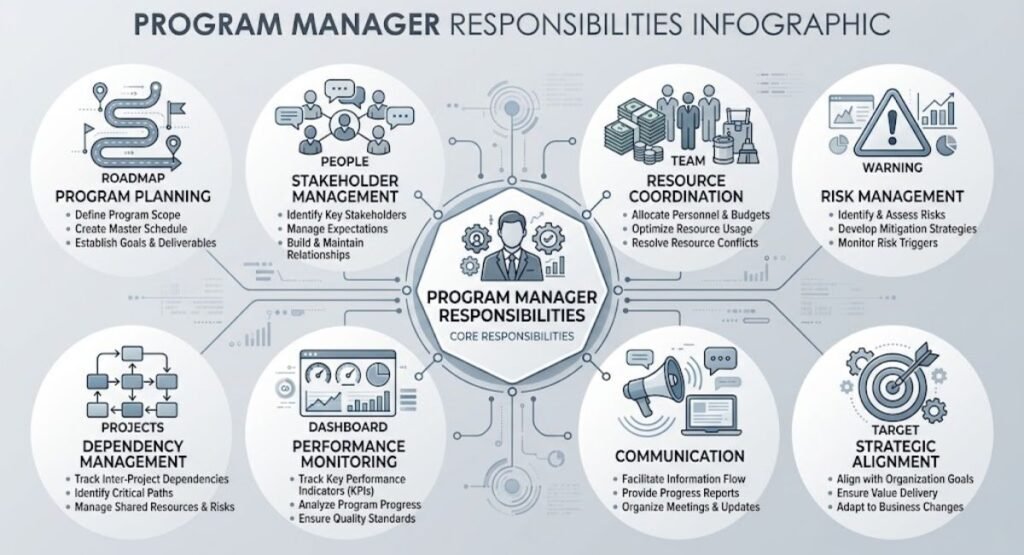
A program manager can handle many responsibilities at the same time. Common duties include:
- Program planning: Defines objectives, scope, priorities, and the overall approach.
- Stakeholder management: Keeps important stakeholders informed and aligned.
- Resource coordination: Helps coordinate people, budgets, technology, and other resources.
- Risk management: Identifies program-level risks and coordinates appropriate responses.
- Dependency management: Tracks relationships and dependencies between different projects.
- Performance monitoring: Reviews progress against objectives, milestones, and expected outcomes.
- Communication: Provides clear and timely updates to stakeholders and leadership.
- Strategic alignment: Connects program activities with wider organizational goals.
Program managers can use a RAID Report to organize and track risks, assumptions, issues, and dependencies across related projects. For a deeper explanation, see our RAID Report: A Practical Guide for Project Management.
The program manager does not necessarily perform every project activity personally. Instead, the role often involves creating alignment between teams and helping them work toward common objectives.
Program Manager vs Project Manager
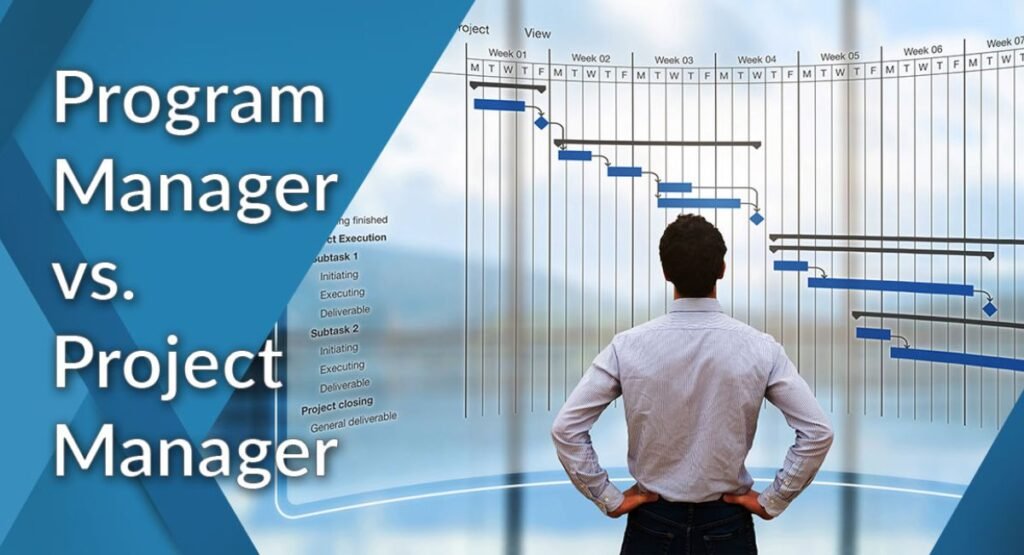
Although program managers and project managers work closely together, their responsibilities are different.
| Area | Program Manager | Project Manager |
| Main focus | Coordinates related projects toward broader outcomes | Manages a specific project |
| Scope | Usually broader | Usually narrower |
| Objectives | Program-level strategic outcomes | Project deliverables |
| Dependencies | Coordinates dependencies across projects | Manages dependencies within the project |
| Stakeholders | Often manages broader stakeholder groups | Focuses on project stakeholders |
| Success measure | Overall program outcomes and benefits | Project scope, schedule, cost, and quality |
In simple terms, a project manager manages a project, while a program manager coordinates related projects and focuses on their combined contribution to broader objectives. The two roles may overlap in some organizations, so job responsibilities should always be considered in context.
Key Skills of a Program Manager
Successful program management requires both technical and interpersonal skills. Important skills include:
- Leadership: Guides teams and encourages alignment around common objectives.
- Strategic thinking: Connects day-to-day activities with broader organizational goals.
- Communication: Shares information clearly with different stakeholder groups.
- Risk management: Identifies potential problems and plans appropriate responses.
- Problem-solving: Helps teams address complex issues and obstacles.
- Negotiation: Works through competing requirements, priorities, and expectations.
- Financial awareness: Understands budgets, costs, and resource considerations.
- Stakeholder management: Builds productive relationships with people affected by the program.
- Decision-making: Evaluates information and supports timely decisions.
- Time management: Prioritizes activities across multiple projects and deadlines.
- Conflict resolution: Helps address disagreements between teams or stakeholders.
- Change management: Supports people and teams when program priorities or processes change.
These skills become particularly important when several projects depend on one another or when different stakeholders have competing priorities.
Program Manager Responsibilities
The responsibilities of a program manager can be summarized as follows:
| Responsibility | Short Definition |
| Program planning | Establishes the overall approach and priorities |
| Governance | Creates structures for oversight and decisions |
| Risk management | Identifies and manages program-level risks |
| Resource management | Coordinates people, budgets, and resources |
| Stakeholder engagement | Maintains communication with key stakeholders |
| Progress tracking | Monitors program performance and milestones |
| Benefits management | Tracks whether the program delivers expected benefits |
A major part of the role is maintaining a broad view of the program. A problem within one project can sometimes affect another project, so the program manager needs to understand relationships between activities rather than viewing each project in isolation.
How Does Program Management Work?
Program management can follow a structured process, although the exact approach varies by organization.

1. Define Program Objectives
Establish what the program is intended to achieve and how its objectives relate to organizational priorities.
2. Identify Related Projects
Determine which projects, workstreams, or activities contribute to the overall program.
3. Establish Governance
Define decision-making responsibilities, reporting structures, escalation routes, and oversight processes.
4. Develop the Program Roadmap
Create a high-level view of major activities, milestones, dependencies, and expected outcomes.
5. Coordinate Resources
Review resource requirements and coordinate people, budgets, technology, and other necessary support.
6. Identify Risks and Dependencies
Look for issues that could affect multiple projects or prevent the program from achieving its objectives.
7. Monitor Progress
Track milestones, performance information, risks, dependencies, and changes.
8. Communicate With Stakeholders
Provide appropriate updates to executives, project teams, business groups, customers, or other stakeholders.
9. Manage Changes
Evaluate significant changes and coordinate their effects across related projects.
10. Evaluate Outcomes and Benefits
Review whether the program achieved its intended outcomes and identify lessons that can support future work.
Program Manager Qualifications
There is no single qualification that is mandatory for every program manager. Requirements can vary significantly according to the organization, industry, role level, and type of program.
Common areas employers may consider include:
- Education: A relevant degree or educational background may be useful for some roles.
- Professional experience: Experience working on projects, programs, operations, or related business activities can be valuable.
- Project or program management experience: Experience coordinating complex work can help prepare someone for the role.
- Leadership experience: The ability to guide teams and coordinate stakeholders is important.
- Industry knowledge: Understanding the relevant business or technical environment can be useful.
- Professional certifications: Some organizations may value relevant project or program management certifications.
Rather than relying on one qualification, aspiring program managers can develop a combination of practical experience, leadership ability, business understanding, and management skills.
Program Manager Tools
Program managers often use different types of tools to organize information, coordinate work, and communicate progress.
Common categories include:
- Project management software: Helps teams organize tasks, schedules, and project information.
- Collaboration platforms: Support communication and teamwork.
- Reporting dashboards: Present performance information in an accessible format.
- Risk registers: Record risks, owners, responses, and status.
- Roadmaps: Provide a high-level view of program activities and milestones.
- Budget tracking tools: Help monitor financial information and resource usage.
- Documentation systems: Store plans, decisions, reports, and other program information.
The appropriate tools depend on the organization’s processes, program size, technology environment, and reporting requirements.
Program Manager Career Path
A possible career progression may look like this:
| Career Stage | Typical Focus |
| Project Coordinator | Supports project activities and documentation |
| Project Manager | Manages individual projects |
| Senior Project Manager | Handles larger or more complex projects |
| Program Manager | Coordinates multiple related projects and strategic outcomes |
| Senior Program Manager | Oversees larger or more complex programs |
| Portfolio/Program Leadership | Coordinates broader organizational investments and priorities |
This is only one possible career path. Organizations use different job titles and structures, and some professionals move into program management from operations, product management, consulting, technology, or other areas.
Program Manager Salary and Job Outlook
Compensation for program managers can vary considerably. Factors may include location, industry, experience, organization size, responsibilities, and seniority.
For this reason, a single salary figure should not be treated as universal. Someone working in a large organization or specialized industry may have different compensation from someone performing a similar role in another market.
Job responsibilities and demand can also vary by industry and location. Anyone researching a specific opportunity should review current job advertisements, employer information, and reliable salary sources relevant to their particular market.
Example of Program Management
Consider an organization carrying out a company-wide digital transformation.
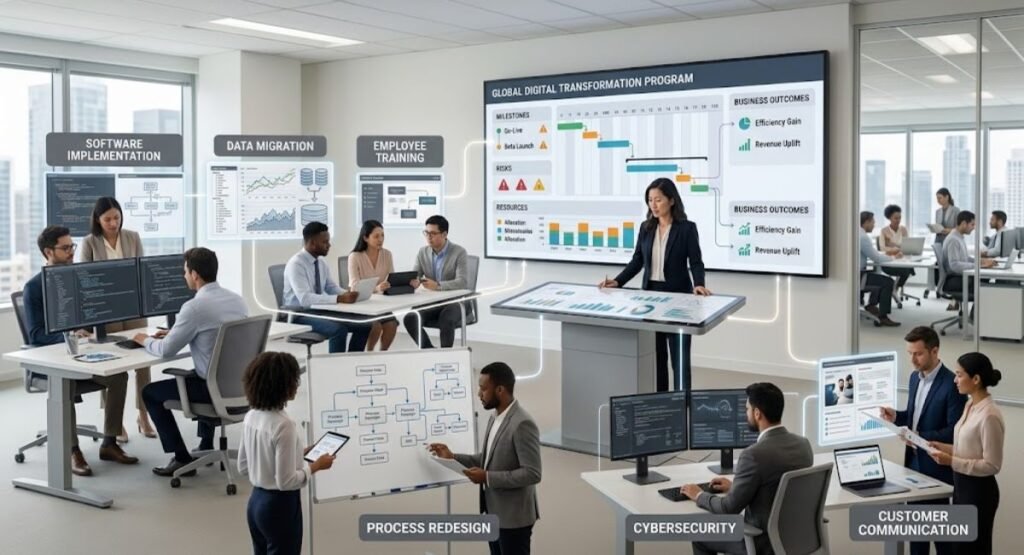
The initiative may contain several related projects, including:
- Software implementation
- Data migration
- Employee training
- Process redesign
- Cybersecurity improvements
- Customer communication
Each project may have its own project manager and team. The program manager looks across the entire initiative.
For example, if the software implementation is delayed, the program manager can evaluate whether that delay affects training, data migration, or process redesign. The program manager can then coordinate stakeholders, review dependencies, communicate the impact, and help determine an appropriate response.
This broader perspective keeps individual projects connected to the overall transformation objectives.
Common Challenges for Program Managers
Program managers can face challenges that involve multiple teams and competing priorities.
- Conflicting priorities: Different projects may need the same resources at the same time.
- Resource constraints: Limited people, budgets, or technology can affect delivery.
- Cross-project dependencies: A delay in one project may create problems for another.
- Stakeholder disagreements: Different stakeholders may have different expectations or priorities.
- Changing requirements: Business conditions or organizational priorities can change during the program.
- Risk escalation: A risk that begins within one project can sometimes become a broader program concern.
- Communication gaps: Incomplete or delayed information can make coordination more difficult.
- Difficulty measuring benefits: Some program outcomes may be harder to measure than individual project deliverables.
Strong communication, structured governance, and early identification of dependencies can help program managers respond to these challenges.
Tips for Becoming an Effective Program Manager
Professionals looking to improve their program management skills can focus on several practical habits:
- Understand strategic goals: Know how the program supports the organization’s broader objectives.
- Build stakeholder relationships: Establish trust and maintain regular communication.
- Communicate consistently: Share relevant information clearly and at the appropriate time.
- Monitor dependencies early: Identify relationships between projects before they create major problems.
- Use data for decisions: Combine performance information with professional judgment.
- Maintain clear documentation: Record important decisions, risks, actions, and changes.
- Focus on outcomes: Look beyond completing individual activities and consider the intended benefits.
- Develop leadership and negotiation skills: These abilities are valuable when priorities conflict.
- Learn from reviews: Use lessons learned and program reviews to improve future work.
An effective program manager needs to balance strategic thinking with practical coordination. The ability to see the bigger picture while understanding important details can support better program-level decision-making.
About the Author
Zain UL Abideen is an SEO specialist and digital content professional focused on creating clear, practical, and search-friendly content around technology, business, project management, and digital ideas. His work emphasizes useful information, clear structure, and reader-friendly writing.
Conclusion
A program manager plays a broad coordination role by connecting related projects with shared organizational objectives. The position commonly involves planning, governance, resource coordination, risk management, stakeholder engagement, dependency management, and monitoring program outcomes.
Strong leadership, communication, strategic thinking, and coordination are important because program managers often work across multiple teams and priorities. Building practical experience and continuously developing these skills can help professionals become more effective in program management.
(FAQs)
1. What is a program manager?
A program manager coordinates related projects and activities to support broader organizational objectives.
2. What does a program manager do?
A program manager plans, coordinates, monitors, and communicates across multiple projects within a broader program.
3. What skills does a program manager need?
Key skills include leadership, communication, strategic thinking, risk management, problem-solving, negotiation, and stakeholder management.
4. What is the difference between a program manager and a project manager?
A project manager focuses on a specific project, while a program manager coordinates related projects toward broader outcomes.
5. How can someone become a program manager?
A person can build relevant project experience, leadership skills, business knowledge, and program coordination experience over time.