
Understanding the difference between a Program Manager and a Project Manager matters for anyone building a career in project management or working in an organization that manages multiple projects.
Although these two professionals work closely together, their responsibilities are different. A Project Manager focuses on planning and delivering an individual project, while a Program Manager coordinates related projects to achieve broader business objectives.
Both roles require leadership, communication, planning, and problem-solving skills. However, they differ in their level of responsibility, strategic focus, and approach to managing work.
In this guide, you will learn what each role involves, how their responsibilities differ, which skills they need, and how to decide which career path may suit you.
What Is a Program Manager?

A Program Manager is responsible for coordinating and overseeing a group of related projects that contribute to a larger organizational goal.
Organizations can use recognized program management standards to coordinate related projects, manage complexity, and keep program activities aligned with strategic objectives.
A Program Manager must understand strategic planning, leadership, stakeholder coordination, and program delivery. You can explore these responsibilities in our detailed guide to the Program Manager role.
Instead of focusing on just one project, a Program Manager looks at how multiple projects work together. Their job is to ensure that these projects support the organization’s strategy and deliver the expected business benefits.
For example, a company planning a digital transformation may launch several projects, including new software development, employee training, data migration, and system implementation. A Program Manager helps coordinate these projects so they contribute to the same overall objective.
Key Responsibilities of a Program Manager
A Program Manager may perform the following responsibilities:
- Strategic alignment: Ensures that program activities support the organization’s business objectives.
- Project coordination: Coordinates related projects and manages dependencies between them.
- Resource planning: Helps allocate people, budgets, and other resources across the program.
- Risk management: Identifies risks that could affect multiple projects and coordinates responses.
- Stakeholder communication: Keeps senior management, project teams, and other stakeholders informed.
- Performance monitoring: Tracks overall program progress and expected benefits.
- Change management: Helps organizations manage changes associated with the program.
The exact responsibilities depend on the organization’s structure, the size of the program, and the industry.
What Is a Project Manager?

A Project Manager is responsible for planning, organizing, and delivering a specific project within agreed requirements.
Their primary focus is to complete the project successfully while managing its scope, schedule, budget, quality, and resources.
For example, if a company wants to develop a new customer management system, the Project Manager will coordinate the development team, set deadlines, monitor progress, manage risks, and ensure the final system meets the agreed requirements.
Key Responsibilities of a Project Manager
A Project Manager typically handles these activities:
- Project planning: Defines objectives, deliverables, tasks, and timelines.
- Budget management: Monitors project spending and manages financial resources.
- Team coordination: Assigns responsibilities and supports team members.
- Schedule management: Tracks deadlines and addresses delays.
- Risk management: Identifies potential project problems and develops response plans.
- Quality control: Checks whether project deliverables meet agreed standards.
- Progress reporting: Provides updates to stakeholders about project performance.
- Project closure: Confirms deliverables, documents results, and formally closes the project.
A Project Manager is mainly accountable for the successful delivery of the assigned project.
Program Manager vs Project Manager: Key Differences
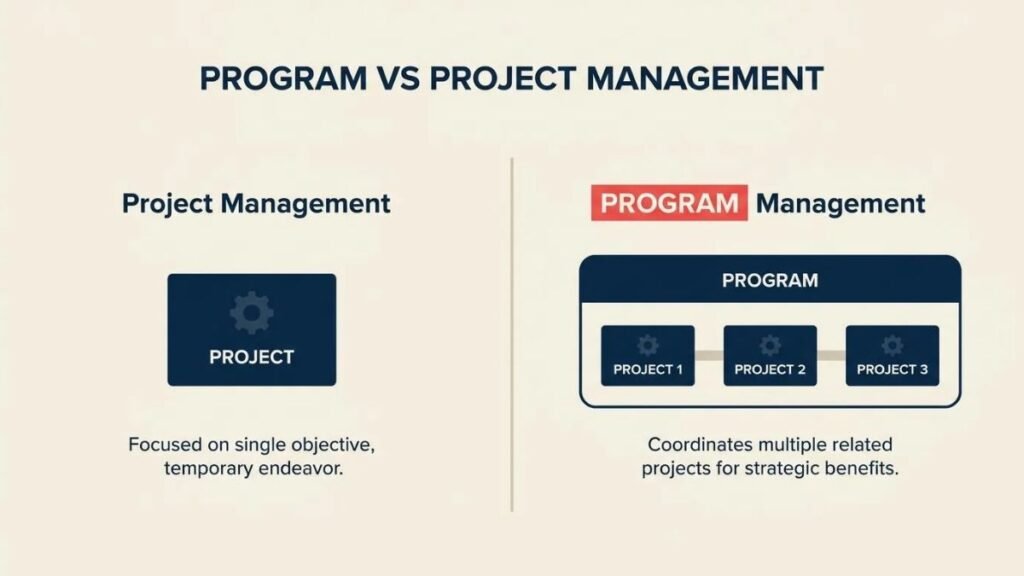
The main difference between these roles is their scope of responsibility. A Program Manager oversees a group of related projects, while a Project Manager manages an individual project.
| Comparison Area | Program Manager | Project Manager |
| Main focus | Overall program objectives | Individual project objectives |
| Scope | Multiple related projects | One specific project |
| Responsibility | Coordinates projects and their outcomes | Plans and delivers project work |
| Planning | Focuses on program-level planning | Focuses on detailed project planning |
| Time frame | Often longer-term | Usually defined by the project schedule |
| Risk management | Considers risks across the program | Manages risks within the project |
| Resource management | Coordinates resources across projects | Manages resources assigned to the project |
| Success measurement | Program outcomes and business benefits | Project deliverables and agreed objectives |
| Stakeholders | Often works with senior leadership and multiple project teams | Works with project teams, clients, and stakeholders |
| Decision-making | Supports broader program-level decisions | Makes or coordinates project-level decisions |
These differences are general rather than universal. Some organizations combine responsibilities or use different job titles.
Organizations managing several programs and projects can use structured portfolio management to prioritize investments, allocate resources, and keep project activities aligned with strategic objectives.
Program Manager vs Project Manager: Daily Activities
Although both roles involve planning and communication, their everyday activities are not the same.
What Does a Program Manager Do Daily?
A Program Manager usually spends time coordinating projects, reviewing overall progress, discussing dependencies, and communicating with senior stakeholders.
Typical daily activities may include:
- Reviewing progress across multiple projects.
- Discussing resource requirements with project managers.
- Identifying issues that could affect the wider program.
- Reviewing program budgets and performance reports.
- Coordinating decisions between departments.
- Checking whether projects remain aligned with business goals.
- Reporting program performance to senior management.
Their work involves looking at the bigger picture and making sure different projects contribute to a shared objective.
Project Managers can use a RAID report to track risks, assumptions, issues, and dependencies throughout the project lifecycle.
What Does a Project Manager Do Daily?
A Project Manager focuses more directly on the activities required to complete a particular project.
Typical daily activities may include:
- Conducting project team meetings.
- Reviewing task completion and deadlines.
- Updating project schedules.
- Managing project budgets and resources.
- Resolving team-related problems.
- Communicating with clients and stakeholders.
- Updating risk and issue registers.
- Checking the quality of project deliverables.
Their main responsibility is to keep the project organized and moving toward completion.
Real-World Example: How Both Roles Work Together
Consider a manufacturing company that wants to modernize its operations by introducing digital technology.
The organization launches a transformation program with several connected projects:
- Software Development Project: Building a new business management system.
- Data Migration Project: Moving existing business data into the new system.
- Employee Training Project: Preparing employees to use the new technology.
- System Implementation Project: Installing and launching the new system across the organization.
The Program Manager oversees the overall transformation program. They coordinate the projects, monitor dependencies, manage program-level risks, and ensure that the work supports the company’s business objectives.
Each Project Manager handles the delivery of an individual project. For example, the software development Project Manager coordinates developers, manages deadlines, monitors the budget, and ensures that the software meets the agreed requirements.
This example shows how both roles contribute to the same organizational goal while maintaining different responsibilities.
Before launching a major business initiative, organizations may also prepare a project information memorandum to communicate important project details, objectives, and relevant business information.
Skills Required for a Program Manager and Project Manager
Both professionals need strong management and communication abilities. However, the level at which they apply these skills can differ.
Essential Program Manager Skills
A successful Program Manager generally needs:
- Strategic thinking: Understanding how projects support wider business goals.
- Leadership: Guiding different teams and coordinating project managers.
- Stakeholder management: Building relationships with senior leaders and other stakeholders.
- Risk management: Identifying risks that could affect multiple projects.
- Financial awareness: Understanding program budgets and resource allocation.
- Change management: Helping organizations manage major changes.
- Decision-making: Supporting decisions that influence the overall program.
Essential Project Manager Skills
A Project Manager generally needs:
- Planning and organization: Creating realistic project plans and schedules.
- Communication: Keeping team members and stakeholders informed.
- Time management: Monitoring deadlines and managing priorities.
- Budget control: Tracking project costs and spending.
- Problem-solving: Resolving issues that affect project delivery.
- Team management: Coordinating people and assigning responsibilities.
- Quality management: Ensuring that deliverables meet agreed requirements.
Both roles benefit from strong leadership, adaptability, and the ability to communicate clearly.
Program Manager vs Project Manager: Salary Differences
Program Managers may earn more than Project Managers in some organizations because their responsibilities can involve larger budgets, multiple teams, and broader business objectives.
However, this is not a universal rule. Actual salaries depend on several factors, including:
- Country and location.
- Industry and company size.
- Years of professional experience.
- Qualifications and certifications.
- Program or project complexity.
- Level of responsibility.
For accurate salary comparisons, review current salary data for your country and industry. Websites such as Indeed and Glassdoor can provide useful market estimates, although reported figures may vary.
Certifications for Program Managers and Project Managers
Professional certifications can help demonstrate knowledge of project and program management practices. The most suitable certification depends on your experience and career goals.
If you are new to project management and want to build your foundational knowledge, our CAPM certification guide explains the qualification, its benefits, and how beginners can prepare for it.
Project Management Certifications
Some widely recognized options include:
- Certified Associate in Project Management (CAPM): Offered by the Project Management Institute (PMI), this certification is suitable for people developing foundational project management knowledge.
- Project Management Professional (PMP): Also offered by PMI, the PMP certification is designed for experienced project professionals who meet its eligibility requirements.
Program Management Certification
- Program Management Professional (PgMP): Offered by PMI, this certification focuses on the skills and experience needed to manage multiple related projects and achieve program-level benefits.
Before applying, check the official PMI website for current eligibility requirements, examination details, and certification policies.
Career Progression: From Project Manager to Program Manager

Many professionals develop their careers by gaining project management experience before moving into program management. However, there is no single career path that everyone must follow.
A possible progression may look like this:
- Project Coordinator: Supports project planning, documentation, communication, and administration.
- Project Manager: Takes responsibility for planning and delivering individual projects.
- Senior Project Manager: Manages more complex projects and may support less experienced project managers.
- Program Manager: Coordinates multiple related projects to achieve wider organizational objectives.
- Portfolio Manager or Senior Leadership Role: May oversee a collection of programs and projects or take on broader strategic responsibilities.
Progression depends on experience, performance, organizational opportunities, and the skills required for each position.
Which Career Is Better: Program Manager or Project Manager?
Neither career is automatically better. The right choice depends on your interests, experience, and professional goals.
Choose Project Management If:
- You enjoy organizing and delivering specific projects.
- You prefer working closely with individual teams.
- You like managing schedules, budgets, and deliverables.
- You want to develop practical project management experience.
- You enjoy solving day-to-day delivery challenges.
Choose Program Management If:
- You enjoy working with multiple teams and projects.
- You are interested in business strategy and organizational goals.
- You can manage complex dependencies and competing priorities.
- You prefer broader planning and coordination.
- You have experience managing projects or leading large initiatives.
If you are new to the field, project management can be a practical starting point. With suitable experience and skills, you may later explore program management opportunities.
How Do Program Managers and Project Managers Work Together?
Program Managers and Project Managers often work together to ensure that organizational initiatives are delivered successfully.
The Program Manager provides overall direction and coordinates the relationship between projects. Project Managers turn that direction into practical plans and manage the delivery of individual projects.
For example, a Program Manager may establish the overall objectives of a business transformation program. Individual Project Managers then manage the projects that contribute to those objectives.
Good collaboration requires:
- Clear roles and responsibilities.
- Regular progress updates.
- Effective communication.
- Shared understanding of priorities.
- Early identification of risks and dependencies.
- Consistent reporting and decision-making.
The reporting relationship varies between organizations. A Program Manager may directly supervise Project Managers in one company, while another company may use a different management structure.
Clear responsibilities help prevent confusion between team members and management roles. A RASCI responsibility matrix can help organizations define who is responsible, accountable, supporting, consulted, and informed during project activities.
Conclusion
The difference between a Program Manager vs Project Manager comes down to the scope and level of responsibility. A Project Manager focuses on delivering an individual project by managing its schedule, budget, resources, risks, and deliverables. A Program Manager takes a broader approach by coordinating multiple related projects and ensuring that they contribute to wider organizational goals.
Both roles are essential for successful business operations. Project Managers help turn plans into completed deliverables, while Program Managers ensure that connected projects work together to produce meaningful business outcomes.
If you are starting your career in management, developing project planning, communication, and leadership skills can provide a strong foundation. As your experience grows, you can decide whether to specialize in project delivery or move toward the broader responsibilities of program management.
Ultimately, the best career choice depends on your strengths, interests, experience, and long-term professional goals.
(FAQs)
1. What is the main difference between a Program Manager and a Project Manager?
A Program Manager coordinates multiple related projects to achieve broader business objectives, while a Project Manager is responsible for delivering one specific project.
2. Is a Program Manager higher than a Project Manager?
In many organizations, Program Managers have broader responsibilities because they oversee multiple projects. However, job titles and reporting structures vary between companies.
3. Can a Project Manager become a Program Manager?
Yes. Project management experience can provide a useful foundation for program management. Professionals generally need to develop broader strategic, leadership, stakeholder, and coordination skills.
4. Who earns more, a Program Manager or a Project Manager?
Program Managers may earn more in some organizations, but salaries depend on location, experience, industry, company size, and job responsibilities.
5. Do Program Managers manage Project Managers?
Sometimes. In certain organizations, Program Managers directly supervise Project Managers. In others, they coordinate with Project Managers without being their direct managers. The structure depends on the organization.