
Projects often involve several people working on different tasks at the same time. When nobody knows who owns a task, who makes the final decision, or who needs to be kept informed, even a well-planned project can become difficult to manage. Team members may duplicate work, miss important activities, or wait for decisions that nobody realizes they need to make.
RACI provides a simple way to solve this problem. It is a responsibility assignment framework that connects project tasks with the people involved in completing them. By defining who is Responsible, Accountable, Consulted, and Informed, teams can create clearer ownership and improve communication.
What Is RACI?
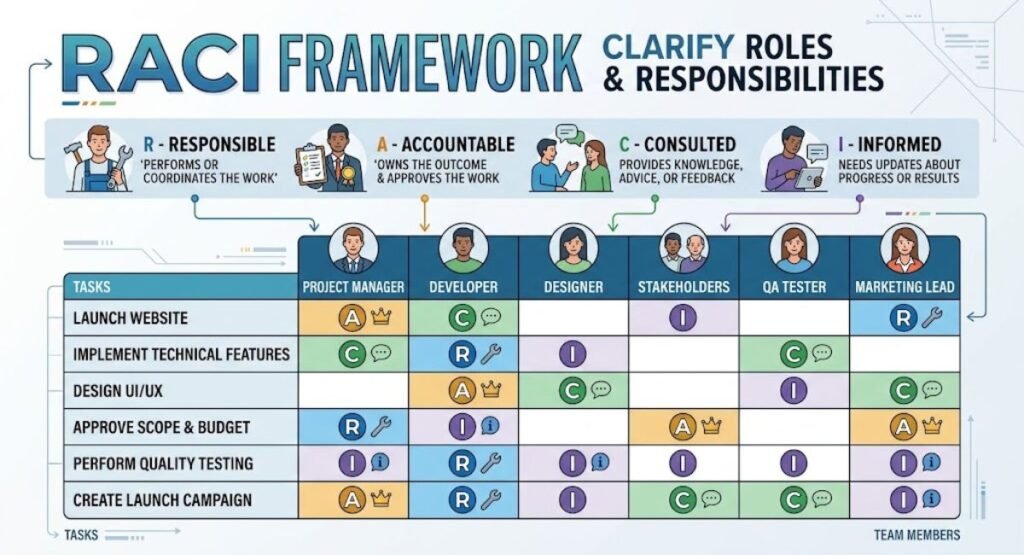
RACI is a framework used to clarify roles and responsibilities for tasks, decisions, and deliverables. It gives project teams a structured way to determine who performs the work, who owns the final result, who provides input, and who should receive updates.
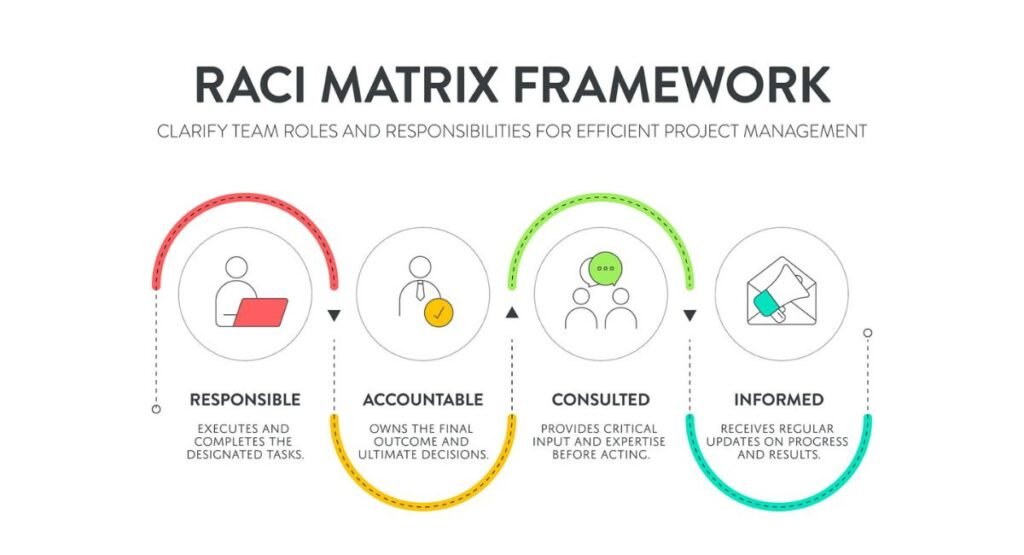
The four RACI roles are:
- R — Responsible: The person who performs or coordinates the work.
- A — Accountable: The person who owns the outcome and approves the work.
- C — Consulted: People who provide knowledge, advice, or feedback.
- I — Informed: People who need updates about progress or results.
The framework is usually displayed as a RACI matrix. Tasks are listed along one side, while team members or stakeholders appear across the top. Each cell receives an R, A, C, or I designation.
For example, a project manager may be accountable for launching a website, while a developer is responsible for implementing its technical features.
What Does RACI Stand For?
Understanding each letter is essential because Responsible and Accountable, in particular, are often confused.
| RACI Role | Meaning | Main Responsibility | Simple Example |
| R — Responsible | Does the work | Completes the assigned task | Developer builds a website feature |
| A — Accountable | Owns the result | Makes sure the task is completed correctly | Project manager approves the final result |
| C — Consulted | Provides input | Gives advice or specialist feedback | Client reviews important design decisions |
| I — Informed | Receives updates | Stays aware of progress or outcomes | Business owner receives launch updates |
. There can sometimes be more than one Responsible person when a task requires collaboration.
The Accountable person owns the outcome. This person usually has the authority to approve the result and should understand whether the task meets the required standard.
Consulted people contribute information before a decision or action is completed. Their input can help the team avoid mistakes.
How Does a RACI Matrix Work?
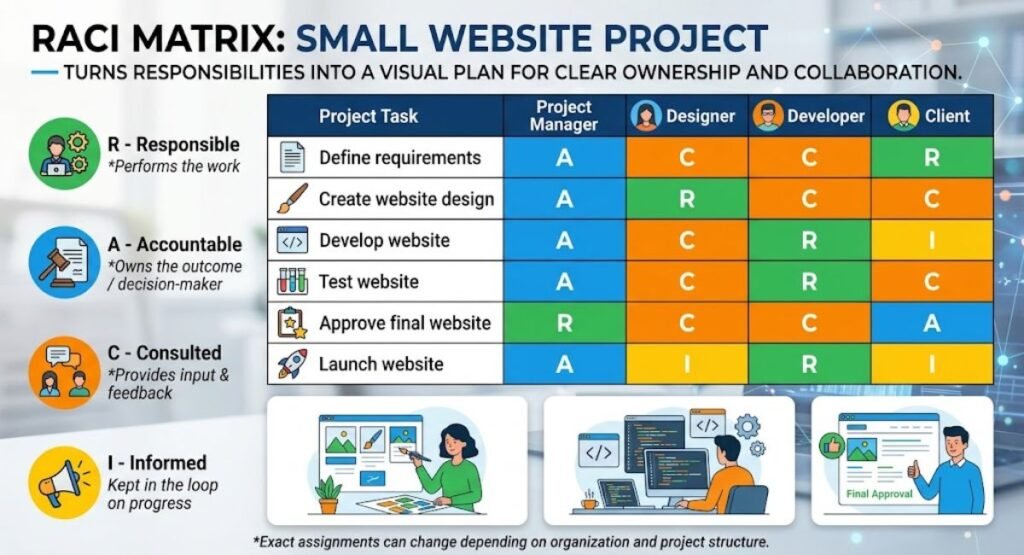
A RACI matrix turns responsibilities into a visual plan. Instead of relying on assumptions, the team can look at a task and immediately see who is expected to perform the work and who owns the outcome.
Consider a small website project involving four roles:
| Project Task | Project Manager | Designer | Developer | Client |
| Define requirements | A | C | C | R |
| Create website design | A | R | C | C |
| Develop website | A | C | R | I |
| Test website | A | C | R | C |
| Approve final website | R | C | C | A |
| Launch website | A | I | R | I |
This matrix makes responsibilities easier to understand. The designer is responsible for creating the design, while the developer handles development and testing. The client provides important input and has final accountability for approving the finished website.
The exact assignment can change depending on the organization and project structure.
Why Is RACI Important in Project Management?
A RACI framework can improve project coordination by making ownership visible.
Clear ownership: Every important task can have a clearly identified owner, reducing uncertainty about who should take action.
Better accountability: Assigning an Accountable person makes it easier to identify who has final ownership of a deliverable or decision.
Fewer misunderstandings: Team members can see where their responsibilities begin and end, which can reduce duplicated or overlooked work.
Improved communication: The Consulted and Informed categories help teams determine who needs to participate and who simply needs updates.
Faster decision-making: When decision ownership is clear, teams are less likely to spend unnecessary time asking who has approval authority.
Better stakeholder coordination: RACI helps stakeholders understand when their input is required and when they only need to receive information.
Reduced duplication: Two people are less likely to unknowingly perform the same task when responsibilities have been documented.
Corporate restructuring and sudden operational changes like the recent Microsoft workforce reductions and operational shifts often lead to role confusion. Implementing a clear RACI framework during such transitions helps surviving teams maintain clarity on task ownership and project continuity.
How to Create a RACI Matrix
A practical approach is to build it around important project activities.
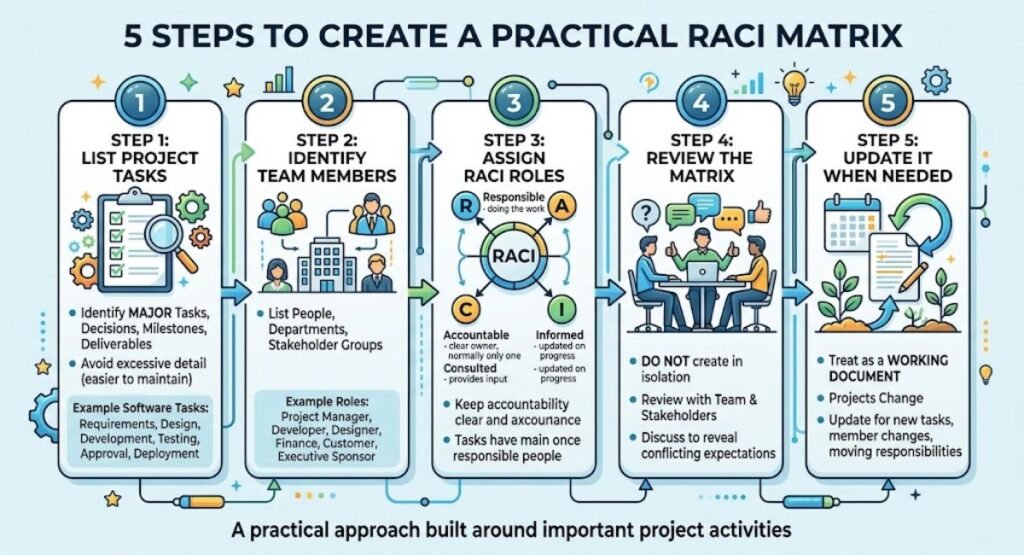
Step 1: List Project Tasks
Start by identifying the major tasks, decisions, milestones, and deliverables. Avoid listing every minor activity because an extremely detailed matrix can become difficult to maintain.
For a software project, tasks might include requirements gathering, interface design, development, testing, approval, and deployment.
Step 2: Identify Team Members
List the people, departments, or stakeholder groups involved in the project. Depending on the project, these could include a project manager, developer, designer, finance team, customer, or executive sponsor.
Step 3: Assign RACI Roles
Review each task and decide who is Responsible, Accountable, Consulted, and Informed.
Try to keep accountability clear. A task should normally have a clearly identifiable Accountable owner. Also make sure every important activity has someone responsible for doing the work.
Step 4: Review the Matrix
Do not create the matrix in isolation. Review it with the relevant team members and stakeholders. This discussion can reveal conflicting expectations before the project reaches a critical stage.
Step 5: Update It When Needed
Projects change. Team members may change, responsibilities may move, or new tasks may appear. Treat the RACI matrix as a working document rather than something that is created once and forgotten.
RACI Matrix Example
Imagine a company is redesigning its business website. The project includes research, design, development, testing, and launch.
| Task | Project Manager | UX Designer | Developer | Marketing Manager | Executive |
| Gather requirements | R | C | C | C | A |
| Create wireframes | A | R | C | C | I |
| Build website | A | C | R | I | I |
| Review content | C | C | I | R | A |
| Test website | A | C | R | C | I |
| Approve launch | R | I | C | C | A |
The matrix shows how different team members contribute without giving everyone the same responsibility. The developer owns the technical implementation, while the UX designer handles the interface work. Marketing takes responsibility for content review, and the executive provides final accountability for the launch decision.
This structure can also expose problems. If an important task has no Responsible person, the team should resolve that gap before work begins.
RACI vs. Other Responsibility Frameworks
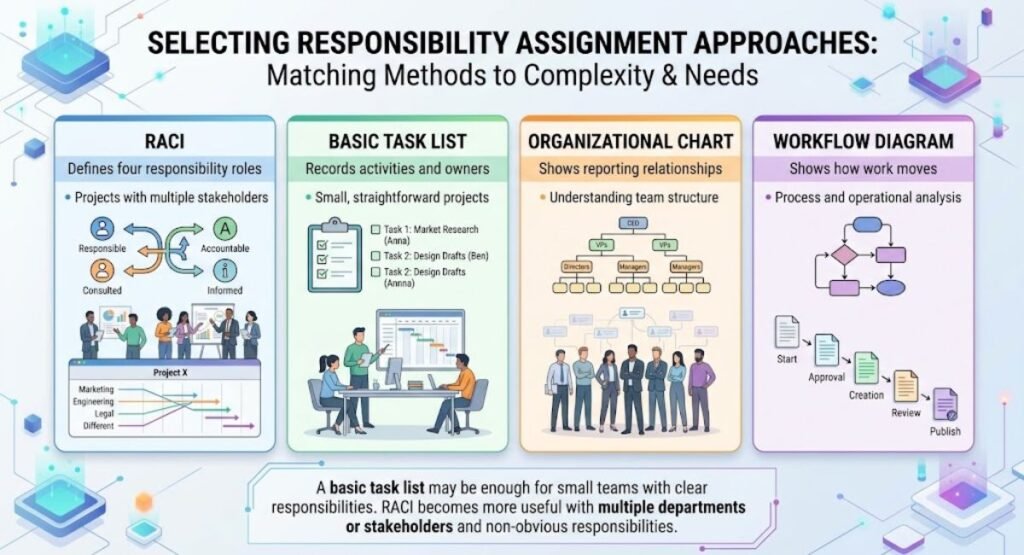
RACI is one type of responsibility assignment approach. Teams should select a method based on the complexity and needs of their work.
| Approach | Main Purpose | Best Used For |
| RACI | Defines four responsibility roles | Projects with multiple stakeholders |
| Basic task list | Records activities and owners | Small, straightforward projects |
| Organizational chart | Shows reporting relationships | Understanding team structure |
| Workflow diagram | Shows how work moves | Process and operational analysis |
A basic task list may be enough when a small team has clear responsibilities. RACI becomes more useful when several departments or stakeholders interact, and responsibilities are not immediately obvious.
Common RACI Mistakes to Avoid
Even a well-designed RACI chart can cause problems if it is used incorrectly.
Assigning too many people as Accountable: Multiple decision-makers can create uncertainty. Define who has final ownership for each important outcome.
Leaving tasks without a Responsible person: Every significant task needs someone who will actually perform or coordinate the work.
Using RACI for every tiny task: Excessive detail can make the matrix difficult to read. Focus on meaningful activities, decisions, and deliverables.
Failing to communicate the matrix: A document only helps when the people involved understand it and agree with their roles.
Not updating responsibilities: If project conditions change, the matrix should change with them.
Confusing Responsible with Accountable: Responsible means doing the work, while Accountable means owning the final outcome.
When Should You Use a RACI Matrix?
RACI can be particularly useful when projects involve multiple teams, departments, or stakeholders.
Common situations include:
- Large projects with many contributors
- Cross-functional business initiatives
- Software development and implementation
- Website development
- Business process changes
- Marketing campaigns
- Organizational changes
- Projects with complex approval processes
However, RACI is not necessary for every situation. A two-person project with simple tasks may not need a formal matrix. If everyone already understands the responsibilities and decision-making process, a basic task list may be more efficient.
The goal is not to create documentation for its own sake. The goal is to remove uncertainty where uncertainty could affect project performance.
RACI Best Practices
Use these practices to make a RACI framework more useful:
- Focus on important tasks and deliverables.
- Define accountability before work begins.
- Keep responsibilities easy to understand.
- Review assignments with the actual team members.
- Avoid assigning unnecessary Consulted or Informed roles.
- Make the matrix accessible to everyone who needs it.
- Update the matrix when project responsibilities change.
- Use the matrix to support conversations rather than replace them.
A good RACI matrix should make a project easier to understand, not create another layer of complicated administration.
About the Author
Zain Kashif is a project management and business operations writer with extensive experience researching project planning, team collaboration, workflow management, and business frameworks. Their work focuses on explaining complex professional concepts in simple, practical language to help readers make better decisions and manage projects more effectively.
Conclusion
RACI gives project teams a straightforward way to clarify roles, assign ownership, and improve communication. By separating Responsible, Accountable, Consulted, and Informed roles, teams can reduce uncertainty and make important responsibilities visible.
The framework works best when it remains practical. Instead of documenting every small activity, focus on important tasks, decisions, and deliverables. Discuss the assignments with the people involved and update the matrix as the project changes.
FAQs
1. What does RACI stand for?
RACI stands for Responsible, Accountable, Consulted, and Informed.
2. What is a RACI matrix used for?
A RACI matrix is used to clarify who performs, owns, advises on, and receives information about project tasks.
3. What is the difference between Responsible and Accountable in RACI?
Responsible people perform the work, while the Accountable person owns the final outcome.
4. Can a project have more than one Responsible person?
Yes, a task can have multiple Responsible people when the work requires collaboration.
5. Is RACI useful for small projects?
Yes, but a simple task list may be more practical when responsibilities are already clear. For a project with several contributors or unclear ownership, a well-designed RACI matrix can be a simple but effective starting point for better project coordination.