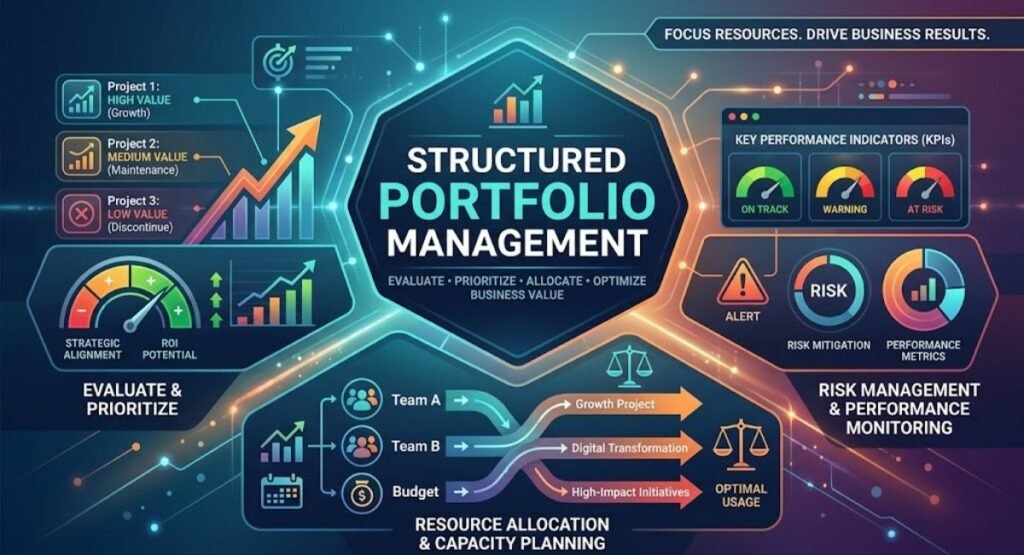
Organizations often manage several projects at the same time, but not every project deserves the same level of investment. Structured portfolio management provides a clear way to evaluate projects, prioritize investments, allocate resources, and keep business initiatives connected to strategic goals. Instead of looking at projects separately, it gives decision-makers a broader view of how different initiatives work together.
A structured approach also makes it easier to identify risks, measure performance, and adjust priorities when business conditions change. Whether a company manages technology projects, operational improvements, product launches, or transformation programs, portfolio management can help leaders focus limited resources on initiatives that create the greatest business value.
What Is Structured Portfolio Management?

Structured portfolio management is a systematic approach to selecting, organizing, prioritizing, and monitoring a group of projects, programs, or investments. Its main purpose is to make sure that organizational resources support the most important business objectives.
For example, a company may have ten proposed projects but enough budget and staff to complete only five. Portfolio management helps leaders compare those projects using factors such as strategic value, cost, risk, expected return, and resource requirements.
This approach moves decision-making away from individual project preferences and toward consistent business criteria.
Why Structured Portfolio Management Matters
Managing a portfolio without a clear structure can create competing priorities, wasted resources, and too many active projects. A structured approach gives leadership a consistent basis for making investment decisions.
Strategic Alignment
Every major project should support an important business objective. Portfolio management helps organizations identify projects that contribute directly to growth, efficiency, customer satisfaction, compliance, or other strategic priorities.
Better Resource Allocation
People, budgets, technology, and time are limited. A structured portfolio allows managers to compare resource requirements across initiatives and direct resources toward higher-value work.
Improved Risk Management
Individual project risks can affect the wider organization. Portfolio-level reviews help leaders identify common risks, dependencies, and areas where several projects may be exposed to the same problem.
Better Decision-Making
Consistent evaluation criteria give decision-makers reliable information. Instead of choosing projects based only on urgency or stakeholder pressure, leaders can compare initiatives using measurable factors.
Key Components of Structured Portfolio Management
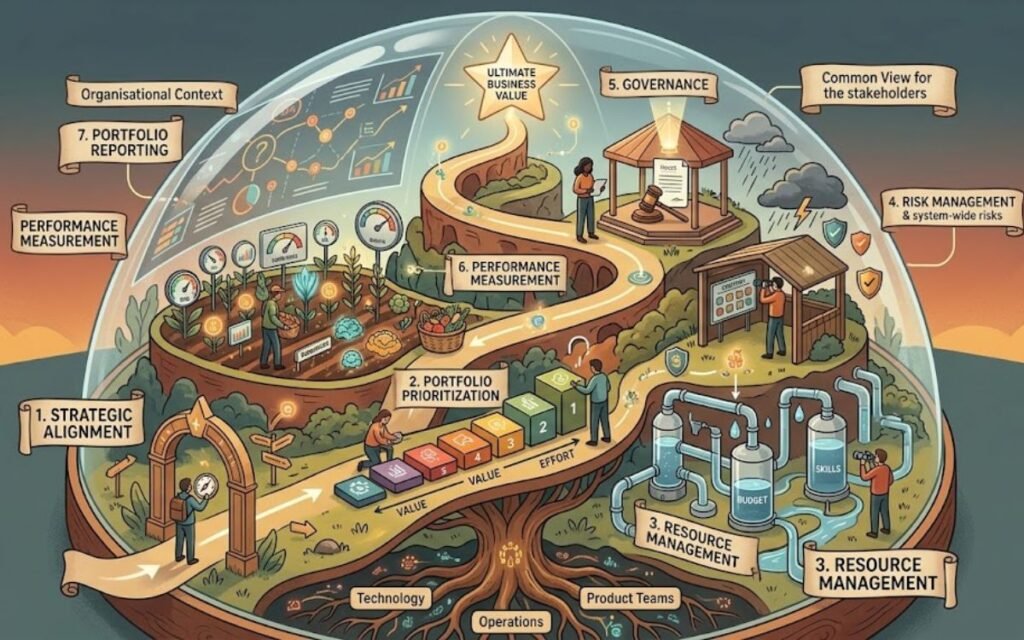
A strong portfolio management approach usually includes several connected components.
1. Strategic Alignment
Projects should have a clear relationship with organizational goals. Initiatives that cannot demonstrate meaningful strategic value should receive additional review before resources are committed.
2. Portfolio Prioritization
Projects need to be ranked according to agreed criteria. Strategic value, financial return, risk, customer impact, and resource demand can all influence priority.
3. Resource Management
Portfolio managers need visibility into available people, budgets, skills, and technology. This prevents organizations from approving more work than they can realistically support.
4. Risk Management
Portfolio reviews should consider both individual project risks and risks that could affect multiple initiatives.
For specialized financial and insurance portfolios, risk and liability reviews can require more detailed analysis, such as the Liability Adequacy Test under IFRS 4.
5. Governance
Clear decision rights help determine who can approve, pause, change, or stop an initiative. Good governance also creates accountability.
6. Performance Measurement
Portfolio leaders need meaningful metrics to understand whether investments are producing expected results.
7. Portfolio Reporting
Regular reporting provides executives and stakeholders with a common view of progress, costs, risks, resources, and expected value.
Structured Portfolio Management Process
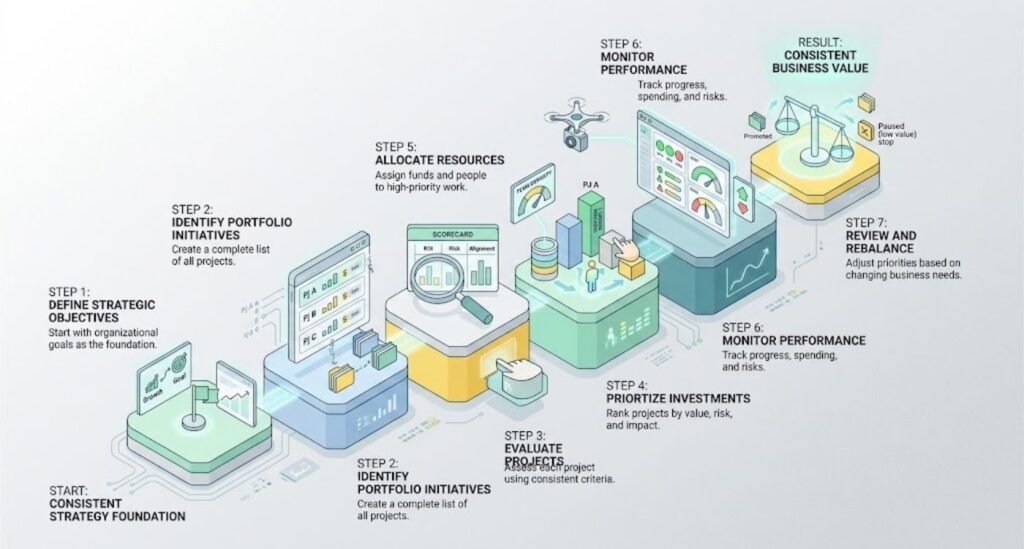
A practical process can help organizations make portfolio decisions consistently.
1. Define Strategic Objectives
Start by identifying the organization’s current business goals. These goals become the foundation for evaluating proposed and existing initiatives.
2. Identify Portfolio Initiatives
Create a complete list of active, planned, and proposed projects. Include basic information such as estimated cost, expected benefits, timeline, resources, and risks.
3. Evaluate Projects
Assess each initiative using consistent criteria. Avoid changing the evaluation method from one project to another because this can make comparisons unreliable.
4. Prioritize Investments
Rank projects according to their strategic importance, expected value, risk, urgency, and resource requirements.
5. Allocate Resources
Assign available funding, people, technology, and other resources to the highest-priority initiatives while considering organizational capacity.
6. Monitor Performance
Track project progress, spending, risks, benefits, and key performance indicators. Portfolio reviews should identify problems before they become larger business issues.
7. Review and Rebalance
Business priorities can change. Regular reviews allow leaders to increase investment in valuable initiatives, delay lower-priority work, or stop projects that no longer provide sufficient value.
Structured Portfolio Management Framework
A simple framework can make portfolio decisions easier to manage.
| Portfolio Stage | Main Activity | Expected Outcome |
| Strategy | Define business objectives | Clear strategic direction |
| Evaluation | Assess initiatives | Consistent project comparison |
| Prioritization | Rank projects | Focus on high-value work |
| Resource Planning | Allocate capacity | Better use of resources |
| Execution | Monitor initiatives | Improved delivery control |
| Review | Assess results | Better investment decisions |
| Rebalancing | Change priorities | Continued strategic alignment |
This framework should not be treated as a fixed process. Organizations can adjust it according to their size, industry, governance structure, and portfolio complexity.
Portfolio Prioritization Criteria
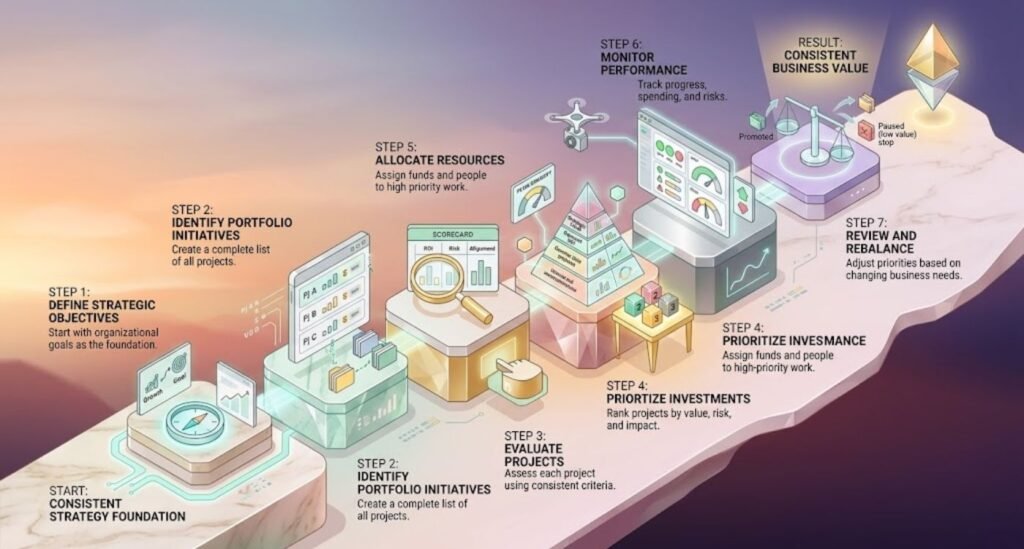
Prioritization is one of the most important parts of structured portfolio management. Organizations should establish clear criteria before comparing initiatives.
| Criterion | What It Measures | Why It Matters |
| Strategic Value | Contribution to business goals | Keeps investment aligned with strategy |
| Expected ROI | Potential financial return | Supports investment decisions |
| Business Impact | Expected organizational benefit | Highlights valuable initiatives |
| Risk | Level of uncertainty or exposure | Helps balance opportunity and risk |
| Resource Demand | People, budget, and technology required | Shows capacity requirements |
| Customer Value | Effect on customer experience | Supports customer-focused decisions |
| Urgency | Need for immediate action | Helps address time-sensitive initiatives |
Using the same criteria across projects makes portfolio decisions more consistent and easier to explain.
Structured Portfolio Management vs. Traditional Project Management
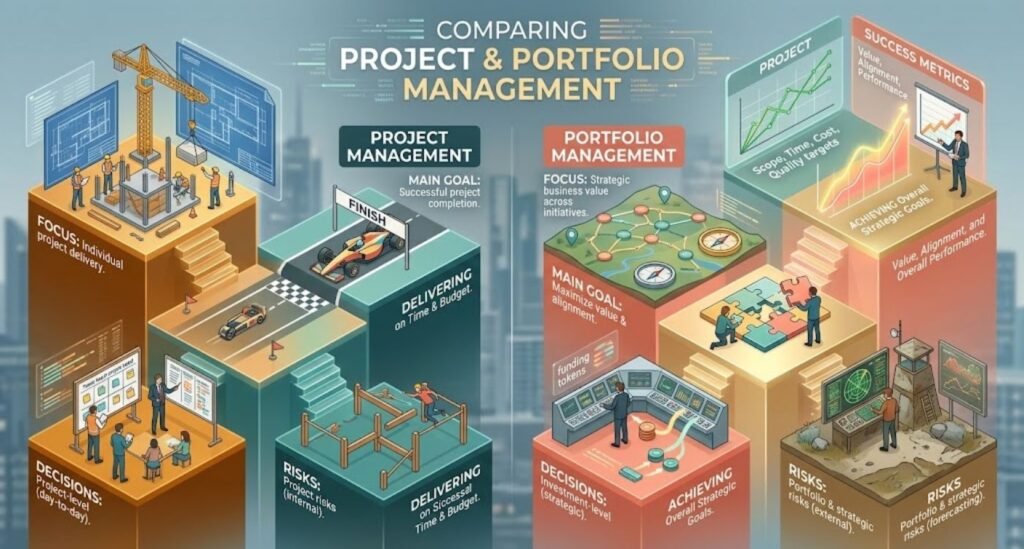
Project management and portfolio management serve different purposes. Project management focuses on delivering a specific initiative, while portfolio management looks across multiple investments.
| Area | Project Management | Portfolio Management |
| Focus | Individual project | Multiple initiatives |
| Main Goal | Successful project delivery | Strategic business value |
| Decisions | Project-level | Investment-level |
| Resources | Project resources | Shared organizational resources |
| Risk | Project risks | Portfolio and strategic risks |
| Success | Scope, time, cost, quality | Value, alignment, and performance |
A project can be delivered on time and within budget but still have limited business value. Portfolio management helps leaders consider whether the project remains worthwhile compared with other investment opportunities.
Common Challenges
Organizations can face several problems when implementing structured portfolio management.
Too Many Active Projects
Starting too many initiatives can spread people and budgets too thin. Managers should regularly assess whether the organization has enough capacity to support approved work.
Poor Prioritization
Projects can receive priority because of internal pressure rather than business value. Standard scoring criteria can reduce this problem.
Conflicting Business Priorities
Different departments may have different goals. Portfolio governance helps leadership resolve conflicts and establish organization-wide priorities.
Limited Data
Poor project information makes comparisons difficult. Standard reporting requirements can improve the quality and consistency of portfolio data.
Resistance to Stopping Projects
Teams may be reluctant to stop initiatives that have already received funding. Regular portfolio reviews can provide evidence for continuing, changing, delaying, or ending projects.
Best Practices
Organizations can strengthen their approach by following several practical practices:
- Connect projects to strategic objectives: Require every major initiative to show how it supports a business goal.
- Use consistent scoring criteria: Evaluate projects using the same basic measures.
- Review the portfolio regularly: Do not wait for an annual planning cycle to reassess priorities.
- Make resource constraints visible: Show leadership where people, skills, or funding are limited.
- Building strong portfolio management skills can also support assured career progression by helping professionals improve strategic planning, decision-making, and leadership capabilities.
- Track portfolio-level risks: Look for risks that can affect multiple initiatives.
- Measure expected and actual benefits: Compare planned outcomes with real results.
- Be willing to change priorities: Pause or stop initiatives when their business value no longer justifies continued investment.
Structured Portfolio Management Example
Consider a company that is evaluating five initiatives: a customer portal, an internal automation project, a new reporting system, a mobile application, and an infrastructure upgrade.
The company has limited funding and cannot complete everything at once. Leaders can score each initiative based on strategic value, risk, expected return, and resource demand.
| Initiative | Strategic Value | Risk | Resource Demand | Priority |
| Customer Portal | High | Medium | High | High |
| Internal Automation | High | Low | Medium | High |
| Reporting System | Medium | Low | Medium | Medium |
| Mobile Application | High | High | High | Medium |
| Infrastructure Upgrade | High | Medium | High | High |
This type of comparison does not automatically determine which projects should be approved. Instead, it gives decision-makers a structured starting point and makes the reasoning behind investment choices easier to communicate.
Key Metrics to Track
Portfolio managers should monitor metrics that show both performance and business value.
“Organizations can also use business intelligence exercises to improve their ability to analyze portfolio data, identify performance issues, and turn data into better business decisions.”
| Metric | What It Measures |
| Strategic Alignment Score | Connection between initiatives and business objectives |
| ROI | Expected or realized financial return |
| Resource Utilization | Use of available organizational capacity |
| Portfolio Risk | Overall exposure to significant risks |
| Project Success Rate | Percentage of initiatives meeting defined targets |
| Budget Variance | Difference between planned and actual spending |
| Benefit Realization | Progress toward expected business benefits |
Metrics should support decisions rather than simply create more reports. A small set of meaningful measures is often more useful than a large dashboard filled with information that does not influence action.
How to Improve Structured Portfolio Management
Organizations can improve portfolio management by first creating a common decision-making framework. Define how projects are evaluated, who makes investment decisions, and how often the portfolio is reviewed.
Better data can also improve results. Portfolio dashboards should provide current information about budgets, timelines, resources, risks, and expected benefits.
Most importantly, portfolio management should remain connected to business strategy. When priorities change, the portfolio should change with them. A project that made sense last year may no longer deserve the same level of investment today.
Conclusion
Structured portfolio management gives organizations a practical way to manage competing projects and investments. By connecting initiatives with strategic objectives, applying consistent prioritization criteria, managing resources carefully, and reviewing performance regularly, leaders can make better investment decisions. The goal is not simply to complete more projects but to ensure that organizational effort produces meaningful business value. A well-structured portfolio also gives stakeholders greater visibility into risks, resources, costs, and expected outcomes, making it easier to adjust priorities when business needs change.
FAQs
What is structured portfolio management?
Structured portfolio management is a systematic method for selecting, prioritizing, monitoring, and adjusting projects according to business objectives.
Why is structured portfolio management important?
It helps organizations use limited resources more effectively while keeping projects aligned with strategic priorities.
What are the main components of portfolio management?
The main components include strategic alignment, prioritization, resource management, governance, risk management, performance measurement, and reporting.
How does portfolio management improve resource allocation?
It compares resource requirements across initiatives so organizations can direct limited capacity toward higher-value priorities.
What is portfolio prioritization?
Portfolio prioritization is the process of ranking projects according to factors such as strategic value, risk, return, and resource requirements.
What metrics should portfolio managers track?
Common metrics include ROI, strategic alignment, resource utilization, portfolio risk, budget variance, and benefit realization.
How often should a portfolio be reviewed?
The review frequency depends on the organization, but regular monthly or quarterly reviews can help maintain alignment as priorities change.