
A private equity operational director plays an important role in improving business performance, increasing operational efficiency, and helping portfolio companies achieve their growth objectives. The main private equity operational director responsibilities include developing value creation plans, monitoring key performance indicators (KPIs), improving profitability, supporting management teams, and implementing operational changes throughout the investment lifecycle.
Unlike investment professionals who primarily evaluate deals and allocate capital, operational directors focus on how businesses perform after—and sometimes before—an acquisition. They work with company leaders to identify problems, implement practical solutions, and measure whether improvements are producing the intended results.
The exact role varies between private equity firms. Some operational directors specialize in cost reduction, technology, or commercial growth, while others manage broader transformation programs and acquisition integrations. Understanding these responsibilities helps professionals explore this career and helps businesses understand how private equity ownership can support operational improvement.
What Is a Private Equity Operational Director?
A Private Equity Operational Director is a senior professional who helps a private equity firm improve the performance of its portfolio companies. A portfolio company is a business in which the investment firm has invested.
The director connects the investment firm’s objectives with the practical work required to improve a business. This may involve reviewing company performance, identifying operational weaknesses, developing improvement plans, and working directly with executives responsible for implementation.
For example, a private equity firm might acquire a growing software company with strong customer demand but inconsistent sales processes. An operational director could help standardize sales reporting, improve customer retention, review pricing, and introduce a more reliable performance-management system.
The objective is not simply to reduce expenses. It is to build a more efficient, profitable, scalable, and resilient business that can achieve its strategic goals.
Titles such as operational director, operating director, director of portfolio operations, and operating partner can overlap. Their responsibilities and decision-making authority depend on the investment firm’s structure and the role’s specific mandate.
Key Private Equity Operational Director Responsibilities

1. Developing and Executing Value Creation Plans
A value creation plan identifies the changes expected to improve a portfolio company’s performance during the investment period.
A structured approach to portfolio management can help businesses prioritize initiatives, monitor performance, and align operational activities with strategic goals.
The operational director helps translate the investment thesis—the reasons the firm believes the investment can succeed into specific initiatives, measurable targets, responsibilities, and deadlines.
Typical activities include:
- Identifying opportunities to increase revenue or improve margins.
- Prioritizing initiatives according to potential impact and implementation effort.
- Assigning responsibility to executives or project leaders.
- Establishing baseline performance measurements.
- Reviewing progress and adjusting plans when assumptions change.
A strong plan explains not only what the business wants to achieve but also who will deliver each initiative and how success will be measured.
2. Improving Operational Efficiency and Cost Management
Operational inefficiencies can reduce profitability and restrict a company’s ability to grow. Directors examine processes, resource allocation, supplier agreements, technology expenses, and organizational structures to identify improvement opportunities.
For example, a manufacturing company might have unnecessary production downtime or excessive inventory. The director could work with operations leaders to improve scheduling, review purchasing practices, and introduce more consistent performance monitoring.
Cost reduction should be based on evidence. Cutting essential staff, weakening customer service, or reducing necessary maintenance may create short-term savings while damaging long-term performance.
3. Supporting Revenue Growth and Commercial Performance
Operational directors also help businesses grow revenue rather than focusing exclusively on expenses.
Depending on the company, this work may involve:
- Reviewing pricing and discounting practices.
- Improving sales team productivity.
- Identifying opportunities to sell additional products to existing customers.
- Strengthening customer retention.
- Improving sales forecasting and pipeline management.
- Supporting entry into suitable new markets.
For a business-to-business software company, the director might examine why customers do not renew subscriptions. Working with sales, product, and customer success teams, the director can help identify recurring problems and establish a plan to address them.
4. Monitoring KPIs, Budgets, Cash Flow, and Profitability
Operational directors use financial and operational information to understand whether a portfolio company is progressing toward its objectives.
They may review earnings before interest, taxes, depreciation, and amortization (EBITDA), operating costs, revenue trends, working capital, cash conversion, and project delivery.
The goal is to turn reporting into action. If margins fall below expectations, the director should help management investigate the cause, agree on corrective measures, and monitor the results.
5. Working With CEOs and Leadership Teams
An operational director typically collaborates with portfolio company CEOs, CFOs, chief operating officers, and functional leaders.
The director may challenge assumptions, facilitate strategic discussions, coordinate improvement projects, and help executives overcome barriers to implementation.
However, the director does not automatically replace the company’s management team. In many arrangements, portfolio company executives retain responsibility for day-to-day decisions, while the operational director provides guidance, specialist expertise, and accountability support.
Clear decision-making authority helps prevent conflicts between the private equity firm’s investment team and company leadership.
6. Assessing Management Capabilities and Organizational Structure
A business may have a promising strategy but lack the leadership capacity to execute it.
Operational directors help assess whether the company has the appropriate skills, reporting relationships, management processes, and organizational structure to deliver its objectives.
Possible actions include identifying training needs, clarifying executive responsibilities, supporting recruitment, and helping design a more suitable operating model.
Any significant restructuring should consider business continuity, employee responsibilities, and the company’s long-term requirements.
7. Supporting Operational Due Diligence
Before an acquisition, operational due diligence helps investors evaluate how a target business actually operates.
The operational director may investigate production capacity, supplier dependencies, customer concentration, management capabilities, technology systems, cost structures, and potential improvement opportunities.
These findings can help test whether the proposed investment plan is realistic. They can also reveal risks that financial analysis alone may not fully explain.
8. Implementing Post-Acquisition and First-100-Day Plans
Following an acquisition, the director may help establish priorities for the first 100 days.
This period can involve confirming the baseline performance, assigning initiative owners, improving management reporting, addressing urgent operational risks, and agreeing on a practical improvement roadmap.
The aim is to establish control and clear accountability without overwhelming the company with too many simultaneous changes.
9. Leading Digital Transformation and Systems Improvements
Operational directors may support technology upgrades, automation, improved reporting systems, and better use of business data.
For example, replacing disconnected spreadsheets with integrated reporting may help management identify problems earlier and make more informed decisions.
Technology projects should begin with a defined business problem. The director should assess costs, implementation risks, user adoption, and measurable benefits rather than recommending new systems simply because they are available.
10. Supporting Acquisitions and Integration
Private Equity Operational Director Responsibilities firms sometimes acquire additional businesses to expand an existing portfolio company. This approach is commonly called a buy-and-build strategy.
Operational directors may coordinate integration across finance, human resources, information technology, sales, and other functions. They may also track expected cost savings and revenue synergies.
A clear integration plan should define milestones, accountable owners, dependencies, and risks. This is especially important when multiple businesses operate across different systems, locations, or countries.
11. Reporting Progress to Boards and Senior Leaders
Directors prepare or contribute to performance reviews, KPI dashboards, board presentations, and updates for the private equity firm’s investment team.
Useful reporting highlights:
- Performance against the agreed plan.
- Initiatives completed and benefits actually realized.
- Problems requiring management attention.
- Changes in budgets, timelines, or assumptions.
- Decisions needed from executives or the board.
Reporting should distinguish between projected benefits and improvements already achieved.
12. Preparing Portfolio Companies for Exit
When a private equity firm considers selling its investment, the operational director may help demonstrate the company’s operational progress and future potential.
This can include improving reporting quality, documenting completed initiatives, strengthening management processes, resolving operational weaknesses, and supporting due diligence from potential buyers.
The objective is to help present an accurate, evidence-based picture of the business. An operational director cannot guarantee a successful sale or a particular valuation.
What Does a Private Equity Operational Director Do Daily?
The daily schedule depends on the number of portfolio companies supported, the director’s specialist responsibilities, and the stage of each investment.
A typical working day might include:
- Morning: Review KPI dashboards, financial reports, project updates, and performance exceptions.
- Midday: Meet with a portfolio company’s CEO, CFO, or operations team to review priorities and resolve implementation issues.
- Afternoon: Work on a value creation initiative, assess an acquisition integration plan, or prepare an update for senior leadership.
- End of day: Confirm decisions, document actions, assign owners, and establish follow-up deadlines.
Some days involve strategic planning and board discussions, while others require detailed work on costs, systems, or operational problems. The role often involves travel to portfolio companies and coordination across multiple teams.
Responsibilities Across the Private Equity Investment Lifecycle
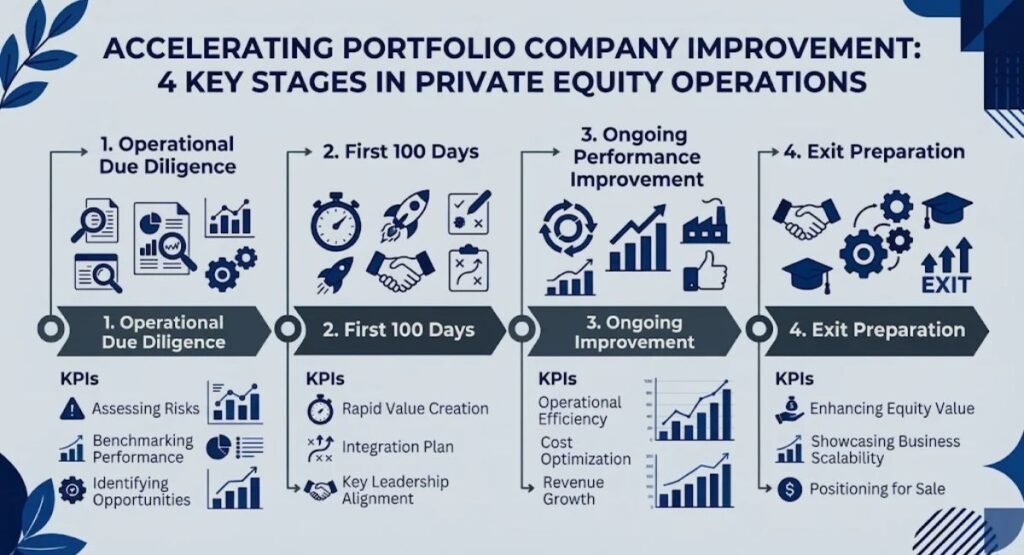
A Private Equity Operational Director Responsibilities director’s work changes as an investment progresses.
| Investment stage | Main responsibilities | Intended outcome |
| Before acquisition | Review operational risks, capabilities, costs, and improvement opportunities | Test the investment assumptions |
| First 100 days | Establish baselines, assign owners, and prioritize initiatives | Create a practical implementation plan |
| Ongoing ownership | Track KPIs, improve operations, and support management | Deliver measurable business improvements |
| Acquisition integration | Coordinate teams, systems, processes, and synergies | Integrate additional businesses effectively |
| Exit preparation | Document results, improve reporting, and address weaknesses | Support a credible investment exit |
A key principle is that a value creation plan must remain achievable and accountable. If market conditions change or an initiative fails to deliver its expected benefits, the director should help management reassess priorities rather than continue following an outdated plan.
Key KPIs and Performance Metrics
The most useful performance indicators depend on the industry, business model, and investment strategy.
Business intelligence techniques can help managers interpret performance data, identify operational trends, and make better-informed decisions.
| KPI or metric | What it measures | Why it matters |
| Revenue growth | Change in sales over time | Shows commercial progress |
| EBITDA margin | EBITDA as a percentage of revenue | Helps assess operating profitability |
| Operating costs | Expenses required to run the business | Identifies efficiency opportunities |
| Cash conversion | How effectively earnings translate into cash | Highlights cash generation |
| Working capital | Cash tied up in receivables, inventory, and payables | Helps manage liquidity |
| Customer retention | The ability to retain customers | Indicates customer stability |
| Sales productivity | Sales output relative to resources used | Helps evaluate commercial effectiveness |
| Initiative delivery | Progress against milestones and targets | Shows whether the plan is being executed |
Directors should establish a reliable baseline before measuring improvements. They should also investigate the reasons behind changes in performance. For example, rising revenue does not necessarily indicate better profitability if operating costs increase faster than sales.
For software businesses, additional measures such as annual recurring revenue (ARR), net revenue retention (NRR), and customer acquisition cost (CAC) may be useful.
Skills and Qualifications Required
Private Equity Operational Director Responsibilities equity operational director positions generally require substantial professional experience, but specific requirements differ between firms and industries.
The most valuable skills include:
- Operational leadership: Experience improving processes, managing teams, and delivering business results.
- Financial analysis: Ability to interpret budgets, profitability, cash flow, and financial forecasts.
- Strategic execution: Turning business objectives into practical initiatives with clear milestones.
- Project management: Coordinating complex projects, dependencies, budgets, and deadlines.
- Communication: Working effectively with executives, boards, investment teams, and functional specialists.
- Data analysis: Using reliable performance information to identify problems and evaluate results.
- Change management: Helping employees and leaders adopt new processes.
- Commercial judgment: Understanding pricing, sales performance, customers, and market opportunities.
Relevant career backgrounds can include senior corporate operations, management consulting, portfolio company leadership, transaction advisory, finance, and business transformation.
A current Bloom Equity Partners job description, for example, emphasizes experience in portfolio operations or related fields, end-to-end acquisition integration, financial modeling, and stakeholder management. Its requirements are specific to that position, not universal requirements for every operational director role.
Operational Director vs Operating Partner vs COO
These titles can overlap, so the actual responsibilities in the job description are more important than the title alone.
| Role | Primary focus | Typical scope |
| Private equity operational director | Executing operational improvements | One or more portfolio companies or a specialist function |
| Operating partner | Guiding value creation across investments | Strategic support, portfolio oversight, and sometimes hands-on execution |
| Chief operating officer (COO) | Running company operations | Day-to-day execution within a particular business |
| Investment director | Evaluating and managing investments | Deal assessment, investment decisions, and financial oversight |
For example, an operating partner may oversee the overall value creation approach, while an operational director leads a specific transformation or acquisition integration. A portfolio company’s COO typically manages its ongoing operations.
These are common patterns rather than fixed rules. Some firms give operational directors broad authority, while others use the title for more specialized execution roles.
Common Challenges and How to Address Them
Operational directors often face challenges that require both analytical skills and practical leadership.
A structured approach to tracking risks, issues, and dependencies can help operational teams identify obstacles early and keep improvement projects on track.
Resistance to change: Employees may be concerned about new systems or processes. Explain the reasons for changes, involve relevant teams, and provide training.
Poor quality data: Inconsistent reporting makes it difficult to measure performance. Agree on clear definitions, establish reliable data sources, and assign responsibility for reporting.
Unrealistic targets: Overly ambitious plans can overwhelm management. Validate assumptions, assess available resources, and prioritize initiatives according to impact and feasibility.
Conflicting priorities: Investment teams and company executives may disagree about which improvements should come first. Establish shared objectives, clarify decision-making authority, and review trade-offs openly.
Management capability gaps: A company may lack the expertise needed to execute its strategy. Identify missing skills early and consider coaching, recruitment, or external specialist support.
Balancing short-term results with sustainable growth: Excessive cost-cutting can undermine service quality or future growth. Evaluate financial benefits alongside customer outcomes, employee capability, and operational resilience.
PwC’s analysis of private equity operating teams highlights the importance of specialist knowledge, collaboration between investment and operations teams, and aligning operating capabilities with the investment strategy.
A Practical Example of Operational Value Creation

Consider a hypothetical private equity-backed distribution company experiencing weak margins, slow customer payments, and inconsistent sales performance.
The operational director could approach the problem in four stages:
- Diagnose the issues. Review product margins, customer profitability, payment delays, discounting practices, and operating expenses.
- Create an action plan. Work with the CEO and CFO to set priorities, define measurable targets, and assign owners.
- Implement improvements. Introduce clearer pricing controls, improve invoice follow-up, review supplier contracts, and establish a consistent sales-performance process.
- Measure the results. Monitor gross margin, overdue receivables, operating costs, and sales productivity during regular performance reviews.
The director should compare results with the original baseline and account for changes in demand, pricing, and other external factors.
This example does not guarantee a particular financial outcome. It illustrates how an operational director can connect analysis, management decisions, implementation, and measurement in a structured process.
Career Path and Professional Development
Professionals interested in this career should build experience in delivering measurable operational improvements rather than relying on job titles alone.
A practical development path may include:
- Gaining experience in operations, finance, consulting, or business transformation.
- Leading projects that improve efficiency, profitability, or customer performance.
- Developing confidence in financial statements, budgets, and KPI analysis.
- Learning how acquisitions and post-merger integrations work.
- Building experience presenting recommendations to senior management.
- Demonstrating the ability to deliver change across multiple departments.
Candidates can strengthen their applications by explaining the business problem they addressed, their individual contribution, the actions they took, and the measurable outcome.
For example, rather than writing “responsible for operational efficiency,” a candidate could describe how they redesigned a reporting process, reduced reporting delays, or improved the reliability of performance information -provided those achievements are accurate.
The most suitable experience depends on the firm’s investment strategy. A technology-focused private equity firm may value digital transformation experience, while an industrial investor may prioritize manufacturing, procurement, or supply-chain expertise.
Conclusion
Private equity operational director responsibilities extend beyond monitoring financial reports. The role involves translating investment objectives into practical business improvements, supporting company leadership, improving operational performance, managing transformation initiatives, and tracking progress throughout the investment lifecycle.
Successful directors combine financial understanding with hands-on execution. They identify the problems that matter most, set realistic priorities, establish accountability, and help management teams measure whether their actions are delivering results.
For professionals considering this career, the strongest preparation is a record of solving real business problems and leading measurable improvements. For private equity firms, clearly defining the operational director’s authority, priorities, and relationship with portfolio company leadership can help create a more effective value creation process.
(FAQs)
1. What are the main responsibilities of a private equity operational director?
The main responsibilities include developing value creation plans, improving operational efficiency, supporting revenue growth, monitoring KPIs, advising portfolio company leaders, and overseeing operational improvement initiatives.
2. What skills does a private equity operational director need?
Important skills include operational leadership, financial analysis, project management, strategic execution, stakeholder communication, data analysis, and change management.
3. How does a private equity operational director create value?
The director helps identify and implement improvements in areas such as pricing, costs, productivity, customer retention, cash flow, and business processes, then measures their actual impact.
4. What is the difference between an operational director and an operating partner?
An operational director often leads defined operational initiatives, while an operating partner may have broader strategic responsibility across investments. However, responsibilities vary by firm.
5. What experience is needed to work in private equity operations?
Relevant experience may come from corporate operations, management consulting, finance, business transformation, or portfolio company leadership. Employers often value a demonstrated record of delivering measurable improvements.