
A valuation proposal is a professional document that explains how a valuation assignment will be handled before the actual work begins. It gives the client a clear understanding of the purpose, scope, methodology, required information, timeline, fees, and expected deliverables.
A well-prepared valuation proposal can make the entire engagement easier for both the client and the valuation professional. It reduces confusion, sets realistic expectations, and creates a clear starting point for the work. Whether the assignment involves a business, property, investment, or another type of asset, a clear proposal helps both parties understand what will be done and why.
What Is a Valuation Proposal?
The document can cover important details such as the valuation purpose, subject of the valuation, valuation date, scope of work, proposed methodology, information requirements, fees, timeline, assumptions, and limitations. The exact contents can vary depending on the type and complexity of the assignment.
A valuation proposal is different from a valuation report. The proposal explains what the professional plans to do, while the final valuation report explains what was actually done and what conclusions were reached.
Why Is a Valuation Proposal Important?
A professional valuation proposal helps establish clear expectations from the beginning. The client can see what services are included, what information must be provided, how the work will be approached, and when the expected deliverables will be available.
It can also reduce disagreements later in the engagement. This makes the valuation process more organized and professional.
Key Benefits of a Valuation Proposal
- Defines the scope of work
- Explains the purpose of the valuation
- Identifies the proposed methodology
- Clarifies professional fees
- Sets an expected timeline
- Lists required documents and information
- Explains important assumptions
- Identifies limitations
- Defines expected deliverables
- Creates a clear basis for client acceptance
Clear valuation information can also support broader investment decisions, particularly when organizations need a structured way to compare projects, investments, risks, and expected value through structured portfolio management.
What Should a Valuation Proposal Include?
A strong valuation proposal should contain enough information for the client to understand the assignment without making the document unnecessarily complicated.
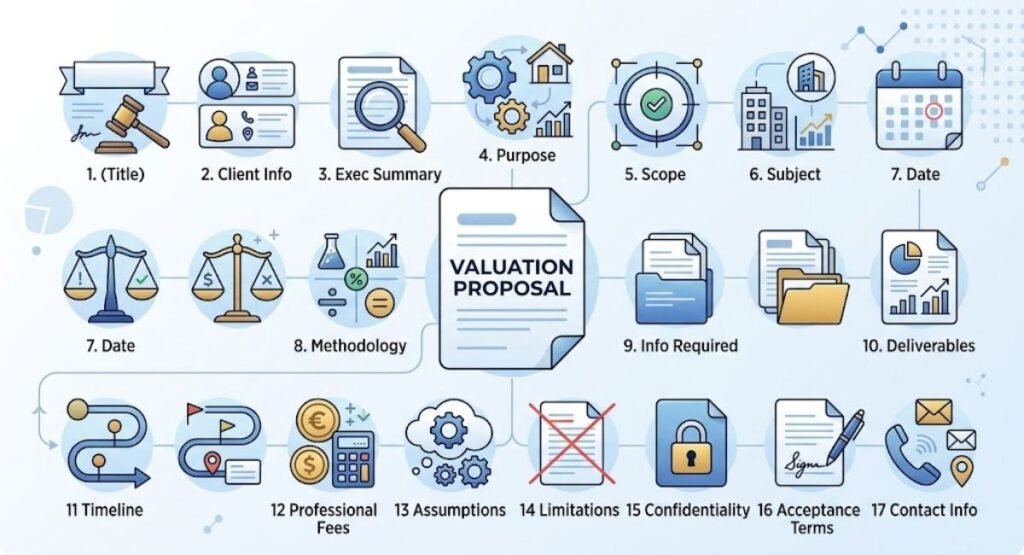
1. Proposal Title
Start with a clear title that identifies the nature of the assignment.
2. Client Information
Include the client’s name, organization, contact details, and other relevant information.
For assignments that depend heavily on financial and operational data, strong analytical skills can improve the quality of decision-making; business intelligence exercises can provide practical experience with data analysis and business reporting.
3. Executive Summary
Briefly explain the client’s requirement and the service being proposed.
4. Purpose of the Valuation
State why the valuation is required. The purpose may relate to a transaction, planning decision, financial reporting, dispute, taxation, financing, or another legitimate business need.
5. Scope of Work
Explain exactly what the valuation professional will review and what the assignment will cover.
6. Subject of Valuation
Clearly identify the business, property, security, asset, or other subject being valued.
7. Valuation Date
State the date to which the valuation will relate.
8. Valuation Methodology
Explain the proposed approach and why it may be suitable for the assignment.
9. Information Required
List the financial records, contracts, operational data, property information, market data, or other documents needed.
10. Deliverables
Explain what the client will receive, such as a valuation report, analysis, schedules, or supporting documentation.
11. Timeline
Provide an estimated schedule for receiving information, performing the work, reviewing findings, and delivering the final document.
12. Professional Fees
Clearly state the proposed fee structure and any relevant expenses, taxes, or payment terms.
13. Assumptions
Explain important conditions or information that the proposed work may rely on.
14. Limitations
Identify boundaries around the work, information availability, or intended use of the valuation.
15. Confidentiality
Explain how confidential client information will be handled, subject to the applicable engagement terms and professional requirements.
16. Acceptance Terms
Provide instructions for accepting the proposal and moving forward with the engagement.
17. Contact Information
Include appropriate contact details for communication about the assignment.
Valuation Proposal Format
A useful valuation proposal format should be organized so that a client can quickly find the information they need.
| Section | What It Should Explain |
| Client Details | Who the proposal is prepared for |
| Valuation Purpose | Why the valuation is being performed |
| Scope of Work | What the valuation will cover |
| Valuation Date | Date to which the valuation relates |
| Methodology | How value is expected to be estimated |
| Required Information | Documents and data needed |
| Deliverables | What the client will receive |
| Timeline | Expected completion period |
| Fees | Professional charges and payment terms |
| Assumptions | Important conditions used in the work |
| Limitations | Boundaries of the valuation |
The most important point is that the proposal should accurately reflect the specific engagement rather than using the same wording for every client.
How to Write a Valuation Proposal Step by Step
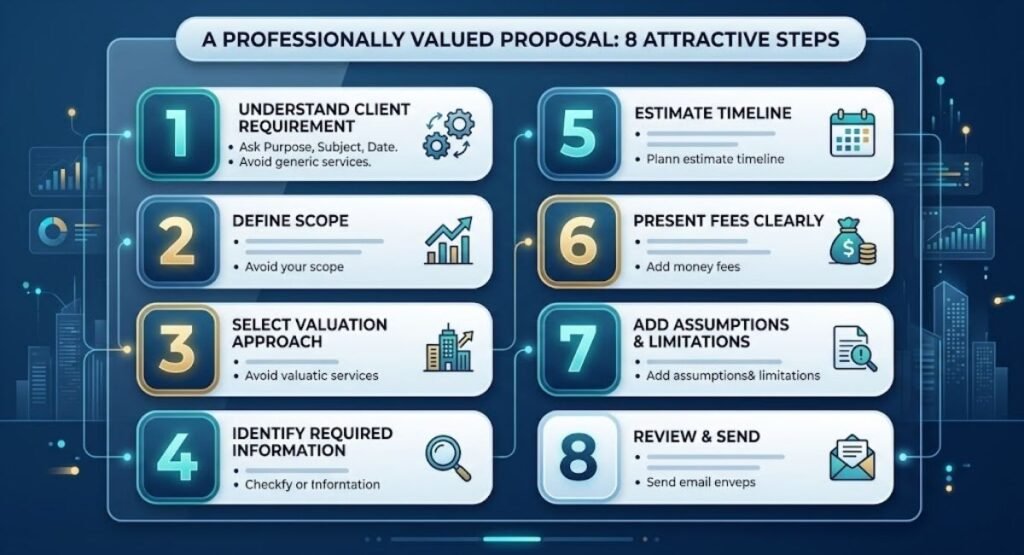
Step 1 — Understand the Client’s Requirement
Start by understanding why the client needs the valuation. Ask relevant questions about the purpose, subject, valuation date, intended users, expected deliverables, and any specific requirements.
A clear understanding at this stage helps prevent unnecessary work later. It also allows the proposal to address the client’s actual needs instead of providing a generic service description.
Step 2 — Define the Scope
A well-defined scope helps the client understand the boundaries of the engagement.
For example, a business valuation may cover specific ownership interests, financial information, operating assets, liabilities, and relevant market information. The exact scope should always match the assignment.
Step 3 — Select the Valuation Approach
The proposed methodology should be appropriate for the subject, purpose, available information, and circumstances of the assignment.
Common approaches include the income approach, market approach, and cost approach.
Step 4 — Identify Required Information
Create a practical list of information that the client may need to provide. Depending on the assignment, this can include financial statements, forecasts, ownership documents, contracts, asset records, property details, and other relevant information.
Step 5 — Estimate the Timeline
Provide a realistic timeline rather than promising an unnecessarily fast completion date. The schedule may depend on how quickly the client supplies information and whether additional analysis or clarification is required.
A simple timeline can include information collection, analysis, review, and final delivery.
Step 6 — Present Fees Clearly
Explain the proposed professional fee in straightforward language. If there are additional expenses, taxes, or payment milestones, make them clear before the engagement begins.
A transparent fee section helps clients understand the financial commitment and reduces the risk of later misunderstandings.
Step 7 — Add Assumptions and Limitations
Assumptions and limitations are important because valuation work can depend on the quality, availability, and reliability of information.
Explain relevant conditions without using unnecessarily complicated language. If certain information has not yet been verified, the proposal should not imply that it has already been confirmed.
Step 8 — Review and Send the Proposal
Before sending the proposal, check the client’s name, assignment details, valuation date, scope, methodology, fees, timeline, and contact information.
The final document should be professionally formatted and easy to read. Errors in basic client or assignment information can reduce confidence in an otherwise strong proposal.
Common Valuation Methods
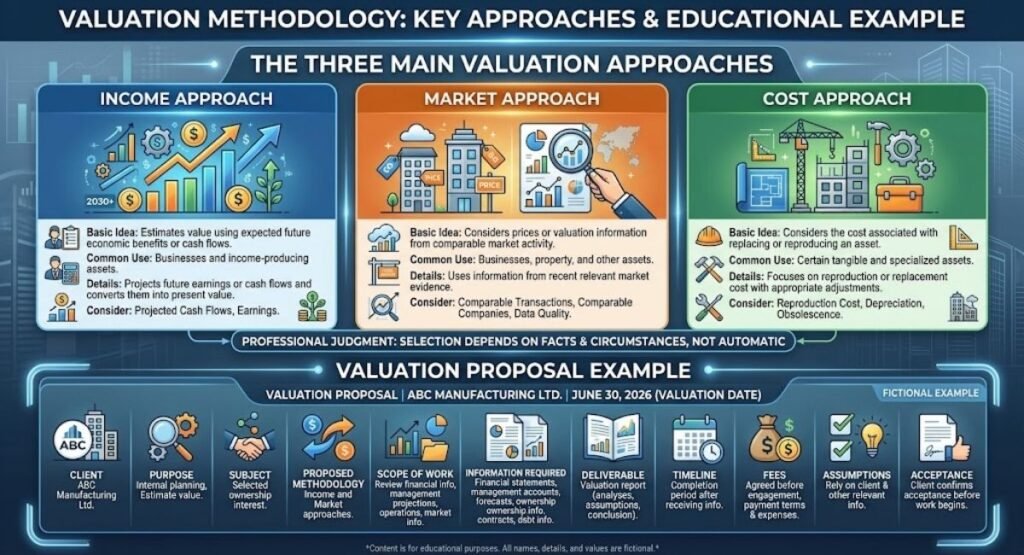
The appropriate valuation methodology depends on the assignment and the information available.
| Valuation Method | Basic Idea | Common Use |
| Income Approach | Estimates value using expected future economic benefits or cash flows | Businesses and income-producing assets |
| Market Approach | Considers prices or valuation information from comparable market activity | Businesses, property, and other assets |
| Cost Approach | Considers the cost associated with replacing or reproducing an asset, with appropriate adjustments | Certain tangible and specialized assets |
Income Approach
The income approach focuses on the future economic benefits expected from an asset or business. Depending on the assignment, projected cash flows or earnings may be analyzed and converted into a value indication.
Market Approach
The market approach uses information from comparable transactions, companies, properties, or other relevant market evidence. The quality and comparability of the available data are important considerations.
Cost Approach
The cost approach considers what it may cost to replace or reproduce an asset, with appropriate consideration of factors such as depreciation or obsolescence where relevant.
A valuation professional should select and apply approaches based on the facts and circumstances of the specific assignment rather than automatically using one method for every valuation.
Valuation Proposal Example
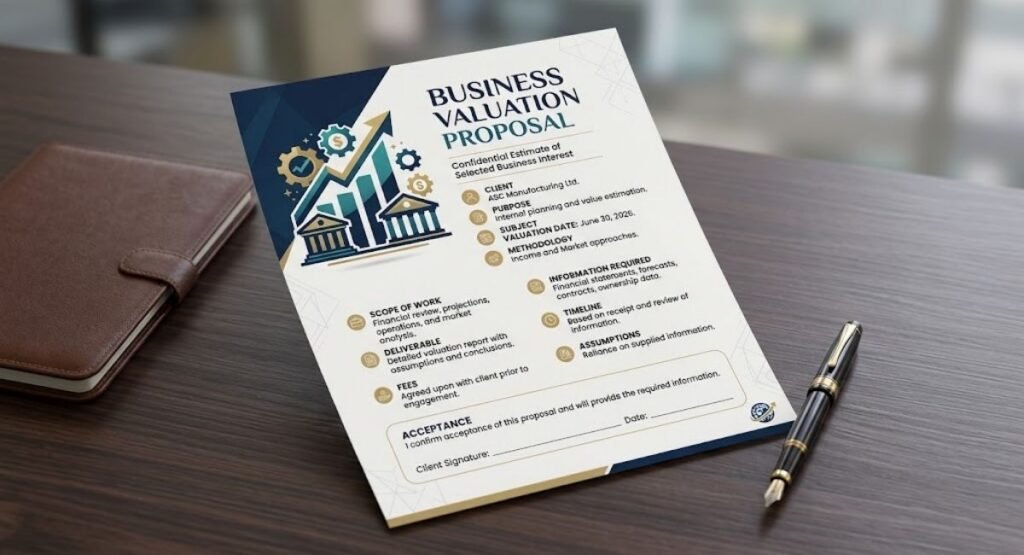
The following is a fictional example for educational purposes.
Client: ABC Manufacturing Ltd.
Purpose: Estimate the value of a selected business interest for internal planning.
Subject: Selected ownership interest in ABC Manufacturing Ltd.
Valuation Date: June 30, 2026
Proposed Methodology: Income and market approaches, subject to available information and professional judgment.
Scope of Work: The professional will review relevant financial information, management projections, business operations, selected market information, and other documents provided by the client.
Information Required: Historical financial statements, current management accounts, forecasts, ownership information, major contracts, debt information, and other relevant business records.
Deliverable: A valuation report describing the work performed, relevant assumptions, analysis, and valuation conclusion or indication as appropriate to the engagement.
Timeline: The proposed completion period will begin after we receive and review the required information.
Fees: Professional fees will be agreed with the client before the engagement begins, together with applicable payment terms and expenses.
Assumptions: The analysis will rely on information supplied by the client and other relevant information available for the assignment.
Acceptance: The client will confirm acceptance of the proposal and provide the required information before the valuation work begins.
This valuation proposal sample demonstrates the type of information a professional document may contain.
Valuation Proposal vs Valuation Report
Although the two documents are related, they serve different purposes.
| Feature | Valuation Proposal | Valuation Report |
| Main Purpose | Defines planned valuation work | Presents completed valuation findings |
| Timing | Usually prepared before the engagement | Usually prepared after analysis |
| Scope | Explains proposed scope | Documents completed scope |
| Fees | May include proposed fees | Usually not the primary purpose |
| Methodology | Describes proposed approach | Describes the approach actually applied |
| Findings | Usually does not contain the final valuation conclusion | Contains the relevant valuation results or conclusions |
Keeping these documents separate helps clients understand what is being proposed before the professional begins detailed analysis.
Common Mistakes to Avoid
A valuation proposal can lose its effectiveness when important information is unclear or missing.
Unclear Scope
If the scope is vague, the client may not understand what work is included.
Solution: Clearly describe the subject, purpose, work to be performed, and relevant boundaries.
Vague Pricing
A fee section that does not explain the basic payment arrangement can create confusion.
Solution: Clearly state the proposed fees and explain relevant expenses or payment terms.
Unrealistic Deadlines
Promising completion before the required information is available can create unnecessary pressure.
Solution: Provide a realistic timeline based on the assignment and information requirements.
Missing Assumptions
Important assumptions can affect how the work is understood.
Solution: Clearly identify material assumptions relevant to the proposed engagement.
Missing Limitations
Clients should understand the boundaries of the proposed work.
Solution: Include relevant limitations and explain them in straightforward language.
Excessive Technical Language
A proposal filled with specialist terminology can be difficult for a non-specialist client to understand.
Solution: Use plain English and explain necessary technical terms.
Unsupported Claims
Don’t present statements about value, market conditions, or expected outcomes without an appropriate basis.
Solution: Use careful, evidence-based wording and avoid promises about results.
Poor Formatting
Even good content can appear unprofessional when headings, spacing, tables, and contact details are inconsistent.
Solution: Use a clean layout with logical sections and consistent formatting.
Ignoring Client Requirements
A generic valuation services proposal may not address the client’s actual purpose.
Solution: Customize the proposal for every engagement.
Using an Inappropriate Method
A valuation method should not be selected simply because it was used in another assignment.
Solution: Consider the purpose, subject, available information, and circumstances before proposing an approach.
Tips for Creating a Professional Valuation Proposal
A strong proposal does not need to be complicated. It needs to be clear, relevant, accurate, and easy for the client to review.
Keep it easy to scan: Use headings, short paragraphs, tables, and bullet points.
Explain technical terms: If a specialist term is necessary, explain it in simple language.
Be transparent about fees: Make the proposed fee structure and payment terms easy to understand.
Set realistic expectations: Do not promise a result or deadline that depends on unknown information.
Define deliverables: Clearly explain what the client should expect to receive.
Protect confidential information: Address confidentiality appropriately within the engagement terms.
Use consistent formatting: Make headings, fonts, spacing, tables, and sections visually consistent.
Review client details: Check names, dates, addresses, scope, fees, and other important information before sending.
Avoid unnecessary jargon: Professional writing should be precise without becoming difficult to understand.
A template should provide structure, not replace professional judgment.
About the Author
[Zain Kashif] is a professional business and valuation writer who focuses on making complex financial, business, and professional topics easier to understand. With experience researching valuation practices and business concepts, [Zain Kashif] creates practical, reader-focused content designed to help professionals and business owners make informed decisions.
Conclusion
A clear valuation proposal gives clients a practical understanding of what a valuation engagement will involve before the work starts. It should explain the purpose, scope, methodology, information requirements, deliverables, fees, timeline, assumptions, and limitations without unnecessary complexity.
The best valuation proposal is not simply a document that lists services; it sets realistic expectations and creates a clear foundation for the engagement. By using simple language, accurate information, professional formatting, and an assignment-specific approach, valuation professionals can create proposals that are easier for clients to understand and evaluate.
FAQs
What is a valuation proposal?
A valuation proposal is a document that explains the planned valuation work, scope, fees, methodology, timeline, and deliverables.
What should a valuation proposal include?
It should normally include the purpose, scope, methodology, information requirements, fees, timeline, assumptions, limitations, and deliverables.
How much does a valuation proposal cost?
The cost depends on the complexity of the valuation assignment and the professional services required.
What is the difference between a valuation proposal and a valuation report?
A proposal describes planned work, while a valuation report presents the analysis and relevant conclusions from completed work.
How long does it take to prepare a valuation proposal?
The time required depends on the complexity of the assignment and the information needed to define the work.