
A competence assessment programme is a structured way to check whether people have the knowledge, skills, and behaviors needed for a specific role. It helps organizations understand what employees do well and where further development may be useful.
A well-designed programme does more than give employees a score. It creates a clear process for gathering evidence, comparing performance with defined standards, providing feedback, and planning future development.
This guide explains what a competence assessment programme is, how it works, which assessment methods can be used, and how organizations can build a practical programme that is fair, clear, and useful.
What Is a Competence Assessment Programme?
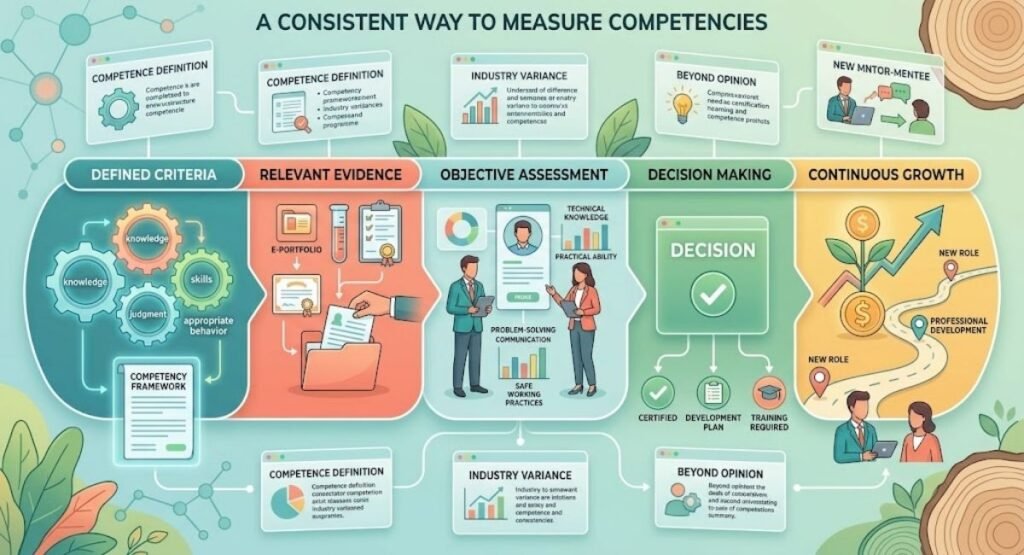
Competence refers to the ability to use knowledge, skills, judgment, and appropriate behavior to perform a task effectively. The exact competencies will vary depending on the job and industry.
An assessment programme provides a consistent way to measure these competencies. Instead of relying only on opinions, assessors can use defined criteria and relevant evidence to make their decisions.
For example, a company assessing a technical employee may look at technical knowledge, practical ability, problem-solving, communication, and safe working practices.
Competence and Assessment Explained
Competence is about what a person is capable of doing. Assessment is the process of collecting and reviewing evidence about that capability.
When these ideas are combined, a competence assessment programme gives an organization a structured method for checking whether employees meet the expected level for their roles.
The programme can also show where additional training, coaching, practice, or support may be helpful.
Why Is a Competence Assessment Programme Important?
Organizations need people with the right capabilities for their responsibilities. However, it is not always easy to identify skill gaps through normal day-to-day work.
A structured competence assessment can provide a clearer picture of current capability. It can help managers and employees discuss development using evidence rather than assumptions.
Some important uses include:
- Identifying skill gaps
- Supporting employee development
- Guiding training decisions
- Maintaining consistent standards
- Supporting career development
- Improving workforce planning
- Helping managers make informed decisions
Key Components of a Competence Assessment Programme
A strong programme normally contains several connected parts. Each part has a specific purpose and should support the overall assessment process.
| Component | Purpose | Example |
| Competency framework | Defines expected capabilities | Technical and communication skills |
| Assessment criteria | Sets measurement standards | Knowledge, skills, and behavior |
| Assessment methods | Measures competence | Tests, interviews, and observation |
| Evidence collection | Supports assessment decisions | Work samples and assessment records |
| Feedback | Supports improvement | Individual development feedback |
| Review process | Maintains programme quality | Periodic reassessment |
Assessment criteria then explain what acceptable performance looks like.
Feedback and review complete the process by turning assessment results into useful development actions.
How Does a Competence Assessment Programme Work?
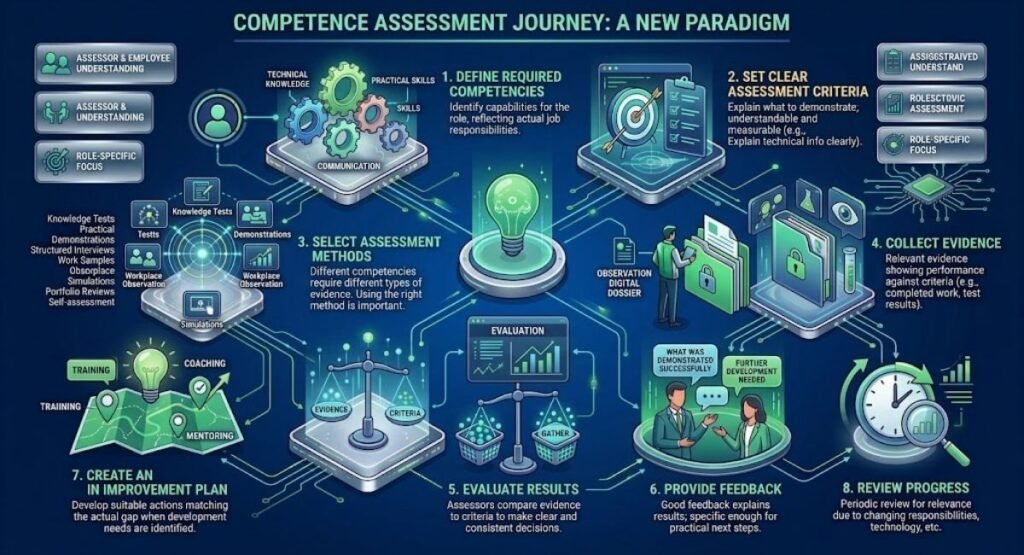
A competence assessment process should be clear enough for both assessors and employees to understand.
The following steps provide a practical starting point.
1. Define Required Competencies
The first step is to identify the capabilities needed for the role.
These may include technical knowledge, practical skills, communication, teamwork, decision-making, or other role-specific requirements.
Competencies should reflect actual job responsibilities rather than a generic list that applies to every position.
2. Set Clear Assessment Criteria
Good criteria explain what the person needs to demonstrate. They should be understandable and measurable where possible.
For example, instead of simply stating “good communication,” an organization could define the expected ability to explain technical information clearly to colleagues or customers.
3. Select Assessment Methods
Different competencies require different types of evidence.
Possible methods include:
- Knowledge tests
- Practical demonstrations
- Structured interviews
- Work samples
- Workplace observation
- Simulations
- Portfolio reviews
- Self-assessment
Using the right method is important because a written test may show knowledge but may not prove that someone can perform a practical task.
4. Collect Evidence
Assessors should collect relevant evidence that shows how the individual performs against the defined criteria.
Evidence may include completed work, test results, observations, interview responses, demonstrations, or other suitable records.
The evidence should be relevant to the competency being assessed.
5. Evaluate Results
The assessor compares the available evidence with the agreed assessment criteria.
The goal is to make a clear and consistent decision about whether the expected level of competence has been demonstrated.
Where evidence is incomplete, another assessment activity may be required.
6. Provide Feedback
Feedback helps employees understand the result.
Good feedback should explain what the employee demonstrated successfully and where further development may be needed.
It should be specific enough to support a practical next step.
7. Create an Improvement Plan
When development needs are identified, the organization can create suitable actions.
These may include training, coaching, mentoring, supervised practice, additional experience, or another assessment.
The development action should match the actual gap rather than being selected simply because it is available.
8. Review Progress
Competence may change as responsibilities, technology, processes, or professional requirements change.
Periodic review can help organizations keep their assessment programme relevant.
The review frequency should depend on the role, workplace requirements, and purpose of the programme.
Competence Assessment Methods
There is no single assessment method that works equally well for every competency.
The best approach depends on what needs to be measured and what type of evidence can demonstrate it.
| Assessment Method | Best Used For | Main Advantage | Possible Limitation |
| Knowledge test | Technical knowledge | Easy to standardize | May not show practical ability |
| Practical assessment | Hands-on skills | Shows real performance | Can require more resources |
| Interview | Communication and reasoning | Allows detailed discussion | Can be subjective |
| Observation | Workplace behavior | Uses real situations | Requires trained assessors |
| Simulation | Complex scenarios | Tests applied decision-making | May take time to design |
| Portfolio | Previous work | Shows real evidence | Evidence quality can vary |
Using more than one method can sometimes provide a more complete view of competence.
For example, a technical role could use a knowledge test to check understanding and a practical assessment to check whether that knowledge can be applied.
Types of Competencies That Can Be Assessed
The competencies included in a programme should be based on the role and its requirements.
Technical Competence
Technical competence relates to the knowledge and skills needed to complete specific job tasks.
For example, an IT role may require knowledge of software systems, troubleshooting, data handling, or technical processes.
Technical competence can also be important in specialized careers such as aerospace engineering, where knowledge, practical skills, and technical expertise can influence career opportunities and professional growth.
Professional Competence
Professional competence covers the ability to apply professional knowledge and follow appropriate working practices.
The exact requirements depend on the profession and organization.
Communication
Communication can include the ability to explain information, listen effectively, write clearly, and communicate appropriately with different audiences.
Leadership
Leadership competence may include delegation, decision-making, team support, planning, and handling workplace issues.
Problem-Solving
Problem-solving measures how effectively a person identifies an issue, considers possible solutions, and selects an appropriate response.
Teamwork
Teamwork can involve collaboration, information sharing, respect for colleagues, and contributing toward shared goals.
Digital Skills
Digital competence may include the ability to use relevant software, systems, digital tools, or information securely and effectively.
Safety-Related Competence
Where safety is part of a role, the programme may assess whether individuals understand and follow the required procedures and practices.
Competence Assessment Programme Example
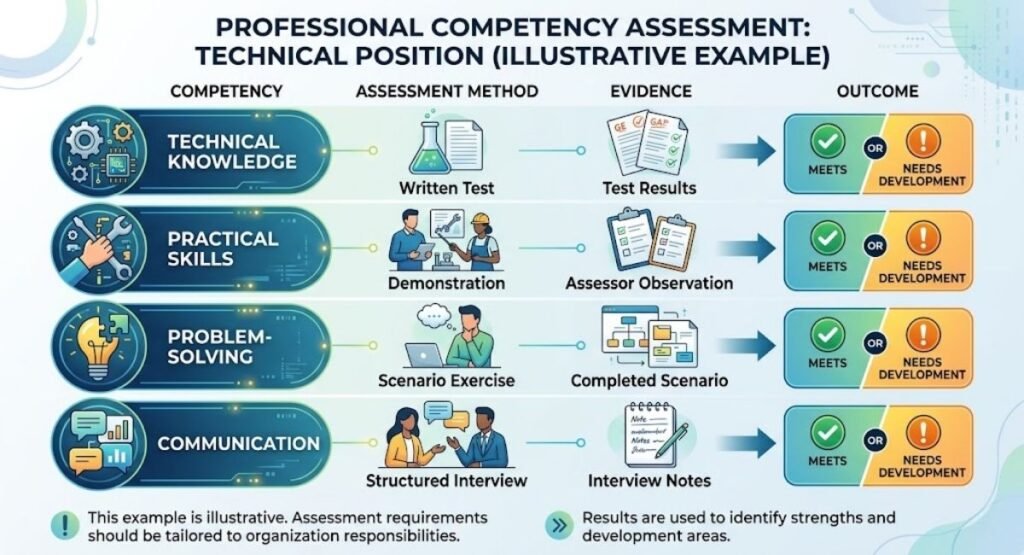
Illustrative example: A company wants to assess employees working in a technical position.
The organization could use several methods rather than relying on one test.
| Competency | Assessment Method | Evidence | Outcome |
| Technical knowledge | Written test | Test results | Meets / Needs development |
| Practical skills | Demonstration | Assessor observation | Meets / Needs development |
| Problem-solving | Scenario exercise | Completed scenario | Meets / Needs development |
| Communication | Structured interview | Interview notes | Meets / Needs development |
This example is only an illustration. Assessment requirements should be designed around the actual responsibilities, standards, and needs of the organization.
The results can then be used to identify strengths and development areas.
Benefits of a Competence Assessment Programme
Better Identification of Skill Gaps
A structured assessment can make development needs easier to identify.
Instead of relying only on general impressions, managers can review evidence against defined competencies.
More Focused Training
Assessment results can help organizations choose training that matches actual development needs.
This can make employee development more targeted.
Consistent Assessment Standards
Clear criteria can help different assessors use the same expectations.
This can reduce unnecessary differences in how competence is evaluated.
Stronger Employee Development
Employees can use assessment feedback to understand their strengths and areas that require additional practice or learning.
Better Workforce Planning
Organizations can use competence information to understand current capabilities and identify areas where additional development may be needed.
Clearer Career Development
A competency framework can help employees understand the capabilities associated with their current or future roles.
Common Challenges
A competence assessment programme can be useful, but it also needs careful planning.
Unclear Competency Definitions
If competencies are vague, assessors may interpret them differently.
Practical solution: Define competencies using clear descriptions and observable expectations.
Inconsistent Assessment
Different assessors may reach different conclusions when criteria are not applied consistently.
Practical solution: Provide assessor guidance and use standardized assessment criteria.
Assessor Bias
Personal opinions can influence an assessment when decisions are not based on sufficient evidence.
Practical solution: Use objective criteria and relevant evidence wherever possible.
Poor Evidence Collection
Weak or incomplete evidence can make assessment decisions difficult to support.
Practical solution: Define acceptable evidence before the assessment begins.
Lack of Assessor Training
Assessors need to understand both the competency framework and the assessment process.
Practical solution: Provide suitable training and guidance for people conducting assessments.
Employee Resistance
Employees may feel uncomfortable if they do not understand why an assessment is taking place.
Practical solution: Explain the purpose, process, criteria, and potential development benefits clearly.
Time and Resource Requirements
Practical assessments and evidence reviews can require time and staff resources.
Practical solution: Match the assessment process to the importance and complexity of the role.
Outdated Competency Standards
Job requirements can change as technology, processes, or responsibilities change.
Practical solution: Review competency requirements regularly and update them when needed.
How to Build an Effective Competence Assessment Programme
Building a useful programme requires more than creating an assessment form.
1. Define the Purpose
Start by explaining why the programme is being introduced.
The purpose could include employee development, skills-gap identification, professional assessment, or maintaining role-specific standards.
2. Identify Role-Specific Competencies
Determine which knowledge, skills, and behaviors are genuinely required for each role.
Avoid adding competencies that have little connection to actual work.
3. Create Measurable Criteria
Explain what acceptable competence looks like.
Clear criteria make the assessment easier to understand and apply.
4. Choose Appropriate Assessment Methods
Select methods that match the competency.
Use practical methods when practical ability needs to be demonstrated and knowledge-based methods when knowledge is the main requirement.
5. Train Assessors
Assessors should understand the criteria, evidence requirements, and assessment process.
Training can help improve consistency.
6. Use Reliable Evidence
Assessment decisions should be supported by relevant evidence.
Avoid making decisions based only on assumptions or informal opinions.
7. Keep Documentation Organized
Maintain clear records of assessments, evidence, decisions, and development actions where appropriate.
Good documentation can make future reviews easier.
8. Provide Constructive Feedback
Feedback should be clear, respectful, and connected to the assessment criteria.
Employees should understand both their strengths and development needs.
9. Create Development Actions
Turn assessment findings into practical next steps.
Training is one option, but coaching, mentoring, practice, or additional workplace experience may also be suitable.
10. Review and Improve the Programme
The programme itself should be reviewed.
Organizations should consider whether the assessment methods remain relevant, whether criteria are clear, and whether the results are helping employees develop.
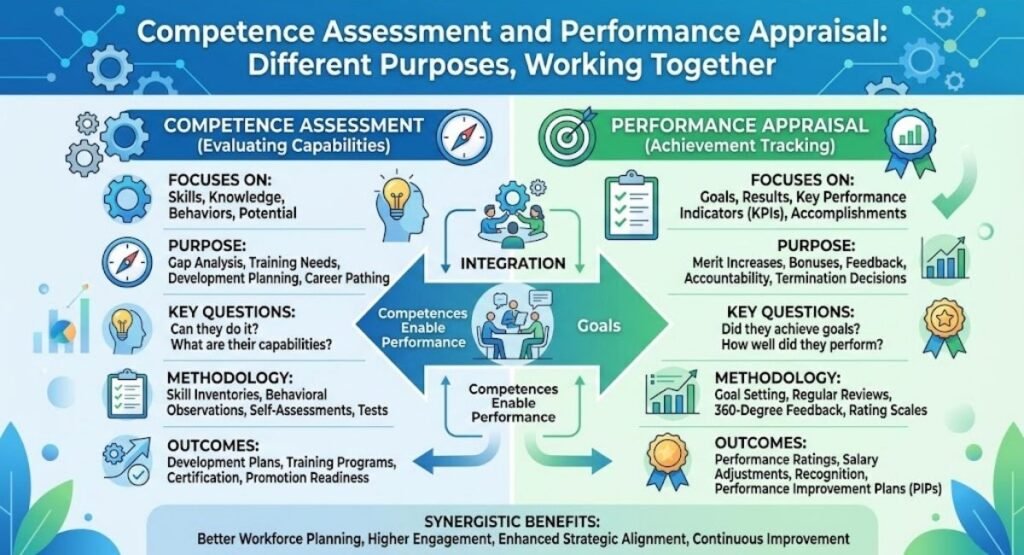
Competence Assessment vs Performance Appraisal
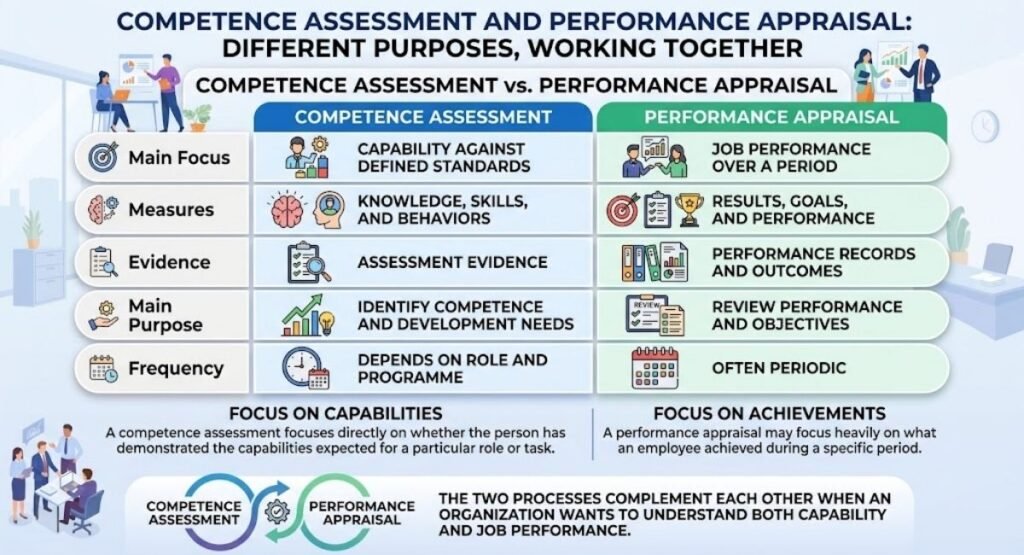
Competence assessment and performance appraisal can work together, but they have different purposes.
| Area | Competence Assessment | Performance Appraisal |
| Main focus | Capability against defined standards | Job performance over a period |
| Measures | Knowledge, skills, and behaviors | Results, goals, and performance |
| Evidence | Assessment evidence | Performance records and outcomes |
| Main purpose | Identify competence and development needs | Review performance and objectives |
| Frequency | Depends on role and programme | Often periodic |
A performance appraisal may focus heavily on what an employee achieved during a specific period.
A competence assessment, by comparison, focuses more directly on whether the person has demonstrated the capabilities expected for a particular role or task.
The two processes can complement each other when an organization wants to understand both capability and job performance.
Best Practices for Competence Assessment
A practical programme should be easy to understand and consistent to use.
Key practices include:
- Keep assessment criteria clear.
- Use suitable evidence.
- Use multiple forms of evidence where appropriate.
- Train assessors.
- Reduce unnecessary subjectivity.
- Document assessment decisions.
- Provide useful feedback.
- Maintain fairness and consistency.
- Review competency standards when roles change.
- Connect results to development actions.
- Check whether the programme is actually helping improve capability.
The goal should not be to create a complicated assessment system.
A simple process with clear standards and relevant evidence can be more useful than a large system that employees and assessors struggle to understand.
Who Can Benefit From a Competence Assessment Programme?
Different types of organizations and professionals may use competence assessment programmes.
Businesses
Businesses can use them to understand employee capabilities and identify development needs.
Training Organizations
Training providers may use structured assessments to evaluate whether learners have demonstrated required skills.
Professional Bodies
Professional organizations may use competence frameworks to define or assess role-related capabilities where appropriate.
Managers
Managers can use assessment results to support development discussions and workforce planning.
HR Teams
HR teams can connect competence information with learning, development, and career planning processes.
Employees
Employees can use assessment feedback to understand their strengths and identify areas for improvement.
Educational and Vocational Organizations
Educational or vocational organizations may use competence-based approaches to connect learning with practical skills.
The exact programme should always reflect the purpose, role, industry, and requirements of the organization.
Conclusion
A competence assessment programme provides a structured way to understand whether people have the capabilities required for their roles. When designed carefully, it can help identify skill gaps, support employee development, improve assessment consistency, and guide future training.
The most effective approach is not necessarily the most complicated one. Clear competencies, practical assessment methods, relevant evidence, trained assessors, and useful feedback can create a process that both organizations and employees can understand.
Because roles and workplace requirements can change, competency standards should also be reviewed when necessary. A well-planned competence assessment programme should remain practical, fair, relevant, and focused on helping people improve.
FAQs
What is a competence assessment programme?
A competence assessment programme is a structured process for evaluating whether a person meets defined role-related knowledge, skills, and behavior requirements.
Why is a competence assessment programme important?
It helps organizations identify capability gaps, support development, and assess people against clear expectations.
What methods are used to assess competence?
Common methods include tests, practical demonstrations, interviews, observation, simulations, portfolios, and self-assessment.
Who can use a competence assessment programme?
Businesses, training organizations, managers, HR teams, professional bodies, and educational organizations can use such programmes.
How often should competence be assessed?
Assessment frequency depends on the role, risks, standards, changes in responsibilities, and the organization’s needs.