
Understanding risk before making an important decision can prevent avoidable problems. Whether the situation involves workplace safety, construction, technology, business operations, or field activities, people need a clear way to identify hazards and decide how to control them. This is where Composite Risk Management (CRM) becomes useful.
Composite risk management is easier to understand as a structured process for identifying hazards, assessing risks, selecting controls, implementing those controls, and reviewing the results. Instead of waiting for something to go wrong, CRM encourages people to think about possible problems before they happen. It can help teams make better decisions while balancing risks against their goals.
What Is Composite Risk Management?

Composite Risk Management is a systematic approach to managing risk. It brings different parts of risk assessment and risk control together so that decision-makers can understand potential hazards and take reasonable steps to reduce their impact.
A hazard is something that has the potential to cause harm, damage, loss, or another unwanted outcome. Risk describes the possibility of that hazard producing a harmful result and the seriousness of that result.
CRM connects these ideas through a repeatable process. A team first identifies what could go wrong, then evaluates the risk, considers ways to control it, implements those controls, and continues to monitor the situation.
For example, imagine a company needs to repair equipment in an area where employees regularly work. Possible hazards could include moving machinery, electrical energy, slips, or limited workspace. Instead of beginning the repair immediately, the team can identify these hazards, assess their seriousness, establish controls, and check whether those controls remain effective.
Composite Risk Management Meaning in Simple Terms
In simple terms, Composite Risk Management means thinking about what could go wrong, deciding how serious the risk is, taking steps to control it, and checking whether those steps continue to work.
A simple example is driving during heavy rain. Reduced visibility and slippery roads are hazards. A driver can reduce the risk by slowing down, increasing following distance, using appropriate lights, and avoiding unnecessary travel when conditions become unsafe.
The same basic thinking can be applied to professional environments. The activities may be more complicated, but the principle remains straightforward: identify the problem, understand the risk, control it, and review the result.
How Does Composite Risk Management Work?
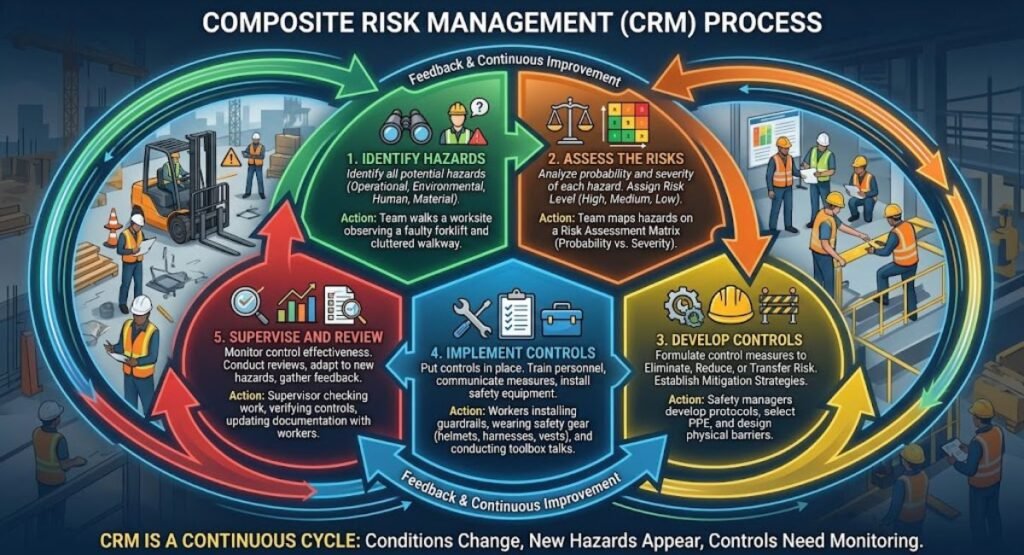
The composite risk management process generally follows five major stages:
- Identify hazards
- Assess the risks
- Develop controls
- Implement controls
- Supervise and review
These steps are connected. Completing one step does not mean risk management is finished. Conditions can change, new hazards can appear, and existing controls can become less effective.
Composite Risk Management Process
| CRM Stage | What Happens | Main Purpose |
| Identify hazards | Potential sources of harm are identified | Find possible problems |
| Assess risk | Likelihood and consequences are considered | Understand risk exposure |
| Develop controls | Measures are selected to reduce risk | Lower potential harm |
| Implement controls | Selected measures are put into practice | Make risk controls effective |
| Supervise and review | Results and changing conditions are monitored | Maintain and improve risk decisions |
The value of this process comes from using the stages together. Identifying a hazard without controlling it does not solve the problem. Similarly, creating a control that is never implemented provides little practical protection.
Why Is Composite Risk Management Important?

Risk exists in almost every activity. The goal is not always to eliminate every possible risk because that may be impossible or impractical. Instead, effective risk management helps people understand the risks they face and make informed decisions about how to handle them.
CRM can:
- Help identify hazards before they cause problems
- Support informed decision-making
- Reduce unnecessary exposure to risk
- Improve planning
- Create a consistent risk-management process
- Encourage accountability
- Help teams respond to changing conditions
- Support continuous improvement
One major advantage is that CRM encourages proactive thinking. A team does not have to wait for an accident, system failure, or project problem before considering what could happen.
It can also improve communication. When team members discuss hazards and controls before an activity begins, they have a better opportunity to identify concerns that one person might overlook.
Composite Risk Management Steps Explained
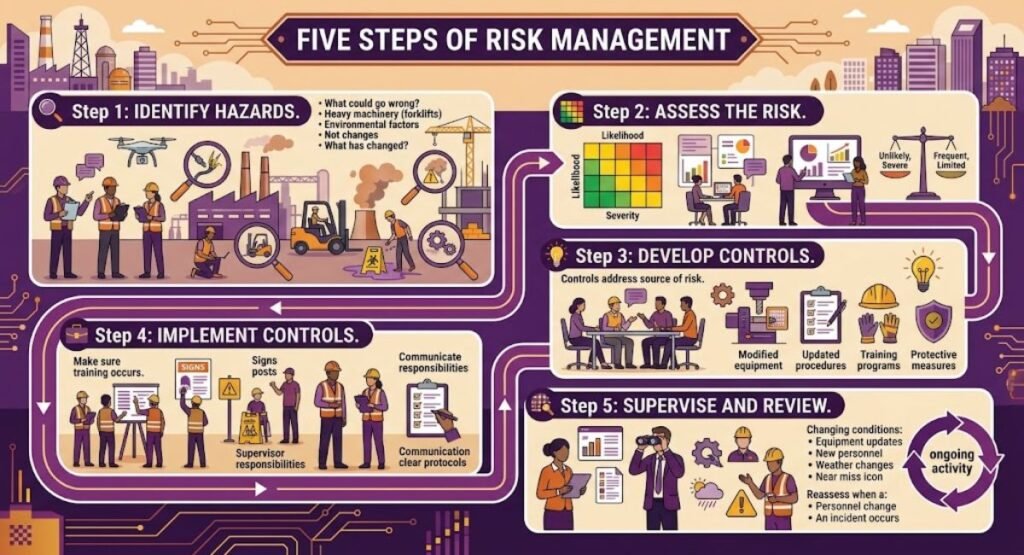
Step 1: Identify Hazards
The first step is hazard identification. The objective is to determine what could cause harm or create an unwanted outcome.
Hazards may come from equipment, people, processes, environmental conditions, technology, materials, or changes in circumstances.
Useful questions include:
- What could go wrong?
- What could cause injury, damage, delay, or loss?
- What has changed since the activity was last performed?
- Are there hazards that are easy to overlook?
- What could happen if an existing control fails?
The quality of later risk decisions depends heavily on identifying the relevant hazards at the beginning.
Step 2: Assess the Risk
After identifying hazards, the next step is to assess the associated risk.
Risk assessment commonly considers two basic ideas: likelihood and severity. Likelihood asks how probable an unwanted event may be, while severity considers how serious the consequences could be.
For example, a hazard that is unlikely to occur but could cause severe consequences may deserve more attention than a frequent hazard with very limited consequences.
Risk assessment should be based on reasonable information rather than guesses or assumptions.
Step 3: Develop Controls
Once risks are understood, the team decides how they can be controlled.
Controls can include changes to equipment, procedures, training, supervision, protective measures, scheduling, or the work environment.
A good control should address the actual source of risk rather than simply creating additional paperwork.
The team should also consider whether a proposed control is practical. A control that looks good on paper but cannot realistically be followed may not provide the expected protection.
Step 4: Implement Controls
Developing a control is only part of the process. The control must also be implemented.
For example, if a risk assessment identifies a dangerous piece of equipment, simply recommending additional training may not be enough. The organization must make sure the training occurs, the relevant procedure is understood, and the equipment is operated according to the established requirements.
Implementation also involves communicating responsibilities. People should understand what controls are required, who is responsible for them, and when they must be applied. A RASCI roles and responsibilities framework can help teams clarify ownership and accountability.
Step 5: Supervise and Review
Risk management should continue after controls are implemented.
Supervision and review help determine whether the controls are working and whether conditions have changed.
A team may need to reassess risk when:
- Equipment changes
- Personnel change
- Procedures are modified
- Weather or environmental conditions change
- New information becomes available
- An incident or near miss occurs
- A control does not produce the expected result
This makes risk management an ongoing activity rather than a one-time checklist.
Composite Risk Management Risk Assessment Matrix
A risk assessment matrix is a tool that can help teams compare likelihood and severity when evaluating risk. Different organizations may use different rating systems, categories, and terminology, so there is no single matrix that applies universally.
A simplified example is shown below:
| Likelihood | Severity | General Risk Consideration |
| Low | Low | Usually limited concern |
| Low | High | Requires attention |
| High | Low | May require controls |
| High | High | Requires urgent attention |
A matrix can make risk discussions easier because it gives teams a consistent way to describe risk. However, the matrix should support professional judgment rather than replace it.
The quality of the final decision depends on the information used to assess the hazard, the assumptions made, and the effectiveness of proposed controls.
Composite Risk Management Example
Consider a company planning to replace electrical equipment in a busy workplace.
The first step is to identify hazards. The team may recognize electrical energy, unexpected equipment movement, restricted access, and the possibility of employees entering the work area.
Next, the team assesses the risks. Electrical exposure could have serious consequences, while unauthorized access could create additional hazards during the repair.
The team then develops controls. Possible controls could include isolating the equipment, restricting access to the work area, using appropriate procedures, and ensuring that qualified personnel perform the relevant work.
The controls are then implemented before the activity begins. The responsible people verify that the required measures are in place.
Finally, the team supervises the activity and reviews conditions. If the work area changes or an unexpected hazard appears, the risk assessment can be updated.
This example shows why CRM is more than simply identifying hazards. The process connects identification, assessment, control, implementation, and review.
Benefits of Using Composite Risk Management
A well-organized risk management approach can provide several practical benefits.
Better planning: Teams can identify potential obstacles before starting an activity.
Improved decision-making: Decision-makers have a clearer understanding of potential consequences.
Greater consistency: A structured process gives teams a common way to discuss and manage risk.
Early problem identification: Hazards can be addressed before they develop into incidents or larger problems.
Better communication: Discussing risks and controls can make responsibilities clearer.
Continuous improvement: Reviewing results allows teams to learn from changing conditions and previous decisions.
The greatest benefit comes when CRM is integrated into normal decision-making rather than treated as a separate administrative task.
Common Challenges in Composite Risk Management
Even a structured process can fail when it is poorly applied.

Common challenges include:
- Incomplete hazard identification
- Poor communication
- Incorrect risk assessment
- Overconfidence
- Weak implementation of controls
- Failure to review changing conditions
- Treating risk management as paperwork instead of decision support
One common problem is overconfidence. People who perform the same task frequently may assume that they already know every possible hazard. Familiarity, however, does not guarantee that conditions remain unchanged.
Another problem occurs when controls are documented but not actually followed. For CRM to work in practice, controls need clear ownership, communication, and monitoring.
Organizations can improve the process by encouraging employees to report concerns, reviewing lessons from previous activities, and reassessing risks whenever important conditions change.
Composite Risk Management vs Traditional Risk Management
The terms used for risk management can differ between industries and organizations. The comparison below provides a general conceptual distinction rather than a universal standard.
| Factor | Composite Risk Management | Traditional Risk Management |
| Approach | Structured and integrated | May vary by organization |
| Hazard identification | Systematic | Can be less consistent |
| Decision support | Strong focus | Depends on the process |
| Controls | Selected and monitored | May vary |
| Review | Ongoing | May be periodic |
The important point is not that one approach is automatically better. Different organizations have different requirements. What matters is whether the chosen risk management process helps people identify meaningful risks, select appropriate controls, and make informed decisions.
Practical Tips for Better Risk Management
Organizations can strengthen their risk management practices by following several practical principles:
- Identify hazards early rather than waiting for problems.
- Involve relevant team members because different people may notice different risks.
- Use clear risk criteria so that assessments are easier to understand.
- Prioritize serious risks instead of treating every risk as equally important.
- Document important decisions when records are needed for accountability and follow-up.
- Apply realistic controls that people can actually implement.
- Monitor whether controls work instead of assuming they are effective.
- Review risks when circumstances change so old assessments do not become outdated.
- Communicate changes clearly to everyone affected by the risk decision.
These practices help turn risk management from a theoretical exercise into a practical part of planning and operations.
Who Can Use Composite Risk Management?
The principles behind CRM can be useful in many environments, although the exact procedures may differ.
Potential applications include:
- Businesses: Managing operational and workplace risks
- Project teams: Identifying risks that could affect project objectives
- Safety teams: Assessing hazards and developing controls
- Construction organizations: Managing equipment, site, and environmental hazards
- Operations teams: Evaluating risks associated with routine activities
- Government organizations: Supporting structured operational decisions
- Technology and IT teams: Considering risks related to system changes and implementations
- Emergency planning: Preparing for hazards and changing conditions
- Training and field operations: Assessing risks before and during activities
The same five-stage thinking can be adapted to different situations without assuming that every organization uses an identical CRM framework.
About the Author
Zain Kashif — Risk Management & Business Operations Writer
Zain Kashif writes about risk management, business operations, workplace processes, and practical decision-making. His work focuses on explaining complex professional concepts in clear, useful language so readers can apply them in real-world situations.
Conclusion
Understanding the composite meaning of risk management starts with a simple idea: identify what could go wrong before making a decision, understand how serious the risk may be, and determine reasonable ways to control it. The five main stages—identifying hazards, assessing risks, developing controls, implementing controls, and supervising and reviewing—create a structured way to approach risk across different activities and environments.
A strong risk management process is not simply a checklist or a paperwork exercise. It is a decision-making tool that can help teams plan more carefully, communicate responsibilities, respond to changing conditions, and reduce unnecessary exposure to hazards. When applied consistently and reviewed when circumstances change, Composite Risk Management can support safer and more informed decisions.
FAQs
1. What is the meaning of composite risk management?
Composite risk management is a structured process for identifying hazards, assessing risks, applying controls, and reviewing results.
2. What are the five steps of composite risk management?
The five steps are identify hazards, assess risks, develop controls, implement controls, and supervise and review.
3. Why is composite risk management important?
It helps people recognize potential problems early and make more informed decisions about how to control risk.
4. What is an example of composite risk management?
Assessing workplace equipment hazards, applying safety controls, implementing them, and monitoring their effectiveness is one example.
5. What is the difference between risk assessment and risk management?
Risk assessment evaluates risk, while risk management includes assessment plus decisions and actions used to control that risk.