
Organizations use corrective action requests in quality management, construction, manufacturing, project management, auditing, compliance, and operations.
A good corrective action request does more than record that something went wrong. It creates a clear path from identifying a problem to understanding why it happened and taking steps to reduce the chance of the same problem happening again. This guide explains the meaning of a corrective action request, what it should contain, how to write one, and how to manage it through closure.
What Is a Corrective Action Request?

A corrective action request is a documented request for a responsible person, team, contractor, supplier, or department to investigate a problem and take appropriate corrective action.
The requirement might come from a contract, procedure, customer specification, internal process, regulation, or quality system.
It is important to understand that correcting a problem and taking corrective action are not always the same thing. A correction addresses a detected problem, while corrective action focuses on eliminating the cause so the problem does not recur. ISO terminology describes corrective action as action taken to eliminate the cause of a nonconformity and prevent recurrence.
For example, replacing a damaged product may correct an immediate problem.
Corrective Action Request Meaning
In simple terms, a corrective action request means:
A documented request to investigate a problem, determine its cause, take appropriate action, and confirm that the action worked.
The exact format can differ between organizations. Some companies use a formal corrective action request form, while others manage CARs through quality software, project management systems, spreadsheets, or internal workflows.
Why Is a Corrective Action Request Important?
A well-managed corrective action request can help an organization turn problems into opportunities for improvement.
1. It creates a clear record
A CAR provides a central record of what happened, when it happened, and how the organization responded.
2. It supports accountability
The request can identify the responsible person or department and establish a target completion date.
3. It encourages root-cause thinking
Instead of stopping at the visible problem, the team investigates the underlying cause.
4. It supports process improvement
Corrective actions can reveal weaknesses in procedures, training, communication, equipment, controls, or workflow.
5. It provides evidence of follow-up
The ISO 9001 framework also distinguishes corrective action from simply correcting a detected nonconformity and calls for evaluating causes, implementing needed action, and reviewing whether similar problems exist or could occur elsewhere.
When Should You Issue a Corrective Action Request?
A corrective action request may be appropriate when a problem is significant enough to require documented investigation or follow-up.
Common examples include:
- A product or service does not meet a specified requirement.
- An audit identifies a nonconformity.
- A project repeatedly experiences the same problem.
- A supplier provides nonconforming material.
- A customer complaint reveals a recurring issue.
- A safety, quality, or compliance concern requires documented action.
- Inspection results show a repeated failure.
- An internal control is not working as intended.
Not every minor issue needs a formal CAR. Organizations should use their own procedures and judgment to determine when documentation and formal corrective action are appropriate.
In project-based work, clear documentation and well-structured proposals can also help teams define requirements and responsibilities before work begins. See our guide to valuation proposal format and examples for a practical example of how proposal documents can support project planning and communication.
What Should a Corrective Action Request Include?
A useful corrective action request should contain enough information for another person to understand the problem without having to guess.
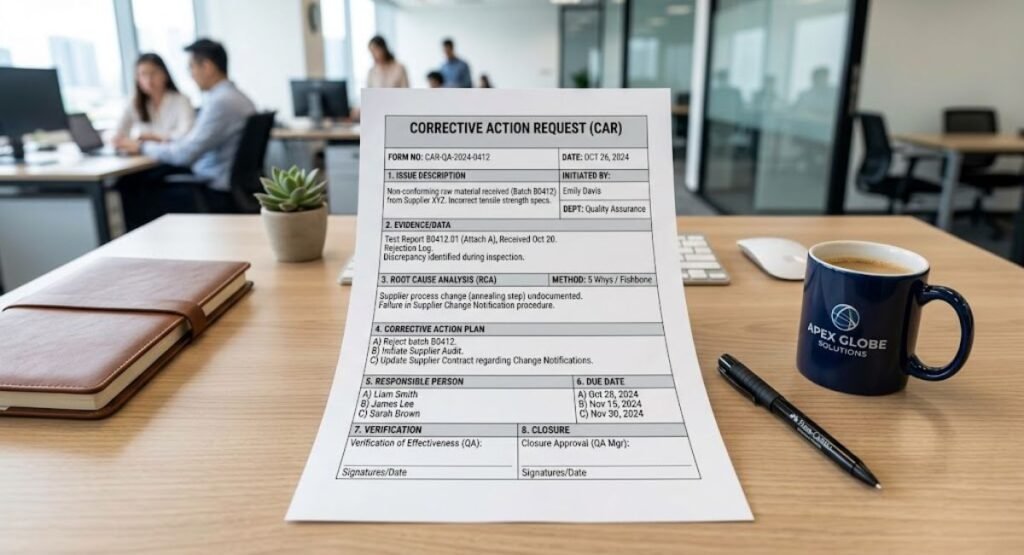
Important fields often include:
- Request number: A unique reference for tracking.
- Date: When the request was created.
- Department or project: Where the issue occurred.
- Problem description: A clear explanation of the issue.
- Evidence: Records, inspection findings, measurements, photographs, or other supporting information.
- Requirement: The specification, procedure, contract requirement, or other criterion that was not met.
- Root cause: The underlying reason for the problem.
- Corrective action: What will be done to address the cause.
- Responsible person: Who owns the action.
- Due date: When the action should be completed.
- Verification: How the organization will confirm that the action was effective.
- Status: Open, in progress, completed, pending verification, or closed.
- Closure date: When the CAR was formally closed.
The quality of these fields matters. A vague statement such as “fix the problem” does not provide enough direction or accountability.
How to Write a Corrective Action Request
A strong corrective action request should move logically from the problem to the solution.
Step 1: Identify the Problem
Describe exactly what went wrong.
Avoid emotional or unclear wording.
For example:
Weak: The installation was not done correctly.
Better: Three installed components were found to be outside the specified measurement during inspection.
Step 2: Document the Evidence
Support the issue with available evidence.
Depending on the situation, this could include an inspection report, test result, photograph, customer complaint, audit finding, delivery record, or documented observation.
Evidence makes the request easier to understand and investigate.
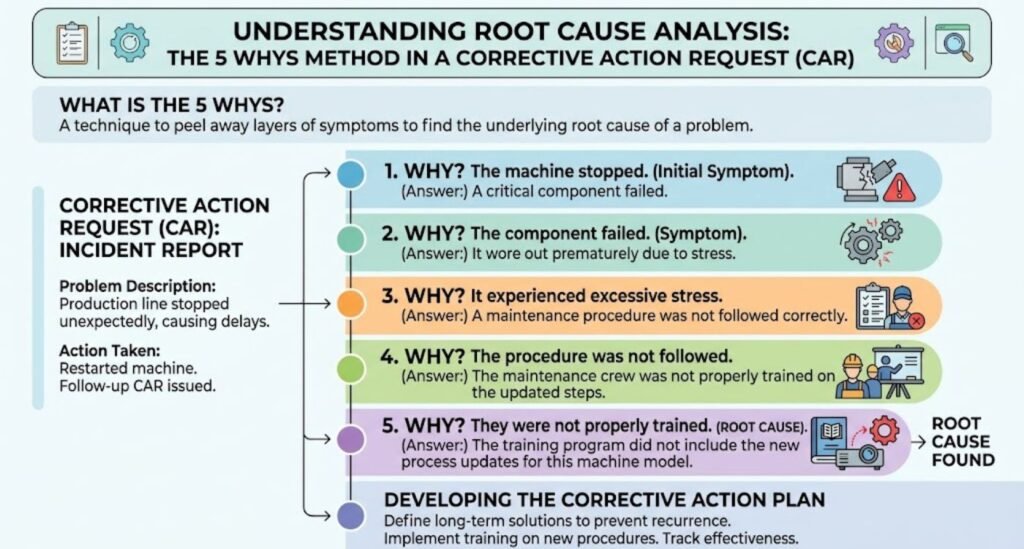
Step 3: Determine the Root Cause
Do not automatically treat the visible symptom as the root cause.
The team may use methods such as the 5 Whys, brainstorming, process analysis, or a fishbone diagram to understand why the problem occurred. ISO auditing guidance also highlights root-cause analysis approaches such as 5 Whys and fishbone diagrams as useful problem-solving tools.
Step 4: Define the Corrective Action
Describe the action that addresses the identified cause.
The action should be specific enough that the responsible person knows what is expected.
Step 5: Assign Responsibility
Name the person, team, or department responsible for completing the action.
Avoid assigning responsibility to a vague group such as “management” unless that is genuinely appropriate.
Step 6: Set a Realistic Deadline
Give the responsible party a clear target date.
The deadline should consider the seriousness of the problem, required resources, dependencies, and the time needed to verify the result.
Step 7: Verify Completion
Completion does not always mean effectiveness.
For example, updating a procedure may show that the action was completed, but the organization may still need to confirm that the revised process prevents the problem from recurring.
Step 8: Close the Request
Close the CAR only after the required action and verification have been completed according to the organization’s process.
Document the evidence supporting closure.
Corrective Action Request Example
Consider a manufacturing company that discovers several finished products have incorrect labels.
A simple corrective action request could look like this:
| Field | Example |
| Request No. | CAR-2026-014 |
| Issue | Incorrect product labels found during final inspection |
| Evidence | Inspection record and affected product samples |
| Requirement | Approved labeling procedure |
| Root Cause | The outdated label file remained available in the production folder |
| Corrective Action | Remove obsolete files, control approved labels, and review the document-control process |
| Responsible Person | Quality Manager |
| Due Date | September 20, 2026 |
| Verification | Review the controlled folder and perform follow-up inspection |
| Status | In Progress |
This example shows why a CAR should move beyond the symptom. Replacing the incorrect labels addresses the immediate problem, while improving document control targets the cause.
Corrective Action Request Template
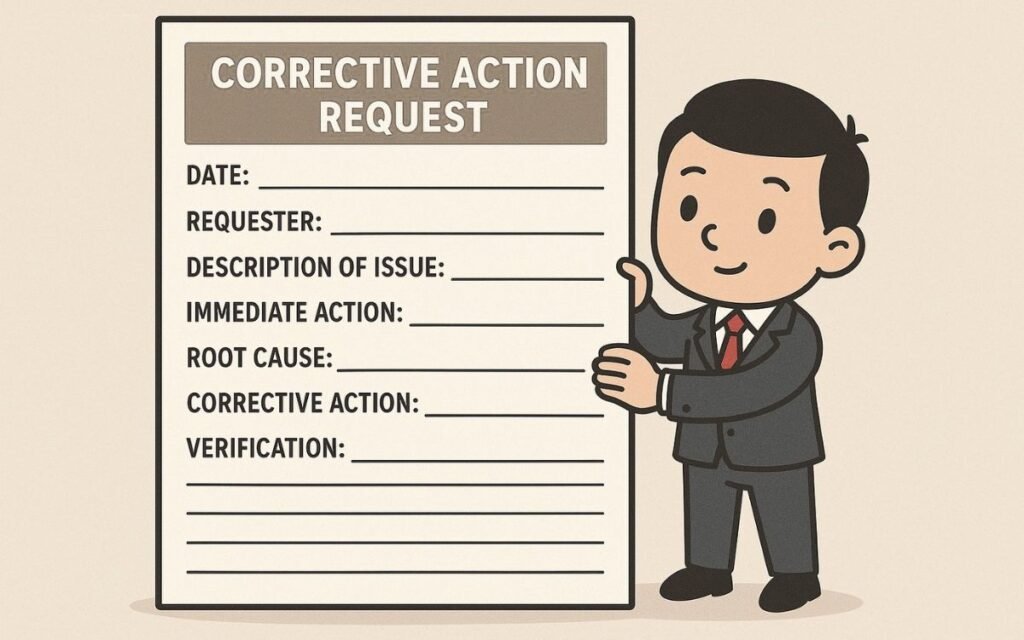
Organizations can adapt the following simple template:
Corrective Action Request
Request Number:
Date:
Project/Department:
Issued By:
Assigned To:
Problem Description:
Describe what happened and what requirement was not met.
Supporting Evidence:
List relevant reports, records, photographs, measurements, or other evidence.
Root Cause:
Explain the underlying cause of the problem.
Corrective Action:
Describe the action needed to address the cause.
Responsible Person:
Name the person or department responsible.
Due Date:
Enter the target completion date.
Verification Method:
Explain how completion and effectiveness will be checked.
Status:
Open / In Progress / Completed / Pending Verification / Closed
Closure Date:
Closure Notes:
Record the verification result and any additional information required by the organization.
Corrective Action Request vs Preventive Action
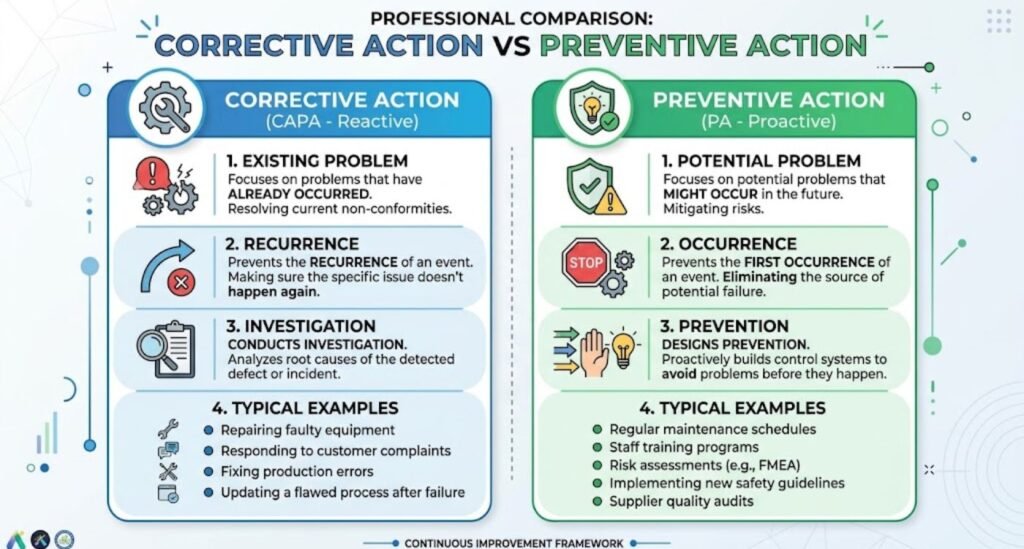
Corrective action and preventive action are related but have different purposes.
| Corrective Action | Preventive Action |
| Responds to an identified nonconformity or problem | Focuses on preventing a potential problem |
| Investigates why the issue occurred | Considers how an issue could occur |
| Aims to prevent recurrence | Aims to prevent occurrence |
| Usually triggered by an existing problem | Can be based on identified risk or potential failure |
ISO terminology specifically distinguishes corrective action, which addresses causes to prevent recurrence, from preventive action, which addresses potential occurrence.
Common Corrective Action Request Mistakes
Even a formal CAR can be ineffective when the information is incomplete.
Common mistakes include:
- Describing symptoms instead of causes: Saying what happened is not the same as explaining why it happened.
- Failing to assign ownership: Without a responsible person, follow-up can become unclear.
- Setting unrealistic deadlines: Deadlines should match the complexity of the action.
- Closing too early: A task being marked complete does not always prove that the corrective action was effective.
- Using unsupported conclusions: Root-cause statements should be based on evidence and investigation.
- Ignoring similar issues: A recurring problem may exist elsewhere in the organization.
Best Practices for Effective Corrective Action Requests
Use these practices to make CARs more useful:
Be Specific
State the problem, requirement, cause, and action clearly.
Focus on Causes
Do not stop at fixing the visible issue. Investigate what allowed it to happen.
Use Evidence
Include relevant records and objective information whenever possible.
Assign Clear Ownership
One clearly identified owner can make follow-up easier.
Set Measurable Actions
A good action should be possible to verify.
Check Effectiveness
After implementation, determine whether the action actually addressed the issue.
Look for Similar Problems
Consider whether the same cause exists in other projects, departments, products, or processes.
Keep Records Organized
Use a consistent naming and tracking system so open and closed requests can be reviewed easily.
How to Track and Close Corrective Action Requests
A corrective action request should not disappear after it is issued.
A simple tracking process can include the following stages:
1. Open: The problem has been documented and assigned.
2. Investigation: The responsible team identifies evidence and root cause.
3. Action Defined: Corrective actions are agreed upon and assigned.
4. In Progress: The responsible party implements the action.
5. Verification: The organization checks completion and effectiveness.
6. Closed: Required actions and verification are documented, and the request is formally closed.
For organizations managing many CARs, a central tracker can help monitor due dates, responsible owners, recurring problems, and overdue actions.
A useful management review should also look for patterns. Several separate corrective action requests may point to the same underlying process weakness. Identifying those patterns can help an organization focus on broader improvement rather than treating every issue as an isolated event.
About the Author
Zain Kashif creates practical, reader-focused content covering project management, business processes, technology, workplace practices, and professional development. The team focuses on clear explanations, useful examples, and actionable guidance for readers.
Conclusion
A corrective action request provides a structured way to move from identifying a problem to understanding its cause and taking appropriate action. A strong CAR should clearly describe the issue, provide supporting evidence, identify the root cause, assign responsibility, set a realistic deadline, and define how the result will be verified. The goal is not simply to fix what went wrong, but to reduce the likelihood of the same issue happening again.
Organizations can make corrective action requests more effective by using consistent templates, specific language, evidence-based investigation, clear ownership, and proper follow-up.
(FAQs)
1. What is a corrective action request?
A corrective action request is a documented request to investigate a problem, address its cause, and verify that appropriate action was taken.
2. What should a corrective action request include?
It should normally include the issue, evidence, root cause, corrective action, responsible person, deadline, verification method, and closure information.
3. Who issues a corrective action request?
A quality professional, auditor, project manager, supervisor, customer, or other authorized person may issue a CAR depending on the organization.
4. What is the difference between corrective action and preventive action?
Corrective action addresses the cause of an existing problem, while preventive action focuses on avoiding a potential problem before it occurs.
5. How do you close a corrective action request?
A CAR is normally closed after the assigned action is completed, documented, and verified as effective according to the organization’s process.