
Aerospace engineering combines advanced science, mathematics, design, testing, and problem-solving to develop aircraft, spacecraft, satellites, and related systems. For people considering this career, aerospace engineer salary is one of the most important factors to evaluate alongside education requirements, job opportunities, specialization, and long-term growth.
In the United States, aerospace engineers had a median annual wage of $134,960 in May 2025, according to the U.S. Bureau of Labor Statistics (BLS). BLS national wage data also reported a mean annual wage of $142,060 for the occupation in May 2025. These figures describe the overall U.S. market, so an individual engineer’s pay can differ substantially based on experience, location, employer, industry, and specialization.
What Is an Aerospace Engineer?
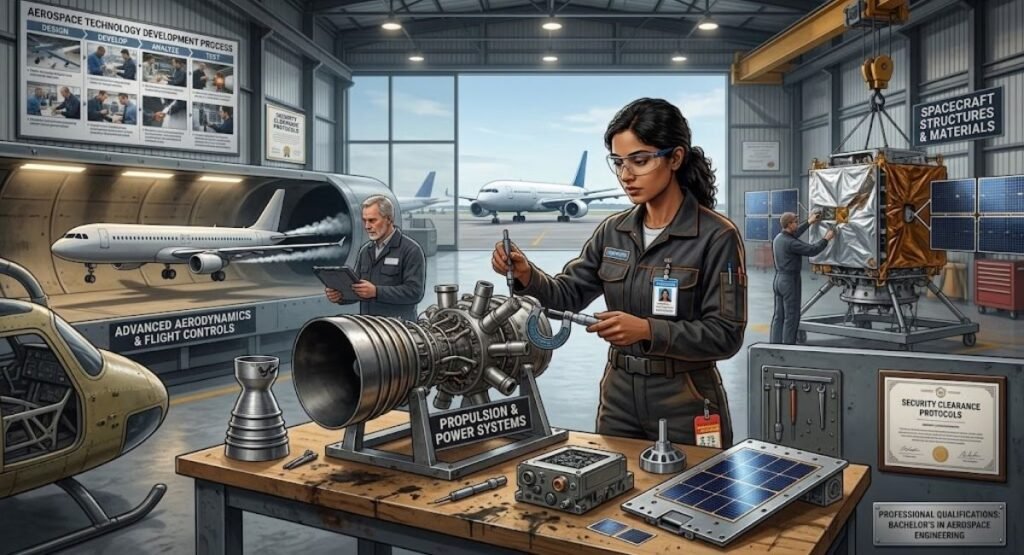
An aerospace engineer designs, develops, analyzes, and tests aircraft and spacecraft systems. Their work can involve airplanes, helicopters, satellites, rockets, missiles, propulsion systems, flight controls, structures, and other aerospace technologies.
The occupation generally requires a bachelor’s degree in aerospace engineering or a related engineering field. Engineers working on certain national-defense projects may also need a security clearance, depending on the employer and project.
How Much Does an Aerospace Engineer Make?
The U.S. aerospace engineer salary varies considerably across the workforce, but the latest BLS data provides a useful national benchmark. The May 2025 median annual wage was $134,960, while the national mean annual wage was $142,060. The median is often more useful for understanding a typical worker’s pay because it is less affected by very high salaries at the top of the distribution.
For additional context, BLS reported that in May 2024 the lowest 10% of aerospace engineers earned less than $85,350, while the highest 10% earned more than $205,850. This illustrates why experience, specialization, employer, and location can make a substantial difference in actual compensation.
Aerospace Engineer Salary by Experience Level
Experience is one of the most important factors affecting an engineer’s earning potential. However, BLS does not publish a simple national salary table that assigns a guaranteed salary to each career stage, so it is better to use published wage distributions instead of presenting unsupported entry-level and senior-level figures.
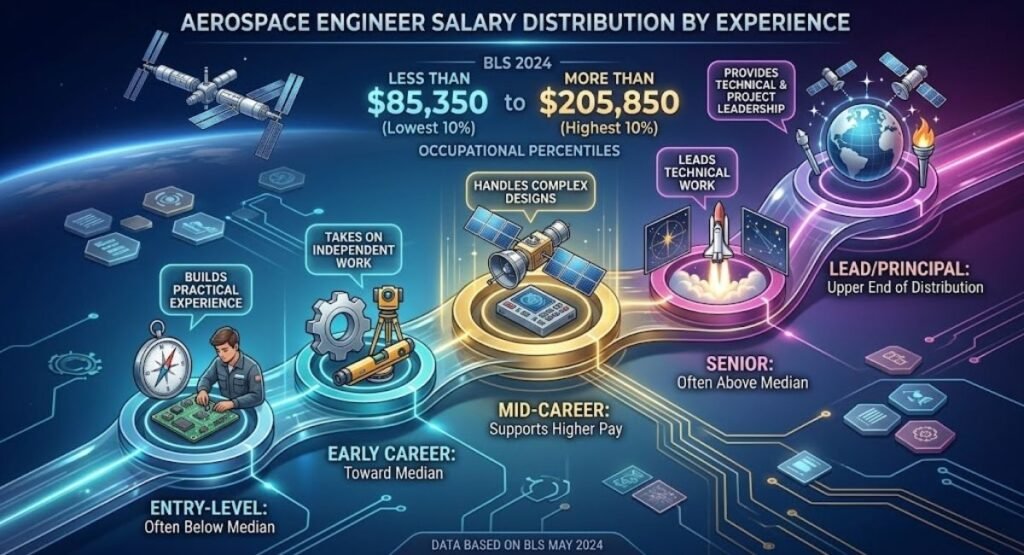
| Career Stage | What Usually Changes | Salary Interpretation |
| Entry-Level | Builds practical engineering experience | Often below the occupational median |
| Early Career | Takes on more independent work | Compensation can move toward the median |
| Mid-Career | Handles complex designs and projects | Experience can support higher pay |
| Senior | Leads technical work and major projects | Often above the occupational median |
| Lead/Principal | Provides technical or project leadership | Can reach the upper end of the wage distribution |
The BLS May 2024 data shows the broader range clearly: less than $85,350 for the lowest 10% and more than $205,850 for the highest 10%. These are occupational percentiles, not fixed salaries for particular job titles or experience levels.
Aerospace Engineer Salary by Location
Location can have a significant effect on compensation because aerospace employment is concentrated in particular regions and local labor markets have different wage levels. BLS publishes wage data by state and metropolitan area, allowing candidates to compare local compensation rather than relying only on a national average.
For example, BLS reported a mean annual wage of $135,660 for aerospace engineers in Huntsville, Alabama, in May 2025. In the Charleston-North Charleston, South Carolina metropolitan area, the reported mean annual wage was $145,750. These examples show why location-specific data can be more useful than a single national figure when evaluating a job offer.
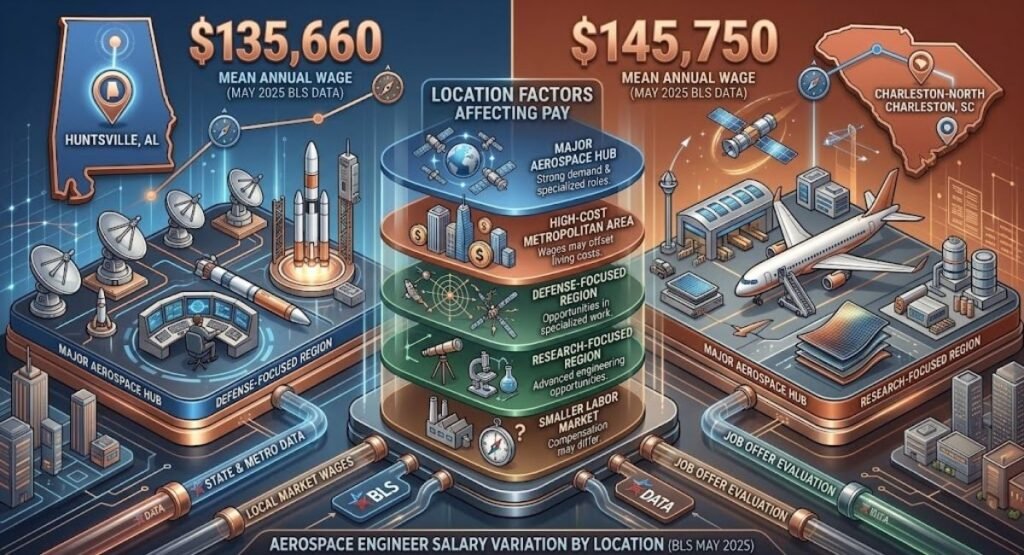
| Location Factor | Potential Effect on Pay |
| Major aerospace hub | May offer strong demand and specialized roles |
| High-cost metropolitan area | Higher wages may partly offset living costs |
| Defense-focused region | May provide opportunities for specialized aerospace work |
| Research-focused region | Can create opportunities in advanced engineering |
| Smaller labor market | Compensation may differ from national benchmarks |
Aerospace Engineer Salary by Industry
The aerospace industry includes much more than aircraft manufacturing. Engineers can work in research, government, defense, manufacturing, engineering services, and other technical environments.
BLS reported the following May 2024 median wages for aerospace engineers in several major industries:
| Industry | Median Annual Wage |
| Research and development in physical, engineering, and life sciences | $143,860 |
| Federal government, excluding postal service | $140,710 |
| Aerospace product and parts manufacturing | $134,950 |
| Navigational, measuring, electromedical, and control instruments manufacturing | $131,990 |
These figures are industry-specific medians from May 2024 and should not be interpreted as guaranteed salaries for every aerospace engineer working in those industries.
Commercial Aviation
Commercial aviation employers may hire aerospace engineers for aircraft design, performance analysis, safety, testing, structures, propulsion, and maintenance-related engineering activities.
Defense and Aerospace
Defense organizations employ engineers on aircraft, missiles, spacecraft, weapons systems, guidance technologies, and other complex programs, with some positions requiring security clearance.
Space Technology
Space-focused engineering can involve spacecraft, launch vehicles, satellites, propulsion, flight systems, and mission-related technologies.
Research and Development
Research and development roles focus on developing and testing new technologies, materials, systems, and engineering methods.
Manufacturing
Manufacturing engineers and aerospace specialists help transform designs into reliable, repeatable production processes while maintaining quality requirements.
Government
Government organizations employ aerospace engineers for technical oversight, research, procurement, testing, regulation, and defense-related programs.
Private Engineering Firms
Engineering firms can provide design, testing, analysis, consulting, and specialized technical services to aerospace and defense clients.
Aerospace Engineer Salary by Specialization
Specialization can influence an aerospace engineer’s career path because different technical areas require different knowledge and skills.
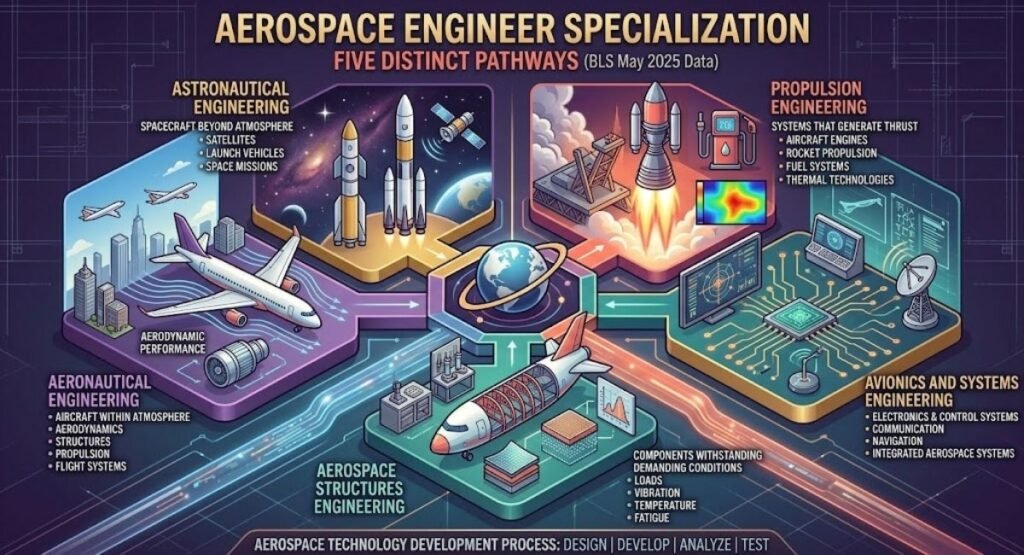
Aeronautical Engineering
Aeronautical engineering focuses primarily on aircraft that operate within Earth’s atmosphere, including aerodynamic performance, structures, propulsion, and flight systems.
Astronautical Engineering
Astronautical engineering focuses on spacecraft and systems designed to operate beyond Earth’s atmosphere, including satellites, launch vehicles, and space missions.
Propulsion Engineering
Propulsion engineers work with systems that generate thrust, including aircraft engines, rocket propulsion, fuel systems, and related thermal and mechanical technologies.
Avionics and Systems Engineering
Avionics and systems engineers work with electronic, control, communication, navigation, and integrated aerospace systems.
Aerospace Structures Engineering
Structures engineers analyze and develop components that must withstand aerodynamic loads, vibration, temperature, pressure, fatigue, and other demanding operating conditions.
Entry-Level Aerospace Engineer Salary
An entry-level aerospace engineer normally enters the profession after completing a bachelor’s degree in aerospace engineering or a related field. The actual starting salary depends on the employer, location, academic background, technical skills, internship experience, and type of aerospace work.
It is better to compare an entry-level offer against local BLS wage data and the employer’s complete compensation package rather than using a single internet salary number. BLS specifically notes that wage data can vary by occupation, industry, and location, making those comparisons useful during salary negotiations.
Senior Aerospace Engineer Salary
Senior aerospace engineers typically take on greater technical responsibility and may lead designs, investigations, testing programs, or engineering teams. Their compensation can therefore be considerably higher than that of newer engineers.
BLS data demonstrates the potential range of the occupation: in May 2024, the highest-paid 10% earned more than $205,850 annually. Reaching this part of the distribution is not automatic, but advanced technical expertise, responsibility, specialization, and leadership can support higher compensation.
Factors That Affect Aerospace Engineer Salary
Several factors can influence how much an aerospace engineer earns.
- Education: A relevant bachelor’s degree is the typical entry requirement, while advanced degrees can support certain specialized or research-oriented career paths.
- Experience: Engineers generally gain greater responsibility as they become more experienced.
- Location: Local demand and cost of living can influence compensation.
- Industry: Research, government, manufacturing, and defense employers can have different wage patterns.
- Specialization: Technical expertise in areas such as propulsion, avionics, structures, or systems engineering can shape career opportunities.
- Security clearance: Some defense-related positions may require a clearance.
- Technical skills: Engineering software, simulation, analysis, programming, and testing skills can strengthen a candidate’s profile.
- Certifications: Relevant credentials may support particular career paths, depending on the role.
- Employer size: Larger organizations may have different compensation structures from smaller engineering companies.
- Leadership responsibilities: Technical leadership and project responsibility can influence compensation.
- Advanced degrees: A master’s or doctoral degree may be valuable for specialized research and advanced technical roles.
Skills That Can Increase Aerospace Engineering Earnings
Strong technical fundamentals remain important, but modern aerospace engineers also benefit from analytical and digital skills. A structured competence assessment programme can also help professionals identify skill gaps and focus their development on areas that support long-term career growth.
Strong technical fundamentals remain important, but modern aerospace engineers also benefit from analytical and digital skills. CAD, computational analysis, simulation, programming, systems engineering, testing, and data interpretation can make an engineer more versatile.
Communication also matters. Engineers who can explain technical findings clearly, work with multidisciplinary teams, document decisions, and communicate with project stakeholders can take on broader responsibilities over time.
How to Increase Your Aerospace Engineer Salary
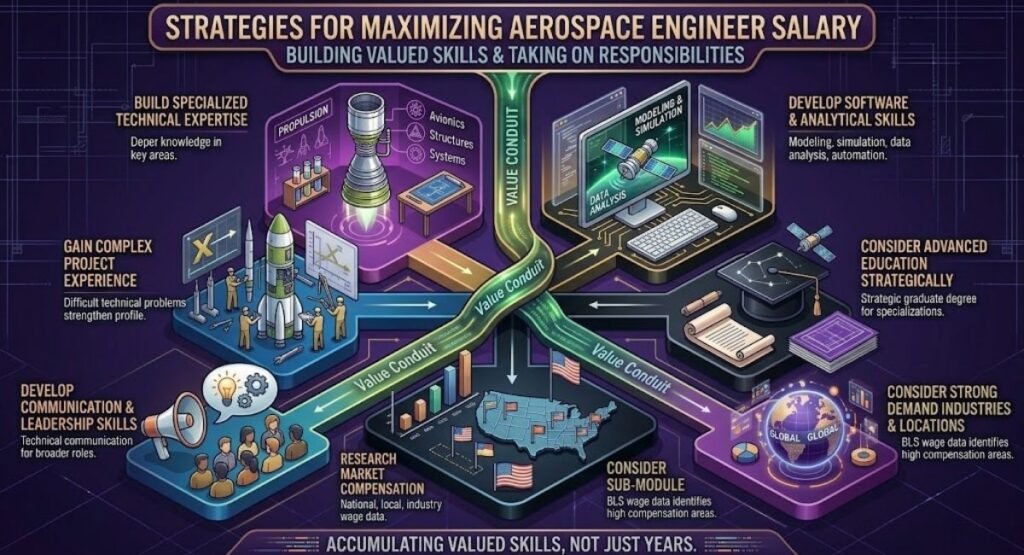
A higher salary usually comes from building skills and taking on responsibilities that employers value rather than simply accumulating years on the job.
As aerospace engineers move into senior and leadership positions, understanding how multiple projects, resources, priorities, and risks are managed becomes increasingly valuable; learning about structured portfolio management can provide useful perspective on this broader responsibility.
Build specialized technical expertise. Develop deeper knowledge in an area such as propulsion, avionics, structures, or systems engineering.
- Develop software and analytical skills. Learn tools used for modeling, simulation, design, data analysis, and engineering automation.
- Gain experience with complex engineering projects. Work that involves difficult technical problems can strengthen your professional profile.
- Consider advanced education strategically. A graduate degree can be useful when it directly supports your target specialization or career path.
- Develop communication and leadership skills. Strong technical communication can help engineers move into broader responsibilities.
- Research market compensation before negotiating. Compare national, local, and industry-specific wage data before discussing compensation.
- Consider industries and locations with stronger demand. BLS wage data can help identify areas where aerospace engineers receive higher compensation.
Aerospace Engineer Career Outlook
The career outlook for aerospace engineers is positive but should be viewed in the context of the wider aerospace market. BLS projects 6% employment growth for aerospace engineers from 2024 to 2034, which is faster than the average for all occupations, with about 4,500 openings projected each year over the decade.
Demand can be influenced by aircraft development, defense programs, space exploration, satellite technology, research, and advances in aerospace systems. The exact opportunities available to an individual engineer will depend on specialization, location, qualifications, and industry.
Aerospace Engineer Salary vs. Related Engineering Careers
Comparing aerospace engineering with other engineering careers can help students and professionals understand the relative earning potential of different fields.
| Engineering Career | 2025 Median Annual Pay | Key Area |
| Aerospace Engineer | $134,960 | Aircraft and spacecraft |
| Electrical and Electronics Engineer | $125,040 | Electrical and electronic systems |
| Mechanical Engineer | $104,110 | Mechanical and thermal systems |
| Materials Engineer | $112,860 | Engineering materials |
The figures above are U.S. BLS May 2025 median wages and are not direct predictions of what an individual will earn.
Is Aerospace Engineering a Good Career?
Aerospace engineering can be a strong career choice for people who enjoy mathematics, physics, design, technology, and complex problem-solving. The profession offers relatively high compensation compared with the overall U.S. workforce, with a 2025 median wage of $134,960.
The career also requires substantial technical preparation and continuous learning. Someone choosing aerospace engineering should consider more than salary, including the cost of education, preferred industry, location, work environment, technical interests, and long-term career goals.
Conclusion
Aerospace engineer salary can vary widely, but current U.S. data shows that the profession offers strong earning potential. The BLS reported a 2025 median annual wage of $134,960 and a mean annual wage of $142,060, while employment is projected to grow 6% from 2024 to 2034.
For anyone considering this career, evaluate salary alongside specialization, location, education, industry, technical skills, and career progression. Comparing local and industry-specific compensation data can help engineers make more informed decisions about job offers, career moves, and salary negotiations.
FAQs
What is the average aerospace engineer salary?
The U.S. BLS reported a mean annual wage of $142,060 for aerospace engineers in May 2025.
Do aerospace engineers make good money?
Yes, aerospace engineers generally earn well above the median wage for all U.S. occupations, with a 2025 median pay of $134,960.
What is the starting salary for an aerospace engineer?
Starting pay varies by employer, location, qualifications, and experience, so local wage data is more useful than one universal starting salary.
Which aerospace engineering jobs pay the most?
Higher-paying opportunities can occur in specialized, senior, research, government, and leadership roles, but compensation varies by employer and location.
Can aerospace engineers increase their salary with experience?
Yes, gaining specialized expertise, greater responsibility, and leadership experience can improve an engineer’s earning potential over time.