
A competence assessment programme is a structured process used by organizations to evaluate whether employees have the knowledge, skills, behaviors, and practical abilities required for their roles. Instead of relying only on qualifications or years of experience, a well-designed programme measures actual workplace competence against clearly defined standards. This approach helps employers identify skill gaps, support professional development, improve workforce performance, and make better decisions about training, promotions, and role assignments.
A strong competence assessment programme should be fair, consistent, evidence-based, and aligned with organizational objectives. It normally begins by defining the competencies required for each role and then selecting suitable assessment methods, such as practical demonstrations, interviews, knowledge tests, workplace observations, simulations, and performance reviews. Organizations can combine several methods to create a more complete picture of an employee’s capabilities while reducing the risk of judging competence from a single assessment.
What Is a Competence Assessment Programme?
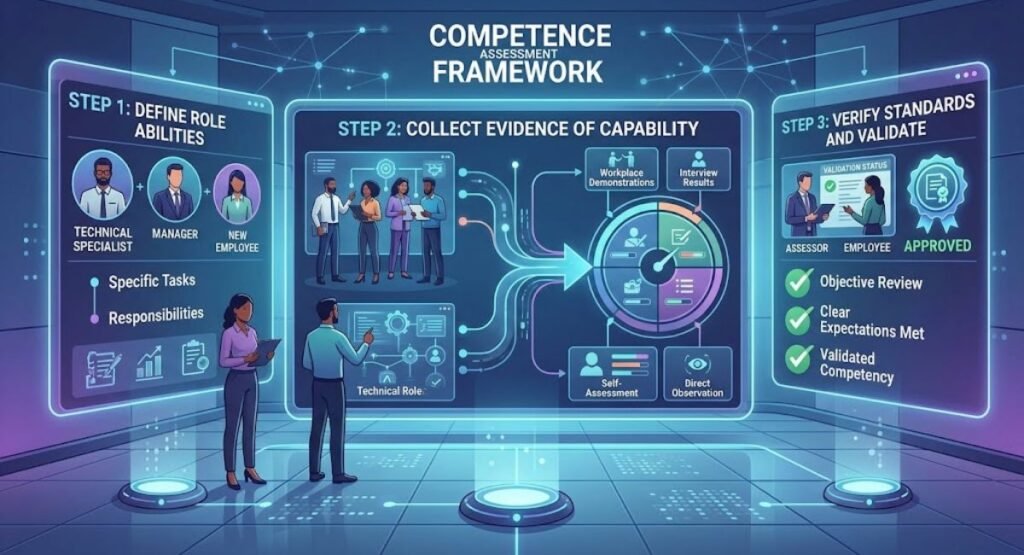
A competence assessment programme is an organized framework for measuring an individual’s ability to perform specific tasks or responsibilities to an established standard. It can be used for new employees, existing staff, trainees, managers, technical specialists, or professionals working toward formal competency requirements.
The programme should answer three basic questions:
- What should the person be able to do?
- What evidence demonstrates that capability?
- Does the evidence meet the required standard?
This makes the assessment more objective and gives employees a clear understanding of what is expected from them.
Why Is a Competence Assessment Programme Important?
Organizations operate more effectively when employees have the right capabilities for their responsibilities. A structured assessment programme provides a systematic way to identify strengths and weaknesses before they affect business performance.
Key benefits include:
- Identifying employee skill gaps
- Improving workforce performance
- Supporting targeted training
- Creating consistent assessment standards
- Strengthening career development
- Supporting promotion and succession decisions
- Improving workforce planning
- Reducing performance-related risks
- Providing evidence for competency decisions
- Encouraging continuous professional development
Key Components of a Competence Assessment Programme
A successful programme normally contains several connected components.
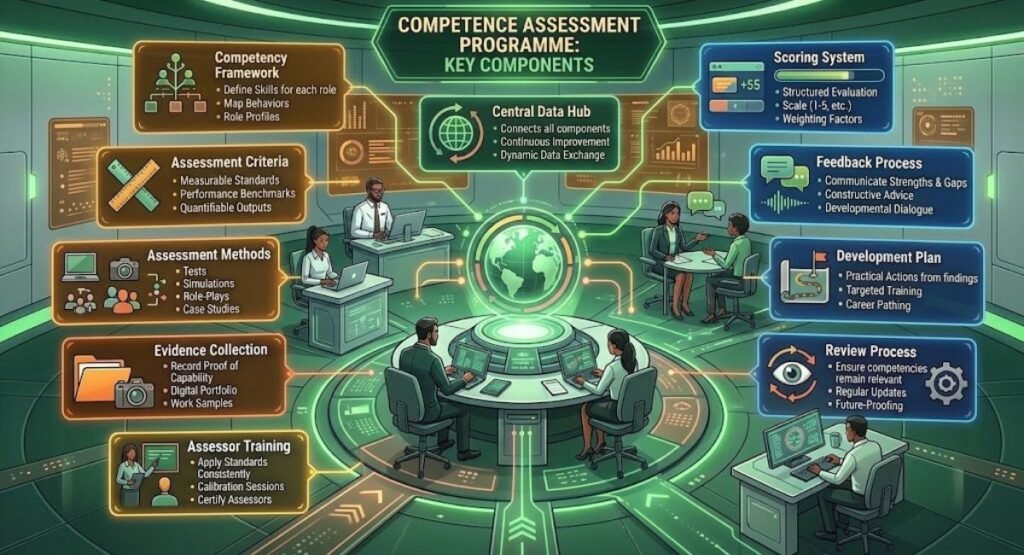
| Component | Purpose |
| Competency framework | Defines the skills and behaviors required for each role |
| Assessment criteria | Establishes measurable performance standards |
| Assessment methods | Determines how competence will be evaluated |
| Evidence collection | Records proof of an individual’s capability |
| Assessor training | Helps assessors apply standards consistently |
| Scoring system | Provides a structured way to evaluate results |
| Feedback process | Communicates strengths and improvement areas |
| Development plan | Converts assessment findings into practical actions |
| Review process | Ensures competencies remain relevant over time |
How to Design a Competence Assessment Programme
A structured approach to managing skills, resources, and organizational priorities can also support better decision-making, similar to the principles discussed in structured portfolio management.
1. Define the Purpose
Start by determining why the organization needs the programme. The purpose might include recruitment, professional development, compliance, promotion, certification, succession planning, or performance improvement.
A clear purpose helps determine the appropriate assessment methods and success measures.
2. Identify Required Competencies
List the competencies required for each role. These may include technical knowledge, communication, leadership, problem-solving, decision-making, teamwork, customer service, or role-specific practical skills.
Each competency should have a clear definition so employees and assessors understand what is being measured.
3. Create Competency Levels
Organizations can use levels such as:
| Level | Description |
| Level 1 – Developing | Requires regular guidance and support |
| Level 2 – Capable | Performs routine responsibilities independently |
| Level 3 – Proficient | Handles complex tasks with limited supervision |
| Level 4 – Advanced | Demonstrates strong expertise and supports others |
| Level 5 – Expert | Provides strategic expertise and leads best practice |
These levels should be adapted to the organization’s roles and requirements rather than treated as a universal standard.
4. Select Assessment Methods
Different competencies require different forms of evidence.
| Assessment Method | Best Used For |
| Knowledge test | Technical and theoretical knowledge |
| Practical demonstration | Hands-on skills |
| Workplace observation | Real-world performance |
| Structured interview | Reasoning and communication |
| Simulation | Decision-making and complex scenarios |
| Portfolio review | Previous work and achievements |
| Self-assessment | Reflection and development planning |
| Manager assessment | Workplace behavior and performance |
Using multiple methods can provide stronger evidence than relying on one test.
5. Establish Assessment Criteria
Assessment criteria should describe what acceptable performance looks like. Avoid vague statements such as “shows good communication skills.” Instead, define observable behaviors, such as communicating information clearly, adapting messages to different audiences, and responding appropriately to questions.
Clear criteria improve consistency between assessors.
Competence Assessment Programme Process
Assessment results can also help employees understand their strengths, identify development needs, and create a clearer path for career progression and professional growth.

A practical assessment cycle can follow these stages:
Plan → Define Competencies → Assess → Collect Evidence → Evaluate → Provide Feedback → Develop → Reassess
Each stage supports the next. For example, assessment results should directly influence the employee’s development plan rather than simply being stored as a score.
Evidence Collection
Evidence is one of the most important parts of competence assessment. Assessors should collect information that demonstrates what an employee can actually do.
Useful evidence may include:
- Completed work
- Practical demonstrations
- Project outcomes
- Work samples
- Customer feedback
- Observation records
- Interview responses
- Training records
- Professional achievements
- Simulation results
Evidence should be relevant, recent, sufficient, and connected to the competency being assessed.
How to Score Competence
A simple scoring model can make results easier to interpret.
| Score | Meaning | Recommended Action |
| 1 | Not yet competent | Provide foundational development |
| 2 | Partially competent | Provide targeted training and practice |
| 3 | Competent | Maintain capability through normal development |
| 4 | Highly competent | Consider advanced responsibilities |
| 5 | Expert | Consider mentoring or specialist responsibilities |
Organizations should define exactly what each score means before assessments begin.
Competence Assessment vs Performance Appraisal
Although these processes can work together, they are not identical.
| Competence Assessment | Performance Appraisal |
| Measures capability against defined standards | Reviews overall work performance |
| Focuses on skills, knowledge, and behaviors | Often considers goals, results, and contribution |
| Can use practical demonstrations and tests | Often uses manager reviews and performance data |
| Identifies capability gaps | Reviews achievement and performance |
| Supports skill development | Supports performance and career discussions |
A performance review may show that an employee achieved a target, while a competence assessment can explore whether the employee has the underlying capabilities required to repeat that performance consistently.
Role of Assessors
Assessors play a critical role in maintaining the credibility of the programme. They should understand the competency framework, assessment criteria, evidence requirements, scoring process, and documentation standards.
Organizations should provide assessor training to reduce inconsistent judgments. Where appropriate, multiple assessors can be used for higher-risk or more complex assessments.
Using Technology in Competence Assessment
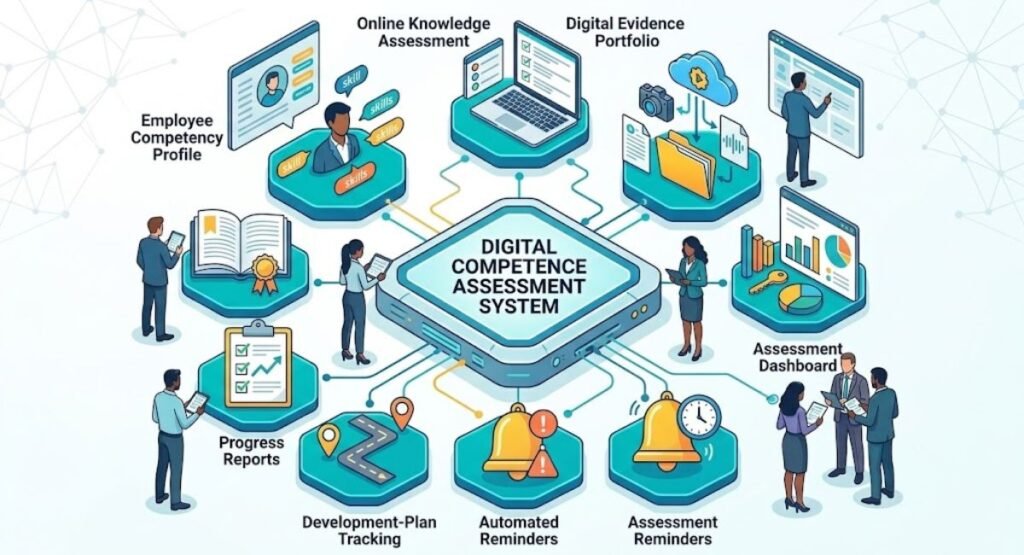
Technology can make assessment programmes easier to manage, especially when an organization has many employees or locations. Digital platforms can help organizations record competencies, schedule assessments, store evidence, monitor progress, and generate reports.
Organizations can also strengthen their technology practices by understanding software security and inspection processes through a corporate software security guide.
A digital competence system may include:
- Employee competency profiles
- Online knowledge assessments
- Digital evidence portfolios
- Assessment dashboards
- Automated reminders
- Development-plan tracking
- Progress reports
- Certification records
Technology should support the assessment process rather than replace professional judgment.
Common Challenges
Organizations may face several challenges when implementing a competence assessment programme.
Inconsistent Assessment
Different assessors may interpret the same competency differently. Standardized criteria, assessor training, calibration sessions, and clear evidence requirements can reduce this problem.
Poorly Defined Competencies
Competencies that are too broad or vague are difficult to measure. Each competency should describe observable and relevant behaviors or capabilities.
Employee Resistance
Employees may perceive assessments as a threat if the purpose is unclear. Organizations should explain how assessment results will be used and emphasize development rather than punishment.
Excessive Administration
A complicated programme can consume significant time. Organizations should focus on essential competencies and use technology to reduce repetitive administrative work.
Outdated Competency Standards
Roles change as technology, regulations, customer expectations, and business strategies evolve. Competency frameworks should therefore be reviewed regularly.
Best Practices for a Successful Programme
| Best Practice | Why It Matters |
| Align competencies with business goals | Keeps assessments relevant |
| Use measurable criteria | Improves objectivity |
| Train assessors | Promotes consistency |
| Use multiple evidence sources | Creates stronger assessment decisions |
| Give constructive feedback | Supports employee development |
| Keep records securely | Improves traceability |
| Review the framework regularly | Keeps competencies current |
| Measure programme outcomes | Demonstrates business value |
Competence Assessment Programme Example
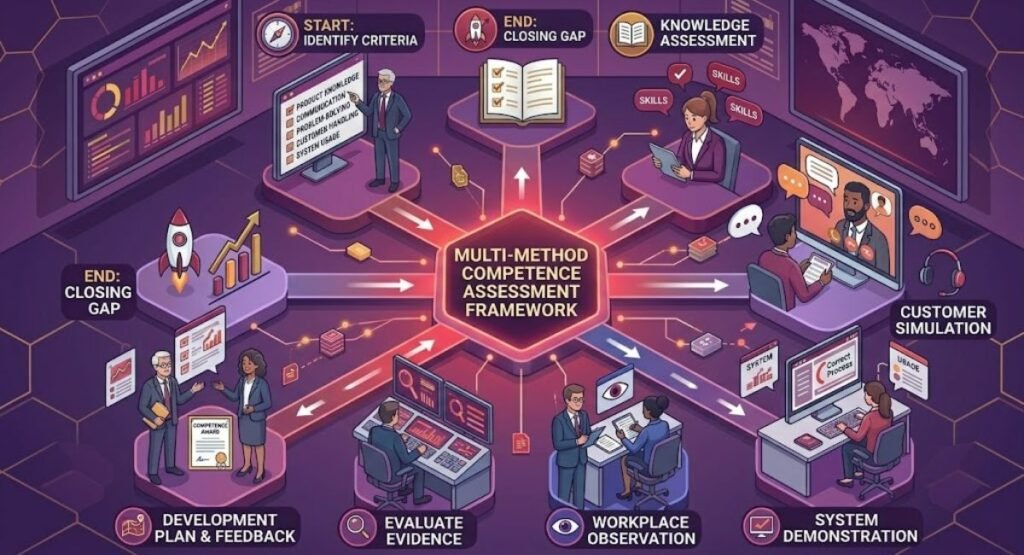
Consider an organization assessing customer service representatives. Instead of evaluating employees only through a written test, the company could assess product knowledge, communication, problem-solving, customer handling, and system usage.
An employee might complete a knowledge assessment, participate in a customer-service simulation, demonstrate the correct system process, and receive a workplace observation. The assessor then compares the evidence against predefined criteria and creates a development plan for any identified gaps.
This approach provides a broader assessment of practical competence than a single examination.
How to Measure Programme Effectiveness
Organizations should evaluate whether the programme is producing useful business outcomes. Possible measures include:
- Competency gap reduction
- Training completion rates
- Assessment pass rates
- Employee development progress
- Internal promotion rates
- Time to competency
- Productivity improvements
- Quality improvements
- Employee engagement
- Retention trends
The most useful measures should connect assessment activity with meaningful workforce or business outcomes.
Conclusion
A well-designed competence assessment programme gives organizations a structured way to understand what their employees can do and where additional development is needed. By defining clear competencies, using reliable assessment methods, collecting meaningful evidence, training assessors, and providing actionable feedback, organizations can create a fairer and more useful approach to workforce development.
The strongest programmes are not simply designed to produce scores. They turn assessment results into practical development decisions that improve individual capability and support wider organizational goals.
FAQs
1. What is a competence assessment programme?
It is a structured process for measuring whether individuals meet defined knowledge, skill, behavior, and performance standards.
2. What are the main methods of competence assessment?
Common methods include tests, interviews, workplace observation, simulations, practical demonstrations, and portfolio reviews.
3. Why do organizations use competence assessment programmes?
They use them to identify skill gaps, improve performance, support development, and make informed workforce decisions.
4. How often should competence assessments be conducted?
The frequency depends on the role, risk level, organizational needs, and how quickly the required competencies change.
5. What makes a competence assessment fair?
Clear criteria, trained assessors, relevant evidence, consistent scoring, and transparent feedback help make assessments fair.