
If you want to start a career in project management but do not yet have extensive project experience, CAPM Certification can be a useful place to begin. The Certified Associate in Project Management (CAPM) is a certification from the Project Management Institute (PMI) that focuses on foundational project management knowledge.
The certification is designed for people who want to understand how projects are planned, organized, delivered, and managed. It can be relevant to students, recent graduates, project coordinators, and professionals moving into project-based roles. Unlike the PMP, CAPM does not require previous project management experience. PMI currently requires a secondary degree and at least 23 hours of project management education before the exam.
This guide explains CAPM certification requirements, the exam, cost, preparation process, benefits, career opportunities, and the main differences between CAPM and PMP.
What Is CAPM Certification?
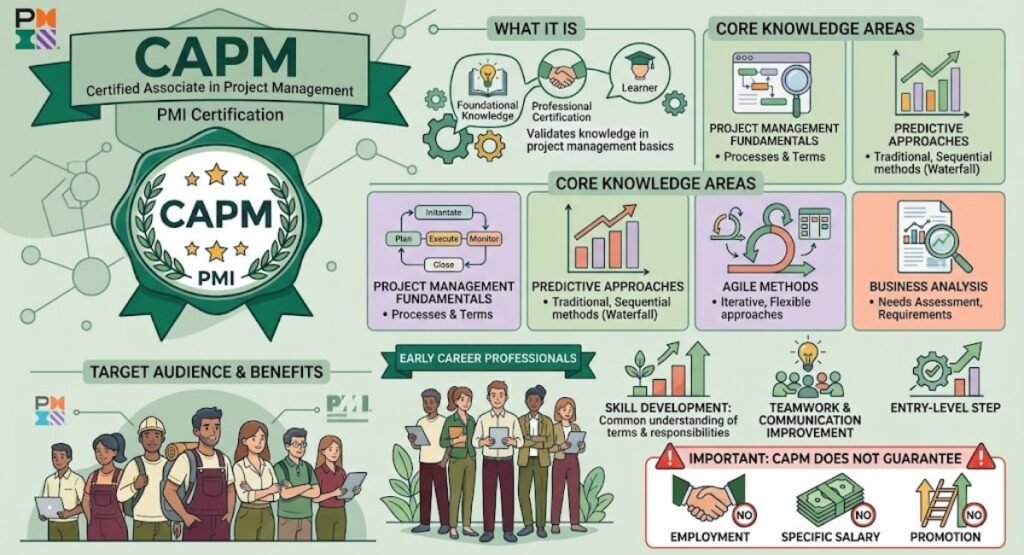
CAPM stands for Certified Associate in Project Management. It is a PMI certification that validates foundational knowledge in project management. The certification covers areas such as project management fundamentals, predictive approaches, agile methods, and business analysis.
CAPM is particularly relevant to people who are at the beginning of their project management journey. It can help learners develop a common understanding of project terms, processes, approaches, and responsibilities before they move into more advanced project work.
The certification does not guarantee employment, a specific salary, or promotion. Instead, it provides a structured way to build project management knowledge and demonstrate that knowledge through a professional certification exam.
Who Should Consider CAPM Certification?
Students and Recent Graduates
Students and recent graduates who are interested in project management can use CAPM to build a foundation before entering the workplace. Learning project management concepts early can make it easier to understand how professional teams organize work, manage requirements, and track project progress.
It can also provide a structured learning path for people who have studied business, information technology, engineering, operations, or another field where project-based work is common.
Entry-Level Project Professionals
People already working as project assistants, coordinators, analysts, or team members may find CAPM useful for strengthening their formal project management knowledge.
Instead of learning only through day-to-day tasks, candidates can use the certification process to study broader project concepts and approaches.
Professionals Changing Careers
CAPM can also suit professionals moving from another career into project management. Someone with experience in operations, administration, technology, finance, or business may already have useful workplace skills but lack formal project management education.
CAPM can provide a structured introduction to the field without requiring the project leadership experience expected for the PMP.
CAPM Certification Requirements
The current PMI requirements are straightforward. Candidates need a secondary degree, such as a high school diploma, GED, or global equivalent, and at least 23 hours of project management education completed before the exam. PMI also states that no project management experience is required for CAPM eligibility.
| Requirement | What It Means |
| Education | A secondary degree such as a high school diploma, GED, or global equivalent |
| Project Management Education | At least 23 hours of project management education before the exam |
| Experience | Previous project management experience is not required |
| Exam | Candidates must pass the CAPM examination |
The education requirement is important because meeting the academic requirement alone is not enough. Candidates must also complete the required project management education before taking the examination.
CAPM Certification Process
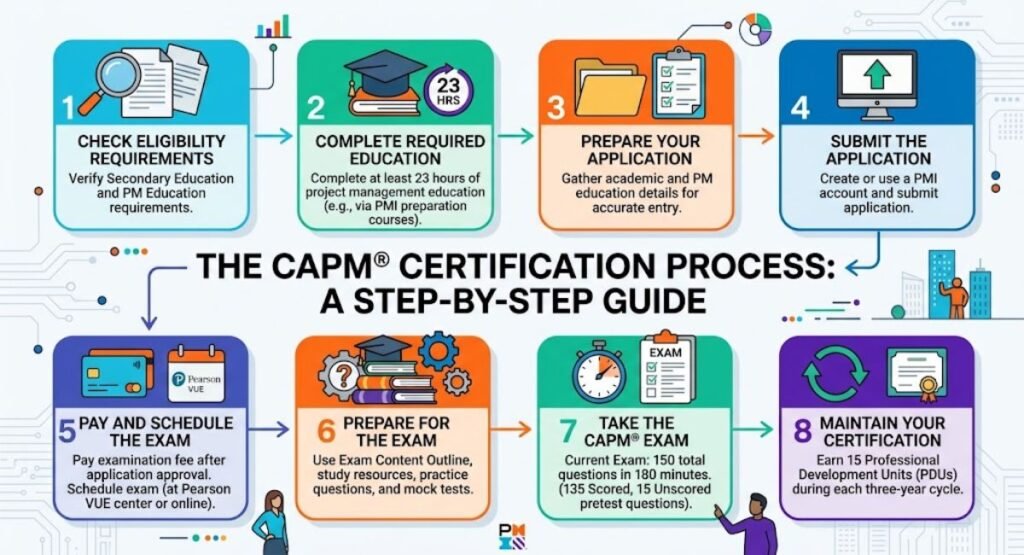
The CAPM certification process can be approached as a series of manageable steps.
1. Check the eligibility requirements
First, confirm that you have the required secondary education and project management education.
2. Complete the required education
Complete at least 23 hours of project management education before taking the exam. PMI offers CAPM preparation options to help you meet this requirement.
3. Prepare your application
Gather your academic and project management education information so you can enter the required details accurately.
4. Submit the application
Create or use your PMI account and submit your CAPM application.
5. Pay and schedule the exam
After your application is accepted, pay the applicable examination fee and schedule your exam. PMI states that candidates can take the exam at a Pearson VUE testing center or online.
6. Prepare for the exam
Use the exam content outline, study resources, practice questions, and mock tests to prepare.
7. Take the CAPM exam
The current exam has 150 questions and a 180-minute time limit. PMI identifies 15 questions as unscored pretest questions and 135 as scored questions.
8. Maintain your certification
After earning CAPM, certification holders need to earn 15 Professional Development Units (PDUs) during each three-year cycle to maintain the certification.
CAPM Exam Overview
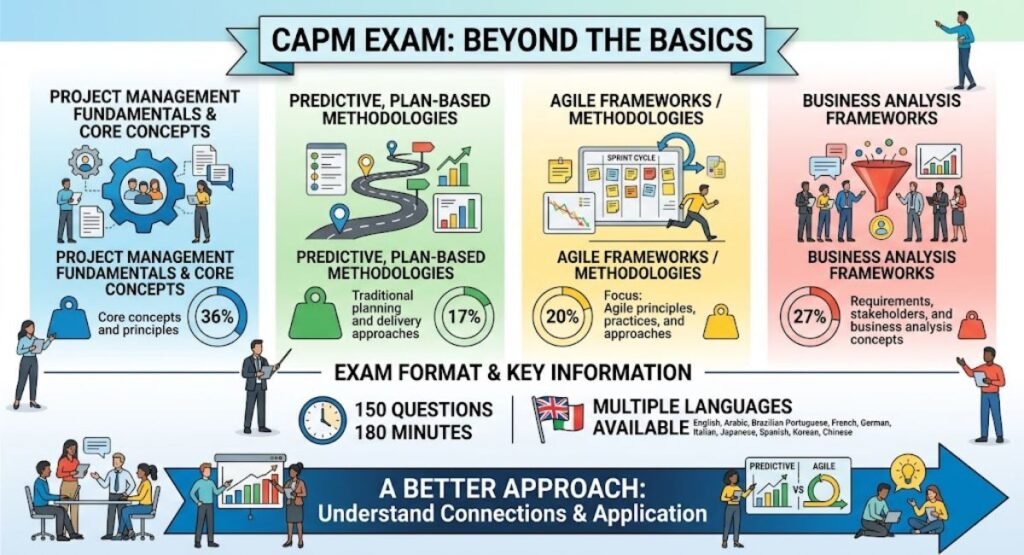
The CAPM exam tests more than basic terminology. The current exam covers four main areas: project management fundamentals and core concepts, predictive plan-based methodologies, agile frameworks and methodologies, and business analysis frameworks.
| Exam Area | Current Weight | What Candidates Should Focus On |
| Project Management Fundamentals and Core Concepts | 36% | Core project management concepts and principles |
| Predictive, Plan-Based Methodologies | 17% | Traditional planning and delivery approaches |
| Agile Frameworks/Methodologies | 20% | Agile principles, practices, and approaches |
| Business Analysis Frameworks | 27% | Requirements, stakeholders, and business analysis concepts |
The exam is currently 150 questions in 180 minutes and is offered in multiple languages. PMI lists English, Arabic, Brazilian Portuguese, French, German, Italian, Japanese, Spanish, Korean, and Chinese among the available languages.
This structure means candidates should not focus only on memorizing definitions. A better approach is to understand how project concepts connect and how different approaches can be used in project situations.
How Much Does CAPM Certification Cost?
The CAPM certification cost depends on the examination fee and the additional resources a candidate chooses. PMI currently lists the CAPM exam fee as $225 for members and $300 for non-members on its certification page.
However, the total amount you spend can be higher if you purchase training, books, practice exams, or other study resources.
| Cost Area | Possible Expense |
| Exam | $225 for PMI members or $300 for non-members, according to PMI’s current listed fee |
| Training | Depends on the course or provider |
| Study Materials | Depends on the resources selected |
| Practice Tests | Free or paid options may be available |
| Retake | Additional examination costs may apply |
Candidates should check PMI’s official certification page before paying because fees and policies can change.
Benefits of CAPM Certification
Builds Project Management Knowledge
One of the main benefits of CAPM is structured learning. Candidates study project management concepts instead of relying only on informal workplace experience.
This knowledge can help beginners understand terms and processes used by project teams and communicate more effectively with colleagues.
Supports Career Development
CAPM can add a recognized project management credential to a professional profile. It may be useful when applying for entry-level or associate-level project roles.
However, certification should be viewed as one part of career development. Practical skills, communication, education, experience, and employer requirements also matter.
Demonstrates Commitment
Completing a professional certification shows that a candidate has invested time in learning project management concepts.
For someone entering the field, this can provide evidence of structured learning even when their professional project experience is still limited.
Provides a Foundation for Future Growth
CAPM can also serve as a foundation for continued professional development. As professionals gain experience, they may choose to pursue more advanced project management education or certifications.
PMI also states that an active CAPM certification can satisfy the project management education/training requirement for a PMP application.
CAPM Certification vs PMP
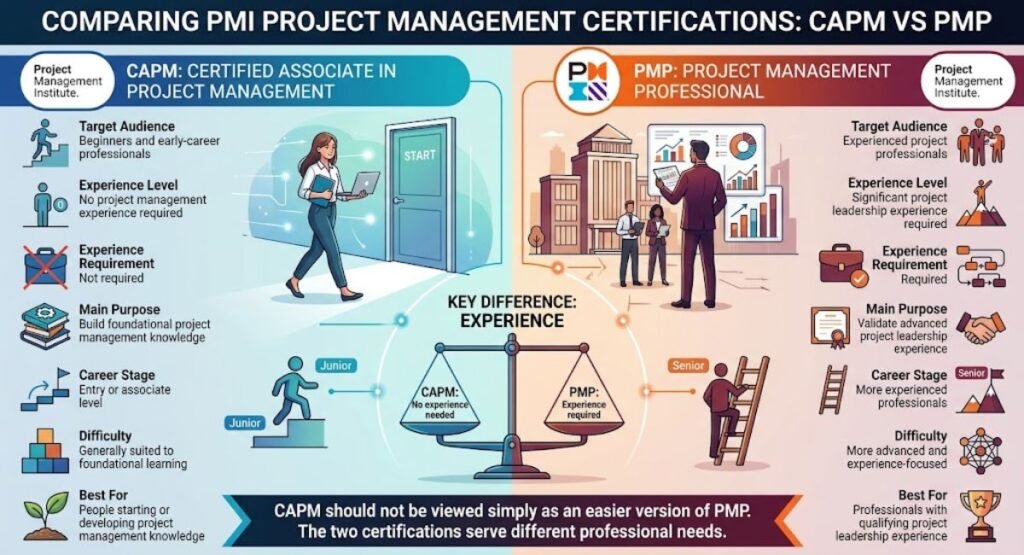
CAPM and PMP are both PMI certifications, but they are designed for different stages of a project management career.
| Feature | CAPM | PMP |
| Target Audience | Beginners and early-career professionals | Experienced project professionals |
| Experience Level | No project management experience required | Significant project leadership experience required |
| Experience Requirement | Not required | Required |
| Main Purpose | Build foundational project management knowledge | Validate advanced project leadership experience |
| Career Stage | Entry or associate level | More experienced professionals |
| Difficulty | Generally suited to foundational learning | More advanced and experience-focused |
| Best For | People starting or developing project management knowledge | Professionals with qualifying project leadership experience |
The key difference is experience. PMI’s current PMP requirements include substantial project leadership experience depending on education level, while CAPM does not require project management experience.
Therefore, CAPM should not be viewed simply as an easier version of PMP. The two certifications serve different professional needs.
How to Prepare for the CAPM Exam
Good preparation starts with understanding what the exam actually tests. Review the current CAPM Exam Content Outline and organize your study around the four examination areas.
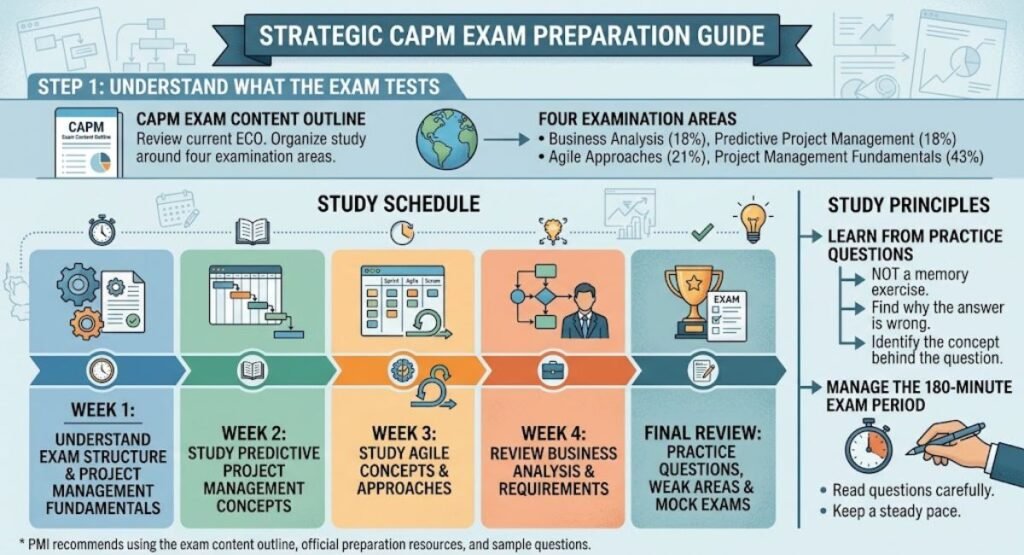
Create a study schedule that gives you enough time to learn concepts, answer practice questions, and review weak areas. PMI itself recommends using the exam content outline to understand what is covered and provides official preparation resources and sample questions.
| Study Stage | Suggested Focus |
| Week 1 | Understand exam structure and project management fundamentals |
| Week 2 | Study predictive project management concepts |
| Week 3 | Study agile concepts and approaches |
| Week 4 | Review business analysis and requirements |
| Final Review | Practice questions, weak areas, and mock exams |
During preparation, do not treat every practice question as a memory exercise. When you answer incorrectly, find out why the answer is wrong and identify the concept behind the question.
Practice also helps you manage the 180-minute exam period. The goal is to become comfortable reading questions carefully while keeping a steady pace.
Common Mistakes to Avoid During CAPM Preparation
Several simple mistakes can make preparation harder than necessary.
- Starting without reviewing the exam structure.
- Relying only on memorization.
- Ignoring agile concepts.
- Avoiding practice questions.
- Studying without a realistic schedule.
- Spending too much time on one topic.
- Failing to review incorrect answers.
- Using outdated preparation material.
Another common problem is trying to study everything at the same depth. A better approach is to understand the exam weighting, build a strong foundation, and spend additional time on areas where your practice results show weakness.
Is CAPM Certification Worth It?
CAPM can be worthwhile for someone who wants structured project management knowledge and is building an early-career path in the field. It is especially relevant to candidates who do not yet meet the experience requirements for the PMP.
However, its value depends on your individual situation. Your career goals, existing education, practical experience, employer expectations, and interest in project management should all influence your decision.
CAPM should therefore be treated as a professional development investment rather than a guarantee of a job or salary. The certification can support your profile, but you still need communication, organization, problem-solving, technical, and workplace skills to succeed in project environments.
CAPM Certification Career Opportunities
CAPM knowledge can be relevant to several entry-level and support positions. PMI specifically identifies opportunities such as project coordinator and junior project manager among roles associated with the certification.
| Career Path | How CAPM Knowledge May Help |
| Project Coordinator | Supports understanding of project processes and coordination |
| Project Analyst | Helps with project terminology, information, and analysis |
| Project Assistant | Provides foundational project management knowledge |
| Junior Project Roles | Supports early-career project development |
| Operations Roles | Can improve understanding of project-related work |
The certification itself does not guarantee that a candidate will qualify for every role listed above. Employers may have different requirements for education, experience, technical skills, and industry knowledge.
About the Author
Zain Kashif — Project Management & Career Development Writer
Zain Kashif writes about project management, professional development, business processes, and career growth. Alex focuses on explaining professional certifications and career topics in clear, practical language to help readers make informed decisions.
This article is for informational purposes and is not officially affiliated with or endorsed by PMI. Certification requirements, fees, exam details, and policies can change, so candidates should verify current information with PMI before applying.
Conclusion
CAPM Certification can be a practical starting point for people who want to build a foundation in project management without first gaining extensive project leadership experience. The certification covers project management fundamentals, predictive approaches, agile methods, and business analysis, giving beginners a broad view of modern project work.
Before applying, candidates should confirm the current eligibility requirements, education requirements, exam fee, and exam structure through PMI. They should also consider whether CAPM matches their career goals. With a realistic study plan and a focus on understanding concepts, CAPM can become a useful part of a broader professional development strategy.
FAQs
1. What is CAPM certification?
CAPM is a PMI certification that validates foundational knowledge of project management.
2. Who is eligible for CAPM certification?
Candidates need a secondary degree and at least 23 hours of project management education before the exam.
3. Is CAPM certification good for beginners?
Yes, CAPM is designed to provide foundational project management knowledge for people starting their careers.
4. Is CAPM easier than PMP?
CAPM and PMP target different career stages, with CAPM requiring no project management experience and PMP requiring qualifying project leadership experience.
5. How can I prepare for the CAPM exam?
Review the official exam content outline, study each exam area, practice questions, and use mock exams to identify weak topics.