
AI transformation is often presented as a technology challenge. Organizations invest in AI platforms, automation tools, data systems, and new software, expecting these investments to deliver better results. However, technology alone does not determine whether an AI initiative succeeds.
The bigger challenge is deciding how AI should be used, who is responsible for its decisions, what data it can access, and how to control risks. Strong governance gives organizations the structure they need to adopt AI responsibly while keeping business goals, people, and risks in view.
Why AI Transformation Goes Beyond Technology

Buying an AI solution is relatively straightforward. Transforming an organization around that solution is much harder.
An AI system can automate tasks, analyze information, generate content, or support business decisions. But someone still needs to decide where the system should be used and what limits should apply. Employees also need clear guidance about which information they can enter into AI tools and when human review is required.
Without proper governance, organizations can end up with disconnected AI projects. Different departments may use different tools, follow inconsistent practices, or make decisions without understanding the associated risks.
Successful AI transformation therefore requires more than technical implementation. It requires policies, ownership, leadership, data controls, risk management, and continuous oversight.
What AI Governance Actually Means
AI governance is the framework an organization uses to guide, control, and monitor its use of artificial intelligence.
It answers practical questions such as:
- Who can approve an AI project?
- Who owns the risks associated with an AI system?
- What data can an AI application use?
- How should sensitive information be protected?
- When should a human review an AI-generated decision?
- How should AI performance be monitored?
- What happens when an AI system produces an unacceptable result?
Good AI governance should not exist only as a policy document.
The objective is to create a balance between innovation and control. Organizations need enough freedom to experiment with AI while maintaining safeguards that protect customers, employees, business data, and the organization itself.
Why Governance Becomes Critical During AI Transformation
Accountability and Decision-Making
AI can influence important business decisions, but responsibility cannot simply be transferred to a machine.
Organizations need clear ownership for AI initiatives. A business leader may own the business outcome, while technology and data teams may manage implementation and technical controls. Legal, security, compliance, or risk teams may also need to participate depending on the use case.
Clear accountability prevents situations where everyone assumes someone else is responsible.
Data Governance
AI systems depend heavily on data. Poor-quality, outdated, incomplete, or improperly controlled data can weaken the value of an AI implementation.
Data governance should address ownership, access, quality, security, retention, and appropriate use. Organizations should also understand what information is being shared with external AI services and whether that use is consistent with internal policies.
Strong data governance gives AI transformation a reliable foundation.
Risk and Compliance
Not every AI application carries the same level of risk. An internal tool that summarizes meeting notes may require different controls from an AI system that influences financial, employment, healthcare, security, or customer decisions.
A practical AI risk management process should identify the purpose of each system, possible failure points, affected stakeholders, required controls, and appropriate monitoring.
Organizations can also strengthen their broader technology risk practices by understanding how corporate software inspection, vulnerability detection, and security controls support enterprise environments.
Organizations should also consider applicable laws, industry requirements, contractual obligations, and internal policies before deploying higher-risk systems.
The Core Components of Effective AI Governance
Effective governance connects several areas rather than relying on a single policy.

| Governance Area | Purpose | Example |
| Leadership | Set direction and accountability | AI steering committee |
| Data Governance | Maintain reliable and controlled data | Data ownership policies |
| Risk Management | Identify and reduce AI risks | AI risk assessments |
| Compliance | Meet legal and organizational requirements | AI usage controls |
| Security | Protect AI systems and data | Access management |
| Monitoring | Track AI performance and risks | Model monitoring |
| Accountability | Define responsibility | Clear ownership structure |
These components work together. For example, security controls are less effective if nobody owns them, while a strong AI strategy can fail if employees do not understand the organization’s data rules.
Common Governance Problems That Can Derail AI Transformation
Organizations can face several governance problems when AI adoption grows faster than internal controls.
Unclear ownership: Teams may deploy AI without establishing who is responsible for its results.
Poor data controls: Employees may use sensitive or unreliable information without understanding the consequences.
Uncontrolled AI adoption: Staff may introduce consumer or enterprise AI tools without proper security or approval.
Lack of employee training: Employees may understand how to operate an AI tool but not when they should question its output.
Weak risk assessment: Organizations may focus on what an AI system can do while overlooking how it could fail.
Unclear policies: Vague rules can lead to inconsistent decisions between departments.
Insufficient monitoring: An AI system that works well today may perform differently as data, users, or business conditions change.
Business-technology disconnect: Technical teams may focus on implementation while business leaders focus on outcomes, creating gaps between the two.
How Organizations Can Build an AI Governance Framework
A practical framework does not need to be unnecessarily complicated. Organizations can begin with a small number of clear steps and expand their controls as AI adoption grows.
| Step | Action | Expected Outcome |
| 1 | Define AI objectives | Clear strategic direction |
| 2 | Assign ownership | Strong accountability |
| 3 | Identify risks | Better risk visibility |
| 4 | Establish policies | Consistent AI use |
| 5 | Govern data | Higher data quality |
| 6 | Monitor systems | Continuous oversight |
| 7 | Review and improve | Long-term governance |
1. Define Clear AI Objectives
Avoid adopting technology simply because it is popular.
A clear objective makes it easier to measure value and determine whether an AI initiative should continue.
2. Assign Ownership
Every significant AI initiative should have an identifiable owner. That person or team should understand the expected outcomes, risks, controls, and review process.
3. Identify Risks Before Deployment
Risk assessment should happen before an AI system becomes deeply embedded in business operations. Consider data risks, security concerns, operational failures, inappropriate outputs, and potential effects on people.
4. Establish Practical Policies
AI policies should be understandable enough for employees to follow. They can define approved tools, prohibited uses, data-handling requirements, human-review expectations, and escalation procedures.
5. Govern the Data
Establish clear rules for what data AI systems can access and how that data should be protected. Data quality checks should also become part of the implementation process.
6. Monitor AI Systems
Governance does not end when an AI application goes live. Organizations should monitor performance, incidents, user feedback, security concerns, and changes in business requirements.
7. Review and Improve
AI governance should evolve with the technology. Regular reviews can reveal gaps and help organizations update policies, controls, and responsibilities.
AI Transformation and Leadership
AI governance cannot be treated as an IT-only responsibility.
Executives and business leaders determine organizational priorities, acceptable levels of risk, investment decisions, and accountability. They also influence whether employees see governance as a barrier or as part of responsible innovation.
Technology teams are essential for implementing technical controls, but business leaders need to understand why those controls matter. Similarly, legal, security, data, and risk teams should be involved when their expertise is relevant.
Technology transformation also creates demand for professionals with specialized technical and digital skills, as shown by the broader career opportunities discussed in our guide to aerospace engineering.
A cross-functional approach creates better decisions because AI transformation affects more than software. It can change workflows, employee responsibilities, customer experiences, and business processes.
Governance Should Enable AI, Not Stop It
Some organizations worry that governance will slow innovation. Poorly designed governance can certainly create unnecessary bureaucracy, but effective governance should do the opposite.
Clear rules allow employees to understand what they can do without repeatedly asking for approval. Defined risk categories can help organizations determine which AI experiments require simple controls and which require deeper review.
For example, an organization could establish a lightweight process for low-risk productivity tools while applying stronger oversight to AI systems that affect important customer or employee decisions.
The goal is not to prevent AI adoption. The goal is to make responsible AI adoption easier.
Practical Example: What Happens Without AI Governance?
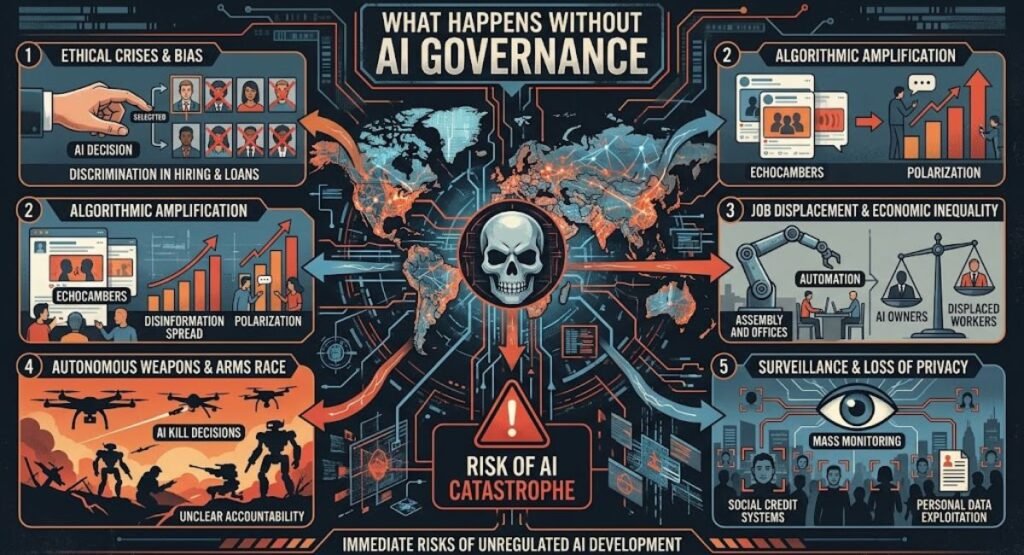
Consider a hypothetical company that introduces several AI tools across its departments. The marketing team uses one platform for content, the sales team adopts another for customer analysis, and employees begin using public AI services for internal documents.
At first, productivity improves. However, the company has no central AI policy, no clear ownership, and no consistent data controls.
Eventually, an employee enters confidential business information into an external AI service. Another department relies on AI-generated customer analysis without checking its accuracy. Management then discovers that nobody has been assigned responsibility for reviewing these systems.
The problem was not a lack of AI technology. The company had plenty of it. The problem was the absence of governance.
A basic governance framework could have established approved tools, data-handling rules, human-review requirements, ownership, and monitoring before these problems occurred.
AI Transformation Governance Checklist
Before expanding AI adoption, organizations should ask whether they have:
- A clear AI strategy
- Defined ownership for AI initiatives
- Appropriate data controls
- A documented risk assessment process
- Security controls
- Employee AI training
- Clear AI usage policies
- Relevant compliance reviews
- AI performance monitoring
- Regular governance reviews
This checklist can serve as a starting point rather than a complete governance framework. Organizations should adjust it according to their industry, AI use cases, size, and risk profile.
About the Author
Zain Kashif is an AI Governance and Digital Transformation Specialist focused on helping organizations understand responsible AI adoption, technology strategy, governance, and risk management. Their work explores practical approaches to implementing AI while maintaining accountability, strong data practices, effective oversight, and alignment between technology initiatives and broader business objectives.
Conclusion
AI transformation is a problem of governance because technology cannot decide how an organization should use AI responsibly. People must establish the objectives, boundaries, responsibilities, and controls surrounding every important AI initiative.
Strong governance connects AI strategy with practical business decisions. It helps organizations manage data, assign accountability, identify risks, protect information, and monitor outcomes without unnecessarily restricting innovation.
The organizations most likely to build sustainable AI capabilities are not necessarily those that adopt the most AI tools. They are the ones that understand how to govern those tools effectively. When leadership, technology, data, risk, and business teams work together, governance becomes an enabler of AI transformation rather than an obstacle.
FAQs
What is AI transformation governance?
AI transformation governance is the framework used to manage AI strategy, risks, responsibilities, data, and organizational controls.
Why is governance important for AI transformation?
Governance helps organizations adopt AI responsibly while maintaining accountability, security, compliance, and business alignment.
Who should be responsible for AI governance?
AI governance should involve business leadership, technology, data, security, risk, legal, and other relevant organizational teams.
What are the biggest AI governance risks?
Major risks include poor data controls, unclear accountability, security problems, unreliable outputs, compliance issues, and uncontrolled AI use.
How can companies improve AI governance?
Companies can improve governance by defining ownership, creating practical policies, assessing risks, controlling data, training employees, and monitoring AI systems.