
A company may introduce new software, restructure teams, change processes, or launch a new business strategy, but the result depends heavily on how people respond.
The Change Acceleration Process provides a practical way to organize that effort. It focuses on the human and organizational side of change while connecting leadership, communication, employee involvement, implementation, and measurement. Instead of treating change as a one-time announcement, it encourages organizations to build the conditions needed for people to adopt and sustain a new approach.
This guide explains what the Change Acceleration Process means, why it matters, its key elements, practical implementation steps, common mistakes, useful tools, and a realistic example.
What Is the Change Acceleration Process?
The Change Acceleration Process (CAP) is a structured approach to managing the people side of organizational change.
In simple terms, the process helps answer an important question:
How do we help people move from the current way of working to a new and better way?
A change initiative can fail even when the new technology, process, or strategy is technically sound. Employees may not understand why the change is necessary, managers may communicate inconsistent messages, or teams may not receive enough training.
The Change Acceleration Process addresses these issues by paying attention to factors such as:
- Leadership commitment
- A clear case for change
- Stakeholder engagement
- Communication
- Employee readiness
- Training and support
- Reinforcement
- Measurement
For example, imagine a company replacing its old project-management system with a new platform. Installing the software is only one part of the project. Employees must understand why the system is changing, learn how to use it, know where to get help, and have enough motivation to stop relying on the old system.
That is where change acceleration becomes important.
Why Is the Change Acceleration Process Important?
Organizations often focus heavily on the technical side of a project and underestimate the human side. A new process may look excellent on paper but produce weak results if employees do not adopt it.
Several problems can slow down organizational change:
- Employees do not understand the reason for the change.
- Leaders send different messages to different teams.
- Employees fear that the change will negatively affect their roles.
- Training is provided too late or not at all.
- Stakeholders are involved only after major decisions have already been made.
- Management expects adoption to happen immediately.
- Feedback from employees is ignored.
- Progress is not measured after implementation.
A structured change approach can help teams identify these problems earlier.
The goal is not to eliminate every obstacle. Change will usually involve uncertainty and resistance. Instead, the objective is to understand those challenges and respond to them before they become major barriers.
Key Elements of the Change Acceleration Process
An effective change initiative normally depends on several connected elements.
1. Create a Clear Case for Change
People need to understand why change is necessary.
A weak message might simply say:
The company is introducing a new system.
A stronger message explains the business problem, the expected improvement, and what the change means for employees.
For example, a company might explain that its existing system creates duplicate work, delays reporting, and makes project information difficult to find. The new platform is being introduced to simplify those problems.
Common mistake: announcing the solution without explaining the problem.
2. Build Leadership Alignment
Leaders should agree on the purpose, priorities, responsibilities, and expected outcomes of the change.
Leadership alignment does not mean that every manager must have identical opinions.
Employees quickly notice when managers disagree publicly about a major initiative.
Common mistake: expecting employees to support a change that senior leaders themselves do not visibly support.
3. Engage Stakeholders
Stakeholders can include executives, managers, employees, customers, suppliers, technical teams, and other groups affected by the change.
A simple stakeholder map can help identify:
| Stakeholder | Main Concern | Level of Influence | Recommended Approach |
| Senior leaders | Business results | High | Regular executive updates |
| Managers | Team performance | High | Workshops and planning |
| Employees | Daily work impact | Medium | Training and open communication |
| IT team | Technical implementation | High | Technical planning |
| Customers | Service impact | Medium | Targeted communication |
Common mistake: treating all stakeholders as if they have the same concerns.
4. Communicate Clearly
Communication is one of the most visible parts of change management.
Effective communication should answer practical questions:
- What is changing?
- Why is it changing?
- When will it happen?
- Who will be affected?
- What will employees need to do?
- What support will be available?
- Where can people ask questions?
Communication should also be two-way. Employees need opportunities to provide feedback rather than simply receiving announcements.
Common mistake: communicating once and assuming everyone understands the change.
5. Prepare People for Change
Readiness varies from one person or team to another.
Some employees may be excited about a new system, while others may be concerned about learning something unfamiliar. A readiness assessment can help identify these differences.
Organizations can use:
- Surveys
- Interviews
- Team meetings
- Focus groups
- Skills assessments
- Change-impact assessments
The objective is to discover barriers early enough to address them.
Change Acceleration Process Step by Step
The exact implementation can vary depending on the organization, but the following sequence provides a practical framework.
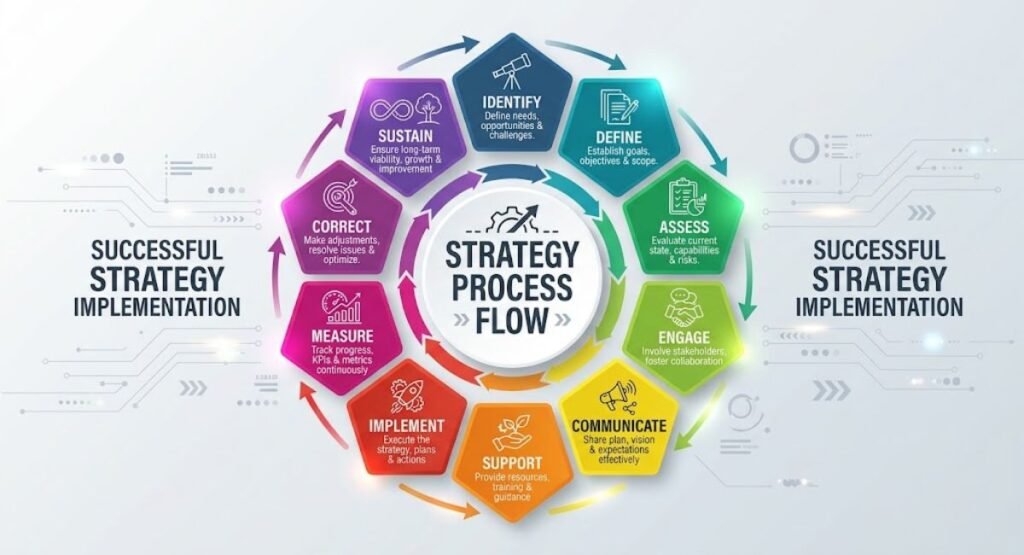
Step 1: Identify the Need for Change
Start by clearly defining the problem.
Ask:
- What is not working?
- Why does it need to change?
- What happens if nothing changes?
- Who is affected?
A clearly defined problem creates a stronger foundation for the entire initiative.
Step 2: Define the Desired Outcome
Describe what success should look like.
Instead of saying, “We want better project management,” define the desired outcome more specifically.
For example:
- Improve visibility of project work.
- Reduce duplicate reporting.
- Create a consistent workflow.
- Make project information easier to access.
The outcome should be understandable to both leadership and employees.
Step 3: Assess Organizational Readiness
Determine whether the organization is prepared for the proposed change.
Consider:
- Available skills
- Employee attitudes
- Existing workload
- Leadership support
- Technical readiness
- Training requirements
- Previous change experience
This assessment can reveal issues before implementation begins.
Step 4: Identify Stakeholders
Stakeholder mapping helps the project team decide who needs detailed communication, who needs training, and who should participate in decision-making.
Step 5: Build Leadership Alignment
Make sure leaders understand:
- The business reason for change
- Their responsibilities
- The expected benefits
- Potential risks
- How they should communicate with their teams
Leadership should remain visible throughout implementation.
Step 6: Develop the Communication Strategy
Create a communication plan based on different audiences.
For example:
| Audience | Message | Channel | Timing |
| Executives | Business progress | Leadership meeting | Monthly |
| Managers | Implementation details | Workshop | Biweekly |
| Employees | What changes for them | Email + training | Before rollout |
| Support team | Technical issues | Team meetings | Weekly |
Step 7: Address Employee Concerns
Resistance is not always a sign that people are unwilling to improve. Sometimes it indicates that employees have legitimate questions.
Listen for concerns about:
- Workload
- Job responsibilities
- Training
- Performance expectations
- Technology
- Job security
- Timing
Respond to valid concerns with information and practical support.
Step 8: Provide Training and Support
Training should be connected to real work.
Instead of explaining every feature of a new system, show employees how they will use the system to complete their normal tasks.
Useful support may include:
- Workshops
- Demonstrations
- User guides
- Frequently asked questions
- Coaching
- Help desks
- Short training videos
Step 9: Implement the Change
Implementation should have clear ownership.
Define:
- Responsibilities
- Timelines
- Dependencies
- Risks
- Support channels
- Escalation procedures
A phased rollout may be appropriate when a change is complex or affects many teams.
Step 10: Measure Adoption
Implementation is not the same as adoption.
A system may technically be available while employees continue using old methods.
Possible adoption indicators include:
- Usage rates
- Training completion
- Process compliance
- User feedback
- Error rates
- Support requests
- Employee confidence
Choose measures that reflect the actual objective of the change.
Step 11: Correct Problems
Use feedback and performance information to identify gaps.
If employees struggle with a process, determine whether the problem is caused by training, communication, system design, workload, or another factor.
Then adjust the approach.
Step 12: Sustain the Change
The final objective is to make the new approach part of normal work.
Reinforcement may include:
- Manager follow-ups
- Performance discussions
- Refresher training
- Updated procedures
- Recognition
- Ongoing measurement
Without reinforcement, employees may gradually return to familiar practices.
Change Acceleration Process Example
Consider a medium-sized company that decides to replace several disconnected project-tracking spreadsheets with a centralized project-management platform.

Initial Problem
Project managers use different spreadsheets. Senior leaders have difficulty getting consistent project information, while employees spend time manually updating multiple files.
Change Objective
The company wants teams to use one centralized system for project schedules, tasks, reporting, and progress updates.
Main Stakeholders
The stakeholders include executives, project managers, employees, IT staff, and department managers.
Initial Resistance
Some employees believe the new system will increase their workload. Others are comfortable with spreadsheets and do not see a reason to change.
Instead of ignoring this resistance, the project team conducts short meetings with affected teams.
Employees identify several concerns:
- They do not know how the new platform works.
- They are worried about duplicate data entry.
- They want to know whether old project information will be transferred.
- They are unsure how performance will be measured.
Response
The project team adjusts its approach.
It creates practical training, explains the migration process, demonstrates common tasks, and provides a support channel for questions.
Managers also begin using the new system themselves instead of continuing to request reports through the old process.
Implementation
The company starts with a limited group of users, collects feedback, fixes problems, and then expands the rollout.
Measurement
Instead of measuring success only by whether the software has been installed, the company monitors actual usage, completion of training, user feedback, and adherence to the new workflow.
Lesson
The main lesson is that technology implementation and organizational adoption are different challenges. A technically successful rollout can still struggle if employees do not understand or accept the new way of working.
Practical Experience With Change Acceleration

Practical Scenario
Imagine a project team preparing to introduce a new reporting process. Initially, management assumes that employees are resisting because they prefer the old process. During discussions, however, the team discovers that the new reporting requirements duplicate information employees already enter into another system.
The issue is therefore not simply resistance to change. There is a genuine process problem.
The team removes the unnecessary duplicate work, explains the reason for the remaining changes, and provides short training. Employees become more willing to use the new process because the organization has responded to their concerns instead of simply telling them to comply.
The practical lesson is important: listen before labeling behavior as resistance. Employee feedback can reveal design problems, unclear communication, workload issues, or training gaps that may otherwise remain hidden.
Benefits of the Change Acceleration Process
A structured approach can provide several benefits when it is adapted to the organization’s situation.
- Better employee adoption: People receive clearer information and support.
- Stronger leadership alignment: Leaders understand their role in the transition.
- Improved stakeholder engagement: Important groups are involved earlier.
- Better communication: Employees know what is changing and why.
- Earlier identification of resistance: Concerns can be addressed before implementation.
- More focused training: Training can be connected to actual job responsibilities.
- Better project visibility: Progress and adoption can be measured.
- More sustainable change: Reinforcement helps prevent a return to old practices.
These benefits are not automatic. They depend on how well the organization applies the approach.
Common Challenges and Mistakes
Change initiatives can fail or underperform when organizations focus too heavily on the solution and not enough on adoption.
| Problem | Likely Cause | Recommended Action |
| Employees ignore the new process | Poor explanation of the reason for change | Explain the business and employee impact |
| Managers give different messages | Weak leadership alignment | Establish common communication points |
| Training has low participation | Training is inconvenient or irrelevant | Make training practical and role-specific |
| Employees continue using old tools | New process is difficult | Identify usability and workflow problems |
| Resistance increases | Concerns are being ignored | Create feedback channels and address valid issues |
| Adoption drops after launch | Weak reinforcement | Use follow-ups, coaching and measurement |
| Project progress looks good, but usage is low | Success is measured by implementation only | Track actual adoption |
Organizational change can also create new operational risks, especially when teams are not prepared for new processes, systems, or responsibilities. A structured risk approach can help organizations identify potential problems early and develop appropriate controls. For more information, see our guide to Composite Risk Management.
Common mistakes to avoid
- Treating communication as a one-time announcement
- Assuming resistance is always negative
- Ignoring middle managers
- Providing training too late
- Measuring installation instead of adoption
- Overloading employees with unnecessary information
- Failing to adjust the plan after receiving feedback
- Declaring success immediately after launch
Change Acceleration Process vs Traditional Change Management
The two concepts overlap considerably. Change management is a broad discipline, while a particular change acceleration approach can provide a structured framework for addressing organizational adoption.
| Aspect | Change Acceleration Process | Traditional Change Management |
| Primary focus | Building conditions for successful change | Managing people and organizational impacts |
| Leadership role | Strong emphasis on visible leadership | Leadership is important throughout the process |
| Employee involvement | Encourages active engagement | Usually includes communication and participation |
| Communication | Focuses on building understanding and commitment | Used to explain and support change |
| Implementation | Connects people factors with execution | Uses structured change activities |
| Measurement | Can include adoption and reinforcement | Often includes readiness, adoption and outcomes |
| Best use case | Complex organizational transformations | A wide range of organizational changes |
The distinction should not be exaggerated. Organizations can combine different change-management frameworks depending on their goals, size, culture, and type of change.
Change Acceleration Process Checklist
Use this checklist before and during a change initiative:
- Change objective is clearly defined
- Business reason for change is understood
- Leadership is aligned
- Stakeholders are identified
- Employee concerns are understood
- Change impacts are assessed
- Communication plan exists
- Training is available
- Implementation responsibilities are assigned
- Support channels are established
- Adoption is measured
- Feedback is collected
- Corrective actions are planned
- Managers reinforce the new behavior
- Change is sustained after implementation
Best Practices for Change Acceleration
1. Start With the Problem
Clearly explain the problem before presenting the solution. People are more likely to understand a change when they can see the reason behind it.
2. Involve Employees Early
Ask affected employees for input before major decisions become difficult to change.
3. Make Leaders Visible
Employees should see leaders supporting the change through their own actions, not just announcements.
4. Keep Communication Consistent
Use a central message while adapting the level of detail for different audiences.
5. Make Training Practical
Teach employees how the change affects their actual work rather than focusing only on theoretical information.
6. Treat Feedback as Data
Feedback can reveal problems in processes, communication, technology, or implementation.
7. Measure Adoption
Do not assume that implementation equals success. Monitor whether people are actually using the new approach.
8. Support Middle Managers
Managers often translate organizational decisions into everyday employee actions, so they need clear information and support.
9. Adjust When Necessary
A change plan should provide direction without becoming so rigid that the team cannot respond to new information.
10. Reinforce the New Behavior
Continue communication, coaching, measurement, and support after launch.
Tools and Methods That Can Support Change Acceleration
Several practical tools can support a change initiative.
Stakeholder Mapping
Stakeholder mapping helps identify who is affected, who has influence, and who needs closer engagement.
Communication Plan
A communication plan defines the audience, message, channel, owner, and timing.
Change Readiness Assessment
Readiness assessments help teams understand whether employees have the knowledge, motivation, resources, and support required for the transition.
Change Impact Assessment
This identifies how a proposed change affects people, processes, technology, responsibilities, and workflows.
RACI or RASCI Matrix
A RACI or RASCI matrix can clarify responsibilities during implementation. It is particularly useful when several departments share ownership.
Training Plan
A training plan identifies who needs training, what they need to learn, and when support should be provided.
Feedback Surveys
Short surveys can reveal employee concerns and help measure confidence during the transition.
Project Dashboard
A dashboard can combine implementation milestones, risks, adoption indicators, training progress, and outstanding issues.
Adoption Metrics
Adoption metrics help determine whether the intended behavior is actually occurring after implementation.
Risk Register
A risk register helps teams identify potential barriers and assign owners for mitigation actions.
Key Takeaways
- The Change Acceleration Process focuses on the people and organizational conditions needed for successful change.
- A technically strong solution can still struggle if employees do not adopt it.
- Leadership alignment and clear communication are important throughout the transition.
- Employee resistance should be investigated rather than automatically treated as a problem.
- Training should be practical and connected to employees’ actual responsibilities.
- Organizations should measure adoption instead of treating implementation as the final goal.
- Reinforcement is necessary to help new behaviors become part of normal work.
About the Author
Zain Ul Abideen focuses on SEO, digital content, technology, business topics, and practical online insights. His approach emphasizes clear communication, useful information, and content that helps readers understand complex subjects without unnecessary jargon.
Conclusion
Successful organizational change requires more than introducing a new tool, process, or strategy. People need to understand the reason for the change, leaders need to support it, stakeholders need to be involved, and employees need practical training and ongoing support. A structured approach also gives project teams a way to identify resistance, collect feedback, measure adoption, and correct problems before they become larger obstacles.
The Change Acceleration Process can provide a useful framework for bringing these activities together. Its value is not in following a rigid formula, but in creating a disciplined way to think about the human side of transformation. When organizations combine clear goals, strong leadership, meaningful communication, employee involvement, measurement, and reinforcement, they are better positioned to make change part of everyday work rather than treating implementation as the finish line.
(FAQs)
What is the Change Acceleration Process?
The Change Acceleration Process is a structured approach for helping people and organizations adopt and sustain important changes.
Why is the Change Acceleration Process important?
It helps organizations address communication, leadership, stakeholder, readiness, and adoption challenges that can affect change outcomes.
What are the main steps in change acceleration?
The process generally involves defining the need, aligning leaders, engaging stakeholders, communicating, supporting implementation, measuring adoption, and reinforcing change.
How can companies reduce resistance to change?
Companies can reduce resistance by explaining the reason for change, listening to concerns, involving employees, providing training, and offering ongoing support.
How do you measure successful change adoption?
Organizations can use indicators such as usage, process compliance, training completion, employee feedback, performance measures, and other outcome-specific metrics.