
Managing a business across countries is more complicated than simply expanding into a new market. Managers must deal with different cultures, communication styles, regulations, customer expectations, time zones, technologies, and workforce practices. A useful way to understand these issues is through the global management challenge model.
The term does not refer to one universally standardized management model. Instead, it can be used as a practical way to examine the major challenges that managers face when coordinating people, strategies, and operations across different countries or regions. This approach helps organizations identify problems, understand their causes, choose appropriate responses, and maintain alignment with wider business goals.
This guide explains the global management challenge model, its key elements, how to apply it, its benefits and limitations, and common mistakes managers should avoid.
What Is the Global Management Challenge Model?
The global management challenge model is a practical framework for examining the difficulties organizations face when operating across different geographical, cultural, economic, and regulatory environments.
A domestic business may be able to use relatively consistent policies, communication methods, and management practices. A global organization, however, often needs to coordinate teams and operations that work under very different conditions.
The model therefore focuses on several connected questions:
- What challenge is affecting the organization?
- What local or global factors are causing the challenge?
- How does the challenge affect people, operations, and strategy?
- What response is appropriate?
- How should the organization monitor the result?
The goal is not to create one solution for every country. Effective international management usually requires a balance between global consistency and local flexibility.
Why Global Management Is Challenging
Global management challenges can come from many sources. Some are related to people, while others involve strategy, regulation, technology, or external uncertainty.
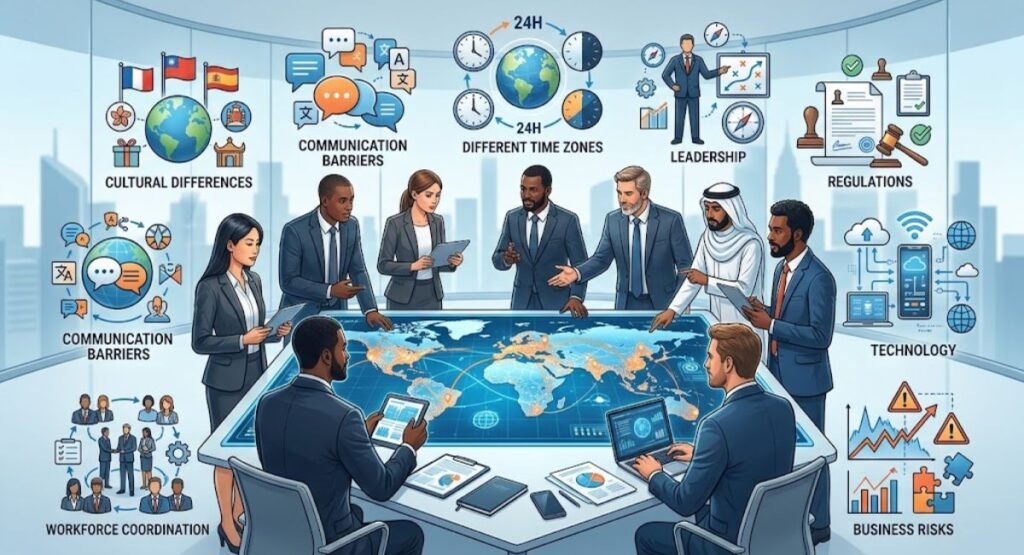
Common challenges include:
- Cultural differences: Employees and customers may have different expectations about communication, leadership, meetings, deadlines, and decision-making.
- Communication barriers: Language differences and different communication styles can create misunderstandings.
- Leadership complexity: Managers must coordinate people who may have different expectations of authority and collaboration.
- Regulatory differences: Employment, data, tax, reporting, and business requirements can vary between jurisdictions.
- Time-zone differences: Global teams may struggle to find suitable meeting times and maintain fast communication.
- Workforce management: Recruitment, training, performance management, and employee expectations can differ between locations.
- Strategic alignment: Local teams may prioritize regional needs while headquarters focuses on global objectives.
- Technology coordination: Different systems, infrastructure, and levels of digital adoption can make collaboration difficult.
- Risk and uncertainty: Economic, political, supply-chain, and market conditions can change the operating environment.
- Stakeholder expectations: Governments, customers, employees, suppliers, and investors may have different priorities.
These challenges rarely occur in isolation. A communication problem, for example, can affect leadership, employee engagement, project delivery, and strategic execution at the same time.
Key Elements of the Global Management Challenge Model
A practical model can be organized around several important areas.
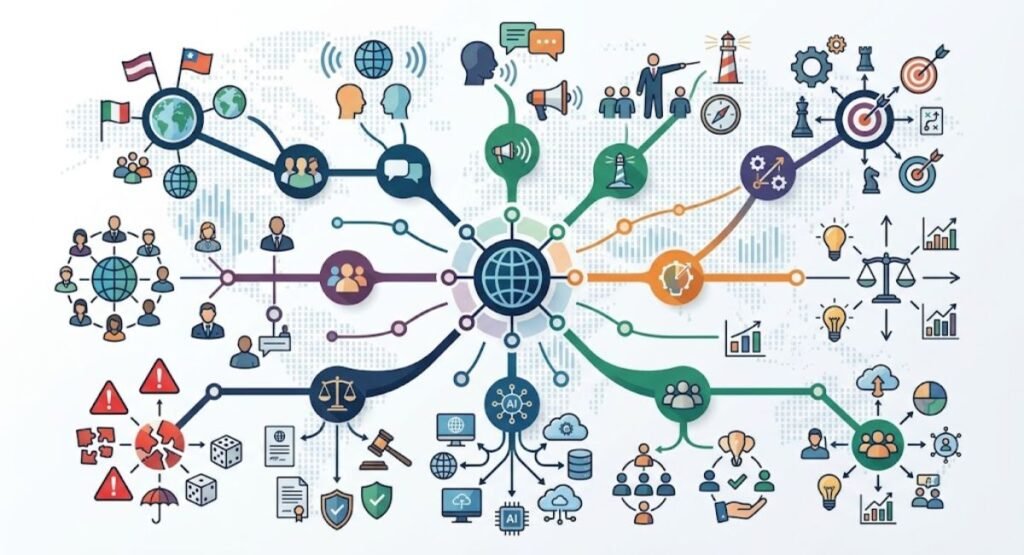
Cultural Differences
Culture influences how people communicate, negotiate, manage conflict, and interpret leadership behavior. A management style that works well in one environment may not produce the same result elsewhere.
Managers should learn about local expectations rather than assuming that one communication or leadership approach will work everywhere.
Communication
Clear communication is essential when teams work across borders. Language differences, time zones, technology, and different interpretations of messages can all create friction.
Managers can reduce these problems by establishing clear communication channels, documenting important decisions, and confirming responsibilities.
Leadership
Global leadership requires more than giving instructions. Leaders need to understand the needs of different teams while keeping everyone connected to common objectives.
Strong global leadership often involves listening, adaptability, cultural awareness, and consistent expectations.
Strategic Alignment
A global organization needs a shared direction. At the same time, local managers may need enough flexibility to respond to regional conditions.
A global organization needs a shared direction. At the same time, local managers may need enough flexibility to respond to regional conditions. The challenge is finding the right balance between central control and local decision-making. A well-prepared project information memorandum can also help decision-makers understand a project’s objectives, scope, risks, and key business considerations before making important decisions.
The challenge is finding the right balance between central control and local decision-making.
Decision-Making
Decision-making becomes more complex when information comes from different markets. Headquarters may have a broad view of the organization, while local managers may have better knowledge of customers and operational conditions in their region.
An effective approach defines which decisions should remain centralized and which should be delegated.
Workforce Management
Global organizations may employ people with different skills, expectations, employment conditions, and professional backgrounds.
Managers should therefore consider local workforce requirements when designing recruitment, training, performance, and development practices.
Legal and Regulatory Differences
Organizations operating internationally need to understand the rules that apply in each market. Policies created at headquarters may need adjustment before they can be implemented locally.
Managers should work with appropriate legal and compliance professionals rather than assuming that one country’s requirements apply everywhere.
Technology and Digital Coordination
Technology enables global collaboration but can also create challenges. Different platforms, cybersecurity requirements, data practices, and technical capabilities can make information sharing more difficult.
A consistent technology strategy combined with appropriate local requirements can improve coordination.
Risk and Uncertainty
Global operations can be affected by changing market conditions, supply disruptions, regulatory developments, and other uncertainties.
Managers should identify important risks, assess their potential effects, and develop practical response plans instead of reacting only after problems occur.
How the Global Management Challenge Model Works
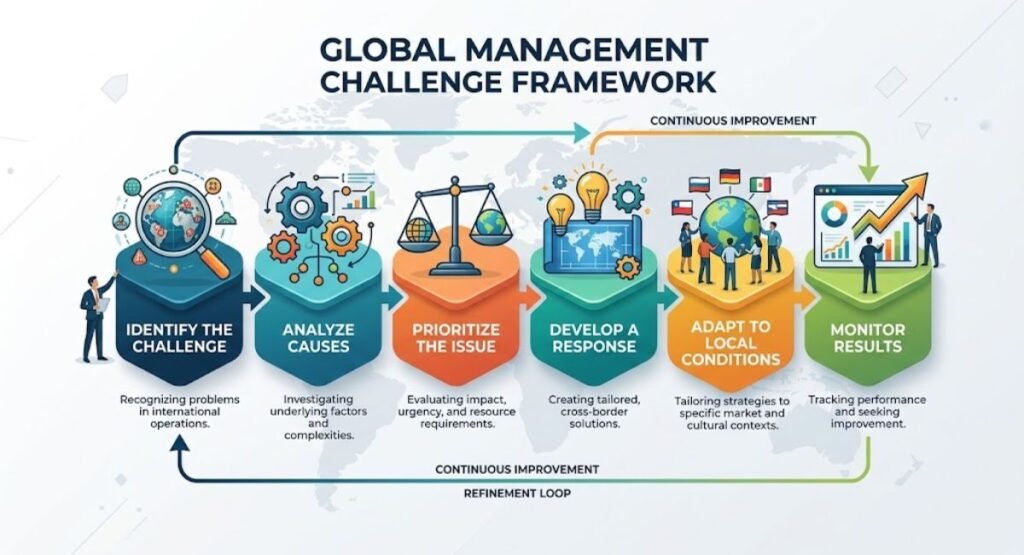
The model can be applied as a simple management process.
| Stage | Key Question | Management Action |
| Identify | What is the challenge? | Define the problem clearly |
| Analyze | Why is it happening? | Examine cultural, strategic, operational, and external factors |
| Prioritize | What matters most? | Assess impact and urgency |
| Respond | What should we do? | Select an appropriate solution |
| Adapt | What needs to change locally? | Adjust the approach to the market or team |
| Monitor | Is the response working? | Review results and make improvements |
1. Identify the Challenge
Start with a specific problem rather than a broad statement such as “global operations are difficult.”
For example, a manager might identify delayed decisions between a regional team and headquarters as the actual issue.
2. Analyze the Causes
Look beyond the visible problem. The delay could be caused by unclear authority, different working hours, missing information, or a lack of defined responsibilities.
3. Prioritize the Issue
Not every challenge requires the same level of attention. Managers should consider the potential effect on customers, employees, costs, operations, compliance, and strategic objectives.
4. Develop a Response
Choose a solution that addresses the actual cause. This could involve changing communication procedures, clarifying decision rights, improving training, or adapting a process for a particular market.
5. Adapt to Local Conditions
A global solution may require local adjustments. Managers should preserve essential organizational standards while allowing reasonable flexibility where local conditions require it.
6. Monitor and Improve
After implementation, managers should review whether the solution produced the intended result. If it did not, the process should be adjusted rather than treated as permanently successful.
Practical Example of the Model

Consider a hypothetical international technology company with teams in three countries.
The company notices that product decisions are taking too long. Headquarters believes regional teams are not responding quickly, while regional teams believe headquarters is making decisions without enough local information.
Using the model, management first identifies the specific problem: unclear decision ownership.
Next, the organization analyzes the causes. Different working hours, unclear approval responsibilities, and limited information sharing are contributing to delays.
The company then prioritizes decisions that genuinely require headquarters approval and delegates appropriate regional decisions to local managers.
It also introduces a shared documentation process so teams can see decisions, responsibilities, and deadlines in one place.
Finally, management reviews the process after implementation and adjusts it if delays continue.
This example shows why global management challenges should be examined systematically. The visible problem may be slow decision-making, but the underlying causes can involve communication, leadership, technology, and organizational structure.
Benefits of Using the Model
A structured approach to global management can help organizations:
- Identify the real causes of international management problems.
- Improve communication between headquarters and regional teams.
- Create clearer decision-making responsibilities.
- Balance global standards with local requirements.
- Recognize cultural and workforce differences earlier.
- Improve coordination across international teams.
- Make risk discussions more structured.
- Encourage continuous improvement.
- Help managers move from reactive problem-solving to planned responses.
The greatest value comes from using the framework as a thinking tool rather than treating it as a rigid formula.
Limitations and Challenges
The global management challenge model also has limitations.
First, global management problems are often interconnected. A simple framework cannot capture every political, cultural, economic, or organizational factor.
Second, local conditions can change quickly. A solution that works in one market may become unsuitable when regulations, customer behavior, or business conditions change.
Third, managers may oversimplify cultural differences. Treating everyone from a particular country as having identical preferences can create stereotypes rather than useful understanding.
Finally, the model does not replace professional judgment. Complex legal, financial, employment, cybersecurity, or compliance issues may require specialists with relevant local expertise.
Common Mistakes to Avoid
Managers should avoid several common mistakes when applying a global management framework:
Assuming One Management Style Works Everywhere
A successful approach in one country may need adjustment in another environment.
Ignoring Local Knowledge
Regional employees often understand local customers, suppliers, regulations, and business practices better than distant decision-makers.
Overcentralizing Decisions
Keeping every decision at headquarters can slow operations and reduce local responsiveness.
Overlocalizing Operations
The opposite problem can also occur when every region operates independently without enough alignment with the organization’s overall strategy.
Treating Communication as an Afterthought
Unclear communication can create delays, duplicated work, and unnecessary conflict.
Focusing Only on Short-Term Problems
Managers should also consider whether today’s solution creates a larger operational or strategic problem later.
How Managers Can Apply the Model Effectively
Managers can make the framework more useful by following a few practical principles.
Start with a clearly defined problem. Avoid broad descriptions that make it difficult to identify an appropriate response.
Listen to local teams. Their experience can reveal issues that may not be visible from headquarters.
Separate global requirements from local preferences. Some standards may need to remain consistent, while other practices can be adapted.
Clarify responsibilities. Teams should understand who makes decisions, who provides input, and who is responsible for implementation.
Document important decisions. Written records reduce confusion when teams operate across different locations and time zones.
Review outcomes regularly. A management response should be evaluated based on whether it actually improves the situation.
Use specialist support when necessary. Complex international legal, regulatory, financial, or technical issues should not be handled through a general management framework alone.
About the Author
Zain UL Abideen is an SEO specialist focused on creating useful, search-friendly content covering business, technology, digital insights, and practical management topics for Templorix.
Conclusion
The global management challenge model provides a useful way to understand and organize the complex problems that arise when businesses operate across countries and cultures. By examining communication, leadership, strategy, workforce management, technology, regulation, risk, and local conditions, managers can move beyond surface-level problems and identify the factors that are actually affecting performance.
The most effective use of the model is flexible rather than rigid. Managers should combine a shared global direction with appropriate local knowledge and judgment. When organizations regularly identify challenges, analyze their causes, implement practical responses, and review the results, they are better positioned to manage international operations in a clear and consistent way..
(FAQs)
What is the global management challenge model?
The global management challenge model is a practical framework for identifying, analyzing, responding to, and monitoring challenges faced by organizations operating across different countries.
Why is global management challenging?
Global management is challenging because organizations must coordinate people, strategies, operations, and decisions across different cultural, regulatory, technological, and market environments.
What are the key elements of global management?
Key elements include cultural awareness, communication, leadership, strategic alignment, decision-making, workforce management, technology, risk management, and stakeholder coordination.
How can managers use the model?
Managers can use the model by identifying a specific challenge, analyzing its causes, selecting a response, adapting it to local conditions, and monitoring the results.
What are the limitations of the model?
The model provides a structured way to think about global challenges but cannot replace local knowledge, professional expertise, or managerial judgment.