
When a company is thinking about buying something, starting a project, or hiring a supplier, one of the first questions is usually about cost.
The problem is that the final price may not be available yet.
The specifications may still be changing. Delivery requirements may be unclear. In some cases, the project itself is still waiting for approval.
This is where a budgetary quote can be useful.
A budgetary quote gives a buyer an early idea of what a product, service, or project could cost. It is mainly used for planning rather than treating the quoted amount as the final purchasing price.
In this guide, we will look at what a budgetary quote means, how it works, what it normally contains, and how it differs from an estimate or formal quotation.
What Is a Budgetary Quote?

A budgetary quote is an initial price indication provided by a supplier, contractor, manufacturer, or service provider.
For example, imagine a company wants to install new equipment in its production facility. The company knows the type of equipment it needs, but the exact model, quantity, installation requirements, and delivery schedule have not been confirmed.
Instead of waiting until every detail is finalized, the company may ask suppliers for preliminary pricing.
The supplier can then provide a budgetary quote based on the information available at that time.
The price may change later if the requirements change.
That is why a budgetary quote should normally be viewed as a planning figure, not automatically as the final price.
Budgetary Quote Meaning in Simple English
The simplest way to understand a budgetary quote is:
It tells you approximately how much something may cost before all the details are finalized.
Suppose a business is considering a $100,000 project but does not know whether the actual cost will be closer to $80,000 or $150,000.
It could approach suppliers and request preliminary pricing.
The responses can help the business decide whether the project fits within its expected budget.
A budgetary quote can therefore answer an early planning question:
“Do we have a reasonable idea of what this project might cost?”
It does not necessarily answer:
“What exact amount will we pay under the final contract?”
That distinction is important.
Why Do Businesses Use Budgetary Quotes?
Businesses often need pricing information before they are ready to place an order.
A budgetary quote can help fill that gap.
Early Budget Planning
A company can use preliminary supplier pricing when preparing an initial project budget.
Instead of choosing an arbitrary figure, the business can base its planning on information received from potential suppliers.
Project Feasibility
Sometimes the first question is not whether a project can be purchased, but whether it makes financial sense to continue planning it.
For larger projects, this early financial planning can also be supported by a project information memorandum, which brings project scope, financial requirements, risks, and other key information together for stakeholders.
A preliminary price can help answer that question.
If the expected cost is far above the available budget, the business may decide to change the scope or reconsider the project.
Internal Approval
Managers and finance teams may need an approximate cost before approving further project development.
A budgetary quote can provide supporting information for that discussion.
Supplier Discussions
Early pricing can also help buyers understand what suppliers can potentially provide within a particular budget.
Comparing Different Options
A company may be considering several solutions.
For example, it might compare two types of equipment or two different service packages.
Preliminary supplier pricing can help the company understand the broad cost difference between those options.
What Does a Budgetary Quote Usually Include?
There is no single format that every supplier must follow.
The information included depends on the industry, supplier, project, and level of detail available.
A budgetary quote may contain:
| Information | Purpose |
| Product or service description | Explains what is being priced |
| Estimated quantity | Shows the basis for the calculation |
| Preliminary price | Gives an initial cost indication |
| Currency | Identifies the monetary basis |
| Assumptions | Explains conditions used to prepare the price |
| Exclusions | Shows what is not included |
| Delivery information | Gives an indication of expected timing |
| Validity period | Indicates how long the pricing may remain relevant |
| Taxes or other charges | Clarifies additional costs |
| Scope of work | Defines what the preliminary figure covers |
Not every budgetary quote will contain all of these items.
The important thing is to understand how the supplier arrived at the figure.
A price without its assumptions can be difficult to use properly.
How Does a Budgetary Quote Work?
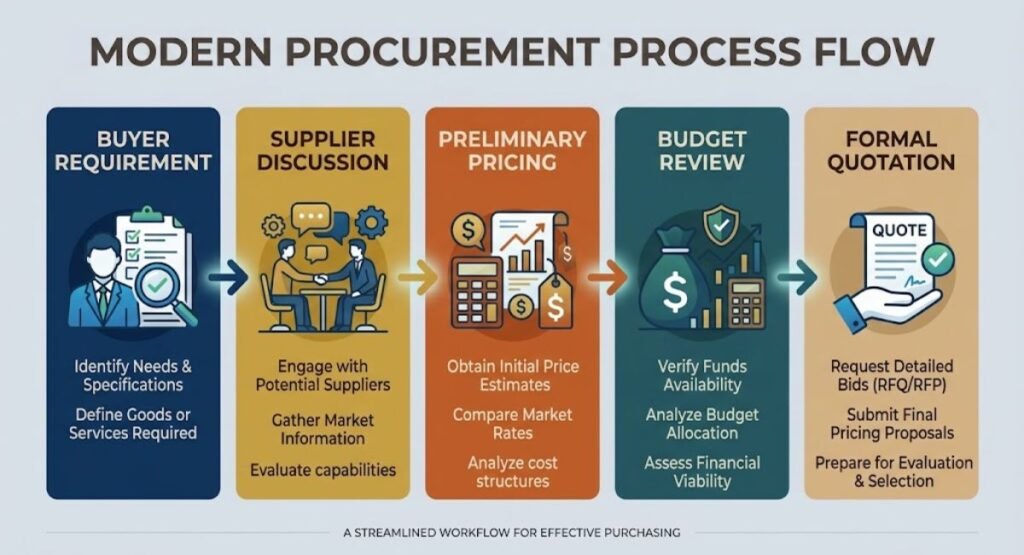
The process is usually straightforward.
First, the buyer explains what they are considering.
The supplier then prepares an initial price.
The buyer reviews that figure and decides what to do next.
A typical process might look like this:
Initial requirement → Supplier discussion → Preliminary pricing → Budget review → Scope refinement → Formal quotation
The process can vary between industries.
Construction project, the supplier may need information about the site and proposed work.
Equipment, technical specifications may be more important.
Professional services, the supplier may need an idea of the expected workload, project duration, and required expertise.
The more information available, the more useful the preliminary pricing may become.
When organizations compare supplier pricing and project costs, basic data analysis can also help them organize and interpret the information more effectively; practical business intelligence exercises can provide useful experience with business data and reporting.
Budgetary Quote vs. Formal Quote
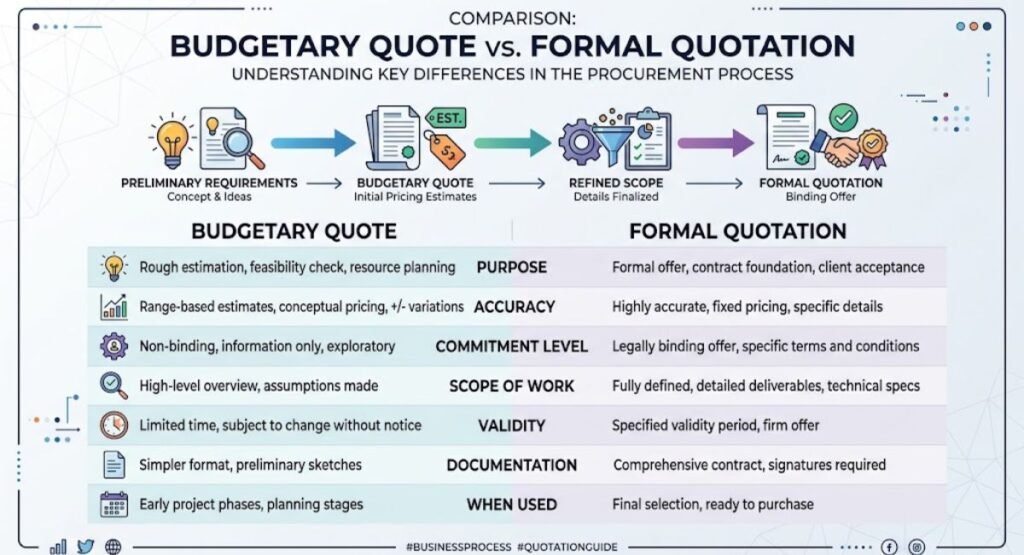
A budgetary quote and a formal quotation can look similar, but they usually serve different purposes.
| Feature | Budgetary Quote | Formal Quote |
| Main purpose | Early planning | Detailed purchasing |
| Project stage | Early | More developed |
| Scope | May still change | Usually more clearly defined |
| Pricing | Preliminary | More specific |
| Assumptions | Often more significant | Usually more clearly documented |
| Buyer decision | Helps with planning | Can support a purchasing decision |
| Final commitment | Not automatically implied | Depends on the quotation and applicable terms |
The biggest difference is the stage at which the document is used.
A budgetary quote is commonly requested while a project is still being developed.
A formal quote is normally associated with a more clearly defined requirement.
However, the exact meaning and legal effect of a quotation depend on its wording and the circumstances in which it is issued and accepted.
A document should therefore be reviewed on its actual terms rather than relying only on the title.
Budgetary Quote vs. Estimate
The terms budgetary quote and estimate are sometimes used interchangeably, but they can describe different things.
An estimate is generally an approximation of expected cost.
When a business needs to present a structured financial proposal for a valuation assignment, a valuation proposal can define the scope, methodology, fees, assumptions, and expected deliverables before the work begins.
A budgetary quote usually comes from an external supplier or contractor and gives the buyer an early indication of what that supplier may charge.
For example:
- A project manager may prepare an internal cost estimate.
- A contractor may provide a budgetary quote.
- A procurement team may collect preliminary prices from several vendors.
- A finance team may use these figures when preparing a project budget.
The terminology is not identical across every business or industry.
For that reason, it is better to look at the purpose, assumptions, scope, and conditions of the document instead of relying only on its name.
When Should You Request a Budgetary Quote?

You may want to request a budgetary quote when you need pricing, but the project is not ready for a final quotation.
Common situations include:
- A project is still being considered.
- The specifications are incomplete.
- Management needs an initial cost.
- A preliminary business case is being prepared.
- You need to check whether the project fits the budget.
- You are comparing different solutions.
- Supplier discussions are still at an early stage.
- The final request for quotation has not been prepared.
For example, a company planning a new warehouse may know the approximate size and purpose of the building but may not yet have completed its final design.
It could ask contractors for preliminary pricing to understand the possible financial scale of the project.
Later, once the drawings, specifications, quantities, and other requirements are finalized, the company can move toward a more detailed quotation process.
How to Request a Budgetary Quote
You do not always need a complete procurement package to request preliminary pricing.
However, giving the supplier useful information can make the response more meaningful.
Explain What You Need
Start with a clear description of the product, service, or project.
Avoid vague requests such as “Please give us a price.”
Instead, explain what you are considering and what you already know.
Provide Estimated Quantities
If you expect to purchase 20 units, mention that.
If the quantity is uncertain, provide a reasonable range or explain that it is still being finalized.
Share Available Specifications
This might include:
- Size
- Capacity
- Material
- Performance requirements
- Product type
- Service requirements
- Installation needs
Mention the Location
Location can matter for projects involving installation, construction, transportation, or on-site services.
Explain the Expected Timeline
Tell the supplier when you expect the project or purchase to take place.
Ask About Assumptions
Ask the supplier to identify the assumptions used to prepare the price.
This can prevent misunderstandings later.
Ask About Exclusions
Find out what is not included.
For example, installation, transportation, taxes, engineering, testing, or permits may be handled separately.
What Can Cause a Budgetary Quote to Change?
A preliminary price is based on information available at a particular point in time.
If that information changes, the price may change too.
Changes in Scope
Adding more work or removing part of the project can affect the cost.
Changes in Quantity
The price for 100 units may not be the same as the price for 500 units.
Technical Changes
A different material, model, capacity, or specification can result in different pricing.
Delivery Requirements
Special delivery arrangements or changes in the expected schedule may affect the final amount.
Site Conditions
For construction and installation work, conditions at the actual site may differ from the assumptions used during early planning.
Taxes and Additional Charges
Taxes, duties, transportation, installation, and other charges may need to be considered separately.
Market Changes
Supplier costs, materials, transportation, currency exchange rates, and other commercial factors can change over time.
For these reasons, a buyer should avoid treating an old preliminary price as a guaranteed current price.
Advantages of a Budgetary Quote
A well-prepared budgetary quote can be useful during the early stages of a project.
It Supports Early Planning
The buyer gets a more realistic starting point for the project budget.
It Can Highlight Financial Problems Early
If preliminary pricing is much higher than expected, the company can identify the issue before spending heavily on detailed planning.
It Helps Refine Scope
The buyer may decide to remove unnecessary features or change specifications to stay within budget.
It Supports Internal Discussions
Managers can discuss a project using an initial supplier figure rather than relying entirely on assumptions.
It Helps With Supplier Evaluation
Preliminary pricing can provide useful information when comparing broad approaches or solutions.
Limitations of a Budgetary Quote
A budgetary quote is useful, but it should not be treated as perfect pricing.
The Final Cost May Be Different
The actual price may change once requirements are finalized.
Some Costs May Be Excluded
The headline number may not include every cost associated with the project.
Assumptions May Become Outdated
A quote prepared using one set of requirements may no longer apply after the scope changes.
It May Not Be Suitable for Final Purchasing
When a project is ready to proceed, the organization may need a formal quotation or another type of commercial documentation.
The buyer should always check the supplier’s terms and the organization’s procurement requirements.
Practical Budgetary Quote Example

Consider a company that wants to upgrade its meeting rooms.
The company knows it needs:
- New conference tables
- Office chairs
- Video-conferencing equipment
- Improved lighting
- Installation services
However, the company has not yet selected the exact equipment models or final room layouts.
The company contacts several suppliers and explains its preliminary requirements.
One supplier provides a budgetary quote of $40,000 based on the information supplied.
The supplier also explains that the figure is preliminary and may change after the company confirms the equipment, quantities, installation requirements, and final scope.
The company can now use the $40,000 figure for early planning.
It can ask:
- Does the project fit the available budget?
- Should the specifications be changed?
- Which requirements need to be finalized?
- Are there important excluded costs?
- Is a formal quotation the next step?
The $40,000 figure in this example is purely illustrative and is not a market-price claim.
What Should You Check Before Using a Budgetary Quote?
Before adding a preliminary quote to a project budget, take a few minutes to review the details.
1. Read the Assumptions
Find out what the supplier assumed when preparing the figure.
2. Look for Exclusions
Check whether delivery, installation, taxes, engineering, testing, or other costs are excluded.
3. Confirm the Quantity
Make sure the supplier used the correct estimated quantity.
4. Review the Scope
Ask whether everything you expect to receive is actually included.
5. Check the Date
A price prepared several months ago may need to be reconfirmed.
6. Check the Currency
This is especially important when dealing with overseas suppliers.
7. Read the Conditions
Look for statements explaining that the price is preliminary, subject to confirmation, or dependent on additional information.
These checks can make a preliminary quote much more useful for planning.
Common Mistakes When Using Budgetary Quotes
Mistake 1: Treating It as the Final Price
A preliminary figure can change.
Mistake 2: Looking Only at the Total
Two suppliers may give different totals because their scopes and assumptions are different.
Mistake 3: Ignoring Exclusions
An inexpensive-looking quote may leave out important project costs.
Mistake 4: Giving the Supplier Too Little Information
Poor requirements can lead to pricing that does not reflect the actual need.
Mistake 5: Forgetting to Update the Budget
If the scope changes, the original budgetary figure should be reviewed.
Mistake 6: Assuming Every Quote Has the Same Legal Meaning
The title of a document does not tell you everything about its contractual effect.
How to Make a Budgetary Quote More Useful
A good preliminary quote is easier to use when both sides understand what is being priced.
A buyer can improve the process by:
- Clearly describing the requirement.
- Providing the information already available.
- Separating confirmed requirements from assumptions.
- Asking suppliers to identify exclusions.
- Recording the date of the pricing.
- Keeping supplier responses for comparison.
- Updating the budget when the scope changes.
- Requesting formal pricing when the project is ready.
This approach reduces confusion when the project moves from an early idea to an actual purchasing decision.
About the Author
Zain UL Abideen is a professional content writer and researcher covering business, technology, project management, procurement, and practical industry topics. Their focus is on turning complex subjects into clear and useful information for everyday readers and professionals.
Conclusion
A budgetary quote is useful when a business needs an early understanding of potential costs. It can help with project budgets, feasibility discussions, internal approvals, supplier conversations, and decisions about whether a project should move forward.
The main point is to understand what the figure actually represents. A preliminary quote is based on the information and assumptions available at the time, so it should be reviewed carefully before being treated as a final purchasing price. Once the scope and requirements are confirmed, a more detailed quotation may be appropriate.
(FAQs)
What is a budgetary quote?
A budgetary quote is preliminary pricing that gives a buyer an early indication of the possible cost of a product, service, or project.
Is a budgetary quote the same as a formal quotation?
No, a budgetary quote is generally used for early planning, while a formal quotation is normally prepared for a more clearly defined purchasing requirement.
Can the price in a budgetary quote change?
Yes, the price can change when the scope, specifications, quantities, market conditions, or other assumptions change.
Is a budgetary quote legally binding?
Not necessarily, because the legal effect depends on the document’s wording, applicable law, and the circumstances of the transaction.
When should I ask for a budgetary quote?
You can request one when you need preliminary pricing for budgeting or feasibility purposes, but your final requirements are not ready.