
Employee benefit trusts are arrangements that can give employers a structured way to provide certain benefits or incentives to employees. They involve a trust, trustees, assets, and beneficiaries, with the precise structure determined by the trust deed and applicable law.
The term can cover several different arrangements. HMRC describes employee benefit trusts (EBTs) as generally discretionary trusts that employers may use to reward or motivate employees, with potential benefits including bonuses, shares, pensions and other forms of support.
This guide explains how these trusts work, their possible uses, their differences from employee ownership trusts, and the main issues employers should consider.
What Is an Employee Benefit Trust?

A trust separates the legal ownership and beneficial interest in property. The trustees normally hold and manage trust property for beneficiaries according to the trust’s governing documents.
The main terms are:
- Employee benefit trust: A trust arrangement designed to provide specified employee-related benefits.
- Trust: A legal arrangement in which trustees hold property for beneficiaries.
- Employer: The company or organization establishing or sponsoring the arrangement.
- Trustee: The person or entity responsible for managing trust assets according to the trust deed and applicable law.
- Beneficiary: A person who may receive a benefit from the trust under its terms.
- Trust deed: The governing document that establishes the trust and defines its powers, purposes, and beneficiaries.
How Does an Employee Benefit Trust Work?

Although structures differ, the basic process can be understood through several steps:
- The employer establishes the trust: The employer creates the trust under an appropriate legal structure.
- Trustees are appointed: Trustees take responsibility for administering the trust.
- The trust is funded: The employer may transfer money, shares, or other assets, depending on the arrangement.
- Trustees manage the assets: Trustees act within the powers and restrictions set out in the trust deed.
- Employees become potential beneficiaries: The trust documents determine who may receive benefits.
- Benefits are provided: Trustees make permitted payments, transfers or other benefits in accordance with the arrangement.
Who Is Involved in an Employee Benefit Trust?
Several parties can have different responsibilities within an EBT.
| Party | Role |
| Employer | Establishes or sponsors the arrangement and may provide funding. |
| Trustees | Hold and administer trust property according to the governing documents. |
| Employees | May qualify as beneficiaries under the trust’s terms. |
| Directors | May be included depending on the structure and applicable rules. |
| Professional advisers | May provide legal, tax, accounting or governance advice. |
Do not confuse the responsibilities of trustees with those of the employer.
What Benefits Can an Employee Benefit Trust Provide?

The purpose of an EBT depends on its structure and governing documents. Possible uses can include:
Employee-related programmes can also support professional development and structured assessment; see our guide to the Competence Assessment Programme for more information.
- Employee bonuses: Providing specified bonus payments where permitted.
- Incentive arrangements: Supporting structured employee reward arrangements.
- Share-related benefits: Holding or transferring shares or securities for employee-related purposes.
- Healthcare support: Certain arrangements may provide medical or health-related benefits.
- Education assistance: A trust may be structured to support specified educational needs.
- Welfare support: Some arrangements can provide assistance for defined employee welfare purposes.
- Employment-related payments: Certain payments may be made where permitted by the arrangement and applicable law.
HMRC identifies general employee benefit trusts as arrangements that can provide benefits such as bonuses, sick pay, medical expenses and education, while separate types of employment-related trusts can cover retirement and share schemes.
The availability and tax treatment of any particular benefit depend on the trust deed and the law applicable to the arrangement.
Common Types of Employee Benefit Trust Arrangements
There is no single structure that applies to every employee benefit trust.
| Type | Main Purpose | Typical Focus |
| General EBT | Employee-related benefits | Bonuses and welfare |
| Employee share trust | Share-related benefits | Employee share arrangements |
| Retirement-related trust | Retirement benefits | Post-employment benefits |
| Employee Ownership Trust | Employee ownership | Holding company shares for employees |
HMRC identifies general employee benefit trusts, retirement benefit scheme trusts and employee share scheme trusts as different categories of employment-related trust arrangements.
It is important not to assume that all of these structures have identical legal or tax consequences.
Employee Benefit Trust Example
Consider a fictional company that wants to create a formal structure for certain employee benefits.
The company establishes an EBT and appoints trustees. It transfers funds to the trust under the arrangement’s terms.
The basic flow is:
Employer → Trust funding → Trustees manage assets → Eligible employees receive permitted benefits
What Are the Main Advantages of an Employee Benefit Trust?
An EBT can provide a formal structure for certain employee-related objectives.
- Employee incentives: It can support structured reward arrangements.
- Long-term planning: It can help organize certain employee benefits over time.
- Share ownership: Some arrangements can support employee share incentives.
- Benefit administration: Trustees can administer assets according to defined rules.
- Employee support: Certain structures may be designed around welfare or other permitted benefits.
These are potential purposes rather than guaranteed outcomes. An EBT does not automatically improve employee retention, productivity or business performance.
The actual value of an arrangement depends on its objectives, design, governance and compliance with applicable requirements.
What Are the Potential Challenges?
EBTs can involve significant administration and professional responsibilities.
Common considerations include:
- Legal complexity: Trust structures require appropriate documentation and governance.
- Trustee responsibilities: Trustees have duties relating to trust assets and beneficiaries.
- Administration costs: Professional and ongoing administration can create expenses.
- Tax compliance: Payments and transactions can create tax obligations.
- Accounting treatment: The accounting depends on the arrangement and applicable reporting framework.
- Reporting requirements: Certain structures may require specific records or disclosures.
- Trust documentation: The trust deed must accurately reflect the intended arrangement.
- Regulatory changes: Tax and employment rules can change over time.
- Jurisdictional differences: Rules in one country may not apply elsewhere.
Tax Considerations for Employee Benefit Trusts
Tax treatment is one of the most important areas to investigate before establishing an EBT.
There is no universal EBT tax rule because the consequences depend on factors such as:
- The country involved.
- The trust’s legal structure.
- The identity of the beneficiaries.
- The type of assets transferred.
- Whether employees or directors receive payments.
- Applicable anti-avoidance provisions.
For example, UK rules contain specific provisions governing EBTs, including rules concerning employer contributions and the taxation of benefits. HMRC guidance states that deductions for employer contributions depend on conditions including the nature and purpose of the expenditure and specific anti-avoidance legislation.
UK readers should also be aware that tax treatment can arise when value leaves an EBT or when employees receive benefits. HMRC guidance discusses circumstances in which payments or transfers from EBTs can create employment-related tax consequences.
Accounting Treatment of Employee Benefit Trusts
Accounting treatment depends on the type of arrangement, the applicable accounting framework and the relationship between the sponsoring organization and the trust.
Important areas can include:
- Recognition: Determining which assets, liabilities, expenses or transactions need recognition.
- Control: Assessing whether the sponsoring entity controls the trust.
- Trust assets: Understanding how assets held by the trust are treated.
- Trust liabilities: Considering obligations associated with the arrangement.
- Employee benefit expenses: Determining when employee-related costs are recognized.
- Financial statement presentation: Applying the appropriate presentation and disclosure requirements.
Under IFRS, IAS 19 Employee Benefits covers employee benefits generally, except share-based payments, which fall within IFRS 2.
The IFRS Foundation has also considered employee benefit trusts used in connection with share-based payment arrangements and noted that different trust structures can raise different accounting questions.
For UK entities using FRS 102, ICAEW guidance similarly emphasizes the importance of identifying the type of employee share trust and determining whether the entity has control of the trust.
Therefore, businesses should not assume that one accounting treatment applies to every EBT.
Employee Benefit Trust vs Employee Ownership Trust
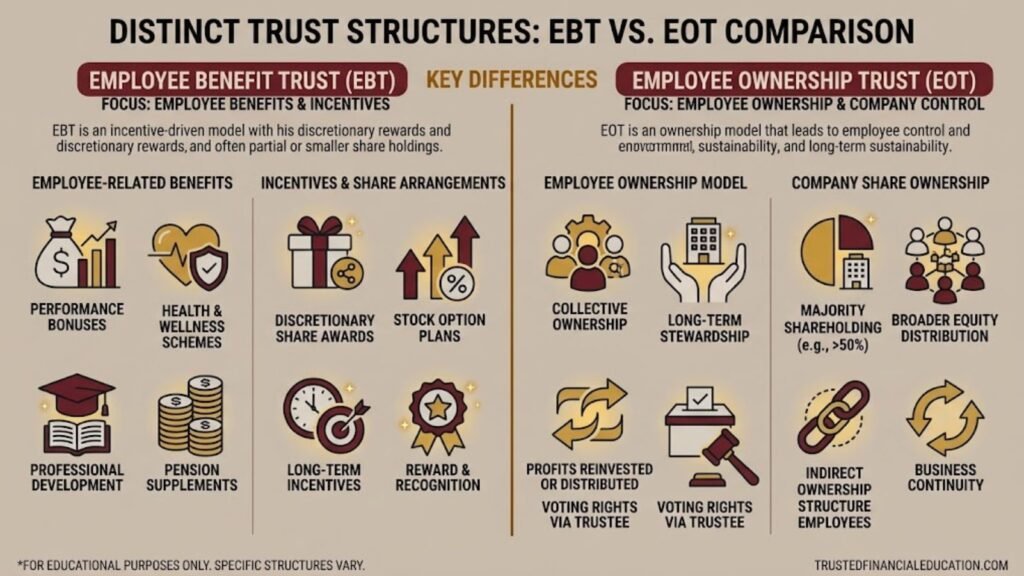
An Employee Ownership Trust (EOT) has a more specific purpose than the broad category of employee benefit trusts.
HMRC describes an EOT as a trust designed to encourage employee ownership of the company and notes that it is a type of EBT, although EOT requirements are different and more specific.
| Feature | Employee Benefit Trust | Employee Ownership Trust |
| Main purpose | Employee-related benefits | Employee ownership |
| Share ownership | May or may not involve shares | Central to the structure |
| Beneficiaries | Depends on trust deed | Generally structured around employees |
| Structure | Depends on arrangement | Specific employee-ownership requirements |
| Legal/tax treatment | Depends on jurisdiction | Depends on jurisdiction and qualifying requirements |
What Should Employers Consider Before Setting Up an EBT?

Before establishing an arrangement, employers should review several areas.
Before establishing an arrangement, employers should review several areas. This is particularly important for organizations operating across multiple markets, where global management and workforce challenges can affect employee policies, communication, governance, and decision-making.
1. Purpose
Define exactly what the trust is intended to achieve.
2. Eligible Beneficiaries
Determine which employees or other people may benefit.
3. Trust Deed
Ensure the governing document clearly defines the trust’s purpose, powers, and beneficiaries.
4. Trustee Selection
Choose appropriate trustees and understand their responsibilities.
5. Funding
Determine what assets will be transferred and how the arrangement will be funded.
When an organization is evaluating a major business arrangement, documenting its purpose, financial considerations, and key information can help support informed decision-making; a Project Information Memorandum provides a useful example of this type of structured business documentation.
6. Tax Treatment
Obtain professional advice about contributions, distributions, and employee taxation.
7. Accounting Treatment
Determine how the arrangement should be reflected under the applicable accounting framework.
8. Governance
Establish appropriate processes for decision-making, records and administration.
9. Reporting
Identify applicable tax, financial and regulatory reporting obligations.
10. Professional Advice
Use qualified legal, tax and accounting advisers where the structure requires specialist analysis.
11. Exit or Winding-Up
Consider what happens to trust assets if the arrangement ends or its purpose changes.
About the Author
Zain UL Abideen is an SEO specialist and digital content professional focused on creating clear, research-based resources covering technology, business, digital trends and professional topics. Through Templorix, he aims to make complex subjects easier to understand through practical, well-structured and reader-focused content.
Conclusion
Employee benefit trusts can provide a formal structure for managing certain employee-related benefits, incentives and share arrangements. Their operation depends on the trust deed, trustees, beneficiaries, assets and applicable legal requirements.
Because EBTs can involve tax, accounting, legal and governance considerations, employers should carefully review the relevant rules before establishing one.
(FAQs)
What is an employee benefit trust?
An employee benefit trust is generally a trust established to hold and administer assets for specified employee-related benefits.
Who can benefit from an employee benefit trust?
Eligible employees, and in some arrangements directors or other beneficiaries, may benefit according to the trust deed and applicable law.
How does an employee benefit trust work?
An employer funds a trust, trustees manage its assets, and permitted benefits are provided to eligible beneficiaries under the governing rules.
Are employee benefit trusts tax-free?
No, tax treatment depends on the jurisdiction, structure, transactions, and benefits involved.
Is an employee benefit trust the same as an employee ownership trust?
No, an EOT is a specific employee-ownership structure and should not automatically be treated as the same as every EBT.