
Artificial intelligence can process large amounts of information, identify patterns, and support business decisions, but useful AI output depends heavily on context. Without a clear understanding of business goals, customers, operations, risks, and priorities, even technically capable AI systems can produce information that is difficult to use strategically.
AI Business Context Strategic Visibility Medium Explained describe the connection between business information, AI-assisted analysis, and the ability of decision-makers to understand what is happening across an organization. When these elements work together, businesses can move from simply collecting information to developing clearer insights for planning and action.
This guide explains how business context influences AI, what strategic visibility means, how AI can support it, and what organizations should consider before relying on AI for important decisions.
What Does AI Business Context Mean?
AI business context refers to the business information and circumstances that help an AI system interpret a problem correctly.
This context can include:
- Business objectives
- Customer requirements
- Market conditions
- Operational information
- Financial considerations
- Organizational priorities
- Risk factors
- Available resources
- Historical data
- Industry conditions
For example, asking an AI system to analyze declining sales without providing information about the relevant products, market, customer segments, pricing changes, or time period can lead to an incomplete analysis.
Context gives information meaning.
A sales decline may indicate a product problem, seasonal demand, pricing changes, increased competition, supply constraints, or changes in customer behavior. AI can help analyze these possibilities, but the quality of the analysis depends on the information and context available.
What Is Strategic Visibility?
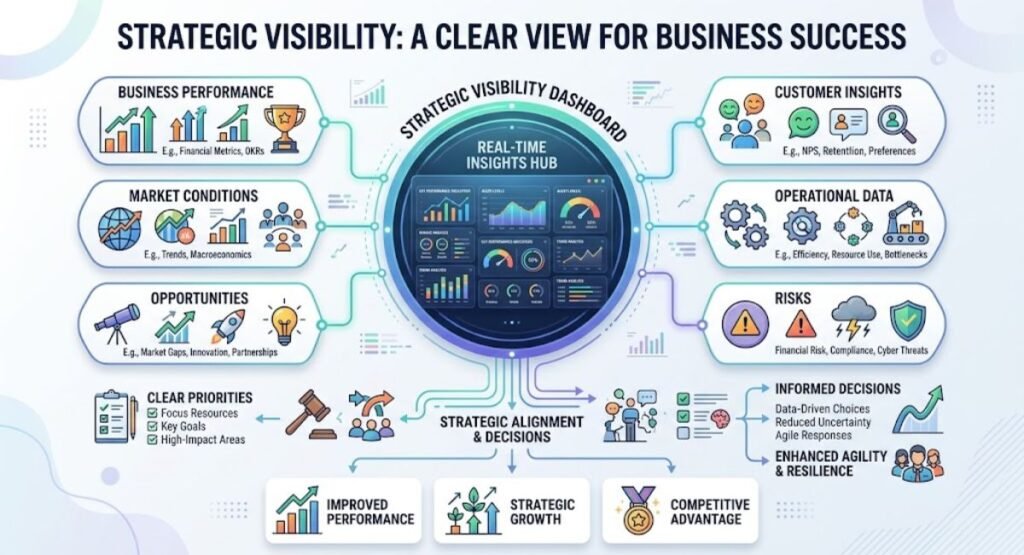
Strategic visibility is the ability of decision-makers to understand important business conditions well enough to identify priorities, risks, opportunities, and potential actions.
It is more than having access to data.
A business may have dashboards, reports, spreadsheets, customer information, and operational systems but still lack clear strategic visibility if decision-makers cannot connect those pieces of information.
Strategic visibility helps answer questions such as:
- What is happening?
- Why is it happening?
- Which issues matter most?
- What could happen next?
- Where are the biggest risks?
- Which opportunities deserve attention?
- What action should management consider?
The goal is not simply to produce more information. The goal is to make important information easier to understand and use.
How AI Connects Business Context With Strategic Visibility
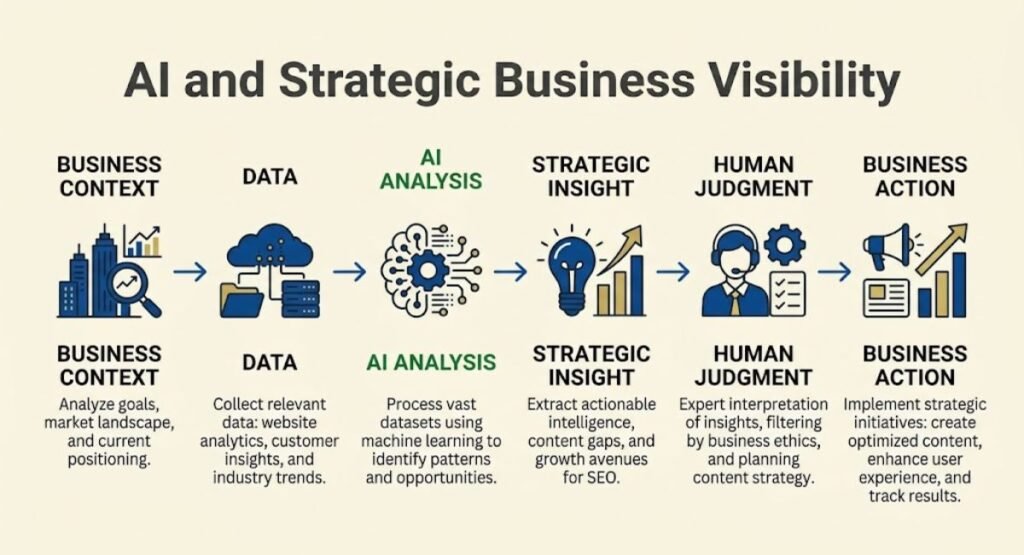
AI can act as an analytical layer between business information and decision-making.
A simplified process looks like this:
Business Context → Data → AI Analysis → Strategic Insight → Human Judgment → Business Action
Each stage has an important role.
1. Business Context
The organization defines the problem, objective, constraints, and surrounding circumstances.
2. Data
Relevant information is collected from appropriate business sources.
3. AI Analysis
AI can help identify patterns, summarize information, classify data, compare scenarios, or highlight relationships.
4. Strategic Insight
The analysis is interpreted in relation to business objectives.
5. Human Judgment
Business leaders assess whether the insight is reliable, relevant, and appropriate for the situation.
6. Business Action
The organization decides what to do based on the available evidence and strategic priorities.
This distinction is important because AI analysis and business decision-making are not the same thing.
Why Business Context Matters When Using AI
AI systems can process information efficiently, but context determines whether the resulting information is useful for a particular business situation.
Consider two companies asking an AI system to analyze customer churn.
The first company may be concerned about subscription cancellations caused by pricing changes.
The second may be investigating churn caused by customer-service problems.
The general topic is the same, but the business context is different. The questions, relevant data, analytical approach, and potential actions may therefore also differ.
Context Improves Relevance
Relevant context helps AI focus on the actual business problem rather than producing a generic explanation.
Context Supports Better Interpretation
The same data point can have different meanings depending on business circumstances.
Context Reduces Unnecessary Analysis
A clearly defined objective can help narrow the information that matters.
Context Connects Insights to Decisions
Business leaders need information that relates to actual priorities rather than isolated observations.
How AI Can Improve Strategic Visibility

AI can support strategic visibility in several ways.
Data Summarization
Organizations often work with large volumes of reports, documents, customer feedback, operational records, and other information.
AI-assisted analysis can also complement business intelligence exercises by helping teams understand patterns, organize information, and turn business data into useful insights.
AI can help summarize large amounts of material so decision-makers can identify important themes more quickly.
Pattern Identification
AI can analyze information for recurring patterns or relationships that may require further investigation.
For example, an organization could use AI-assisted analysis to identify changes in customer behavior across different periods or segments.
Scenario Analysis
AI can help organize different assumptions and possible scenarios.
However, scenario analysis should not be treated as a prediction of what will definitely happen. It is more useful as a structured way to consider possible outcomes.
Risk Visibility
AI can help surface information associated with operational, financial, customer, or strategic risks.
AI can help surface information associated with operational, financial, customer, or strategic risks. Organizations can then use structured approaches such as composite risk management to assess and respond to identified risks.
Human review remains important because an identified signal does not automatically represent a confirmed risk.
Management Reporting
AI can assist with turning complex information into clearer summaries for management discussions.
This can reduce the amount of time spent manually organizing information and allow more attention to be given to interpretation.
AI Business Context and Decision-Making

Good strategic visibility does not mean allowing AI to make every important decision.
Instead, AI can support decision-makers by helping them understand information more efficiently.
A useful distinction is:
| AI Contribution | Human Contribution |
| Process information | Define business priorities |
| Identify patterns | Interpret business significance |
| Summarize information | Evaluate evidence |
| Compare scenarios | Consider organizational constraints |
| Highlight potential risks | Decide how risks should be managed |
| Generate analytical possibilities | Make accountable decisions |
This division helps organizations use AI as decision support rather than treating it as an unquestionable source of truth.
Practical Business Use Cases
The relationship between AI, business context, and strategic visibility can appear across different functions.
Strategic Planning
AI can help organize market information, summarize internal reports, and compare strategic considerations.
Business leaders can then use those insights when evaluating strategic priorities.
Customer Analysis
AI can analyze customer feedback, support conversations, surveys, or other relevant information to identify recurring themes.
The organization still needs to determine which themes matter strategically.
Competitive Analysis
AI can assist with organizing publicly available business information and identifying areas that may require deeper analysis.
The quality of the result depends on the quality, relevance, and freshness of the underlying information.
Operational Management
AI can help identify recurring operational patterns and summarize performance information.
This can make it easier to identify areas requiring human investigation.
Risk Management
AI-assisted analysis can help organize risk-related information and highlight patterns for review.
Risk teams should validate important findings before using them for consequential decisions.
Executive Reporting
AI can help convert large volumes of business information into concise management summaries.
The final report should still be reviewed for accuracy, context, and relevance.
Strategic Visibility Requires More Than More Data
One common mistake is assuming that better strategic visibility simply requires collecting more information.
In reality, excessive information can make decision-making harder.
A useful strategic visibility system should help answer:
- Which information matters?
- Why does it matter?
- How reliable is it?
- What business objective does it relate to?
- What requires further investigation?
- What decisions could be affected?
The objective should therefore be relevant visibility, not unlimited information.
A Practical Framework for AI-Driven Strategic Visibility

Businesses can use the following six-stage framework to structure their approach.
Stage 1: Define the Business Question
Start with a specific business problem.
Instead of asking:
“What can AI tell us about our business?”
ask:
“What information do we need to understand this specific business problem?”
A clear question creates a stronger starting point.
Stage 2: Establish the Context
Identify:
- business objective
- relevant time period
- affected customers or operations
- constraints
- known risks
- available resources
- important assumptions
Stage 3: Gather Relevant Information
Use information that directly supports the question.
Do not assume that every available dataset is useful.
Stage 4: Apply AI-Assisted Analysis
Use appropriate AI capabilities to summarize, compare, classify, identify patterns, or explore scenarios.
Stage 5: Validate the Findings
Review important outputs for:
- accuracy
- missing context
- unsupported assumptions
- outdated information
- potential bias
- inconsistent data
Stage 6: Convert Insight Into Action
Determine what the organization should investigate, monitor, change, test, or discuss.
This final step is essential because analysis has limited value if it never informs a practical business process.
Common Challenges
Poor Data Quality
Incomplete or inconsistent information can reduce the usefulness of AI-assisted analysis.
Missing Business Context
AI output may be technically reasonable but strategically irrelevant if the underlying business problem has not been clearly defined.
Overconfidence in AI Output
AI-generated information should not automatically be treated as verified fact.
Fragmented Information
When important information exists across disconnected systems, developing a unified view can become difficult.
Project teams can use structured tracking methods such as a RAID report to organize risks, assumptions, issues, and dependencies that may affect strategic visibility.
Lack of Human Oversight
Important strategic decisions require appropriate human review and accountability.
Unclear Objectives
If an organization does not know what it wants to understand or accomplish, adding AI may produce more information without improving strategic clarity.
Common Mistakes to Avoid
Treating AI as a Replacement for Strategy
AI can support analysis, but strategic direction still requires human judgment and organizational responsibility.
Using AI Without Context
A generic prompt or incomplete dataset can produce information that does not address the real business problem.
Measuring Activity Instead of Value
Generating more reports or AI outputs does not automatically mean that strategic visibility has improved.
Ignoring Data Limitations
AI analysis is only as useful as the information and assumptions supporting it.
Skipping Validation
Important findings should be reviewed before they influence consequential business decisions.
How Businesses Can Build Better Strategic Visibility
A practical approach is to begin with business needs rather than AI capabilities.
For organizations managing multiple initiatives, structured portfolio management can also help connect strategic priorities with resource allocation and business decisions.
Start With Decisions
Identify the decisions that managers need to make.
Identify Information Gaps
Determine what information is missing or difficult to understand.
Improve Context
Document the objectives, assumptions, constraints, and definitions that give business information meaning.
Introduce AI Where It Adds Value
Use AI for tasks where it can genuinely improve speed, analysis, organization, or accessibility.
Maintain Human Review
Create appropriate review processes for important outputs.
Monitor Results
Evaluate whether AI-assisted analysis is actually improving understanding and decision-making.
This approach keeps technology connected to business value.
AI Visibility, Business Intelligence, and Strategic Intelligence

These concepts are related but should not be treated as identical.
| Concept | Primary Focus |
| AI | Using machine-based systems to perform or support analytical tasks |
| Business Intelligence | Turning business data into information for analysis and reporting |
| Strategic Visibility | Understanding important conditions that affect business priorities |
| Strategic Intelligence | Using relevant information to support strategic understanding and decisions |
AI can contribute to business intelligence and strategic visibility, but it does not automatically create either one.
The surrounding business process still matters.
What “Medium” Means in This Context
The phrase “AI business context strategic visibility medium” can be interpreted in different ways depending on the source or framework where it appears.
“Medium” should therefore not be presented as a universally established technical definition without supporting evidence.
If the term refers to a particular framework, platform, maturity scale, communication channel, or visibility level, the meaning should be defined according to that specific context.
This distinction matters because using an assumed definition could change the meaning of the entire query.
The Role of Human Judgment
Strategic visibility ultimately exists to support people who are responsible for understanding and acting on business conditions.
AI can help make information easier to process, but people still need to determine:
- whether the information is reliable
- whether the context is complete
- whether an insight is strategically important
- whether assumptions are reasonable
- what risks are acceptable
- what action is appropriate
The strongest approach is therefore not simply AI-first.
It is business-first, context-aware, and AI-assisted.
About the Author
Zain UL Abideen
Zain UL Abideen is an SEO specialist and content creator associated with Templorix, focusing on technology, business, digital ideas, and practical professional topics. His content aims to make complex subjects easier to understand through clear explanations and useful, reader-focused guides.
Conclusion
AI Business Context Strategic Visibility Medium Explained becomes more useful in business when it is connected to the right context. Business objectives, relevant data, organizational priorities, risks, and constraints help determine whether AI-generated analysis is meaningful. Strategic visibility is therefore not simply about having more information; it is about understanding which information matters and how it relates to business decisions.
Organizations can strengthen AI-driven strategic visibility by starting with clear business questions, establishing context, using relevant information, validating AI-assisted analysis, and maintaining human oversight. The practical goal is to create a clearer path from business context to insight and from insight to informed action.
(FAQs)
1. What does AI Business Context Strategic Visibility Medium Explained mean?
AI Business Context Strategic Visibility Medium Explained is the business information and circumstances that help AI produce more relevant analysis for a specific organizational problem.
2. What is strategic visibility?
Strategic visibility is the ability to understand important business conditions, risks, opportunities, and priorities for informed decision-making.
3. How can AI improve strategic visibility?
AI can help organize information, identify patterns, summarize complex data, and support analysis for business decision-making.
4. Why is business context important for AI?
Business context helps connect AI analysis with actual objectives, constraints, priorities, and decision-making requirements.
5. Does AI replace human strategic decision-making?
No, AI can support analysis and decision-making, but important strategic decisions still require appropriate human judgment and accountability.