
AI Business Context Strategic Visibility has more data than ever, but having more information does not automatically create better decisions. Sales figures, customer records, project updates, financial reports, operational metrics, market information, and internal documents often exist across separate systems. The challenge is connecting these signals so decision-makers can understand what they mean in the context of the business.
This is where AI business context strategic visibility becomes useful as a practical concept. AI can help organize and interpret large amounts of information, but its usefulness depends heavily on whether it understands the business situation behind that information. When business data is connected to goals, processes, priorities, constraints, and relevant history, AI can help create a clearer view of what is happening and what deserves further attention.
What Is AI Business Context and Strategic Visibility?

AI business context refers to the organizational information AI needs to interpret business data meaningfully. This can include company objectives, customers, products, processes, financial information, operational conditions, business rules, and strategic priorities.
Strategic visibility is the ability to see important relationships across business information so decision-makers can better understand what is happening, why it may be happening, and where further investigation or action may be required.
A useful way to understand the relationship is:
Business Data → Business Context → AI Interpretation → Connected Insights → Strategic Visibility → Human Decision-Making
This is a practical explanatory framework rather than a universal industry definition. The central idea is simple: AI becomes more useful when information is interpreted within the right business context.
Why Business Context Matters for AI

AI can process information quickly, but processing information is not the same as understanding an organization’s priorities.
Consider a sales report showing that revenue has fallen in one region. On its own, that number says very little. Business context may reveal that the region recently lost a major customer, experienced a supply issue, changed pricing, or entered a seasonal period.
Without context, an AI system may identify the decline but struggle to explain its business significance accurately.
Business context can include:
- Business objectives
- Customer information
- Product and service information
- Sales and marketing data
- Financial information
- Operational data
- Project information
- Organizational processes
- Market conditions
- Historical trends
- Business rules
- Risk factors
- Strategic priorities
- Organizational constraints
The more relevant context available to an AI system, the better positioned it may be to connect individual signals with broader business questions.
That does not mean more data is always better. Irrelevant, outdated, duplicated, or unreliable information can make analysis more difficult rather than improving it.
How AI Can Improve Strategic Visibility

AI can contribute to strategic visibility in several ways.
1. Connecting Information
Business information is frequently distributed across different systems. AI can help summarize and connect information from multiple sources when the underlying systems and permissions support that use.
For example, a project manager may need to consider:
- Project status
- Budget
- Risks
- Dependencies
- Resource availability
- Delivery milestones
- Business objectives
Looking at these factors separately can create a fragmented picture. Connecting them provides a broader basis for understanding the project’s current position.
2. Identifying Patterns
AI can help identify patterns that may be difficult to notice when people manually review large volumes of information.
A business might examine customer activity, sales performance, support requests, and product usage together. A pattern across those signals could indicate an issue that deserves investigation.
The important point is that pattern detection is not the same as proving causation. An AI-generated pattern should be treated as something to examine, not automatically as a final business conclusion.
3. Summarizing Complex Information
Executives and managers often need to review information from several departments before making a decision.
AI can help summarize large volumes of reports, documents, metrics, or operational updates into a more manageable view.
The value comes from reducing information overload while preserving the context necessary for understanding the situation.
4. Supporting Scenario Analysis
AI can also support structured exploration of possible scenarios.
For example, a business could examine how changes in demand, staffing, project timing, or operating costs might affect a particular plan.
Scenario analysis does not eliminate uncertainty. Instead, it can help decision-makers explore assumptions and questions more systematically.
What Information Creates Business Context?
Good AI business context is not limited to a database of historical information. It should reflect how the organization actually operates.
For project-related decision-making, structured documents such as a project information memorandum can also provide important business and project context.
| Context Area | Examples |
| Business goals | Growth, efficiency, customer retention, delivery targets |
| Customers | Segments, needs, behavior, relationships |
| Products | Features, pricing, lifecycle, positioning |
| Operations | Processes, capacity, workflows, constraints |
| Finance | Revenue, costs, budgets, forecasts |
| Projects | Milestones, risks, dependencies, resources |
| Market | Competitors, demand, industry conditions |
| Strategy | Priorities, initiatives, objectives |
| Governance | Rules, permissions, policies, accountability |
| History | Previous decisions, outcomes, trends |
This context gives meaning to individual data points.
For example, a rising operational cost may look negative in isolation. But if the increase comes from a deliberate investment that supports a strategic expansion, the interpretation can be different.
Context changes the question from “What happened?” to “What happened, why might it matter, and what should we examine next?”
AI Business Context vs Traditional Business Intelligence
Traditional business intelligence is related, but they are not identical.
| Area | Traditional Business Intelligence | AI-Enabled Analysis |
| Reporting | Strong focus on structured reports | Can combine reporting with AI-assisted interpretation |
| Dashboards | Commonly central to analysis | Can supplement dashboards with natural-language interaction |
| Data analysis | Often based on predefined queries | Can support broader analytical exploration |
| Pattern identification | Depends heavily on configured analysis | AI can assist with identifying patterns |
| Context | Usually defined through data models and business rules | Can incorporate additional contextual information where available |
| Human judgment | Remains important | Remains essential |
AI does not make business intelligence irrelevant. Instead, AI can become another layer for interacting with, interpreting, and exploring business information.
A dashboard may show that performance changed. AI may help summarize possible relationships across several datasets. A human decision-maker still needs to determine what the information means for the organization’s strategy.
Readers who want to explore business intelligence through practical examples can also review our guide to business intelligence exercises.
How Strategic Visibility Supports Decision-Making
Strategic visibility does not mean having complete knowledge of everything happening inside a business.
Instead, it means having enough relevant and connected information to understand serious situations more clearly.
A useful decision process can move through five questions:
- What is happening?
- Why might it be happening?
- Which business factors are connected?
- What risks or opportunities deserve attention?
- What should be investigated or decided next?
AI can assist with the first four questions by organizing information and identifying relationships. The fifth question often requires human judgment because business decisions involve priorities, values, accountability, risk tolerance, and consequences.
Strategic visibility can also support portfolio-level planning, where structured portfolio management helps organizations evaluate projects and priorities in a connected way.
Practical Examples of AI Business Context

For a more structured approach to tracking project risks, issues, assumptions, and dependencies, a RAID report can provide useful project context.
Sales
A sales team could combine customer activity, pipeline information, product data, and historical performance.
AI could help identify changes in customer behavior or highlight accounts requiring further review.
The final interpretation still belongs to the sales and business teams.
Operations
An operations department could connect workflow information, capacity, delivery performance, and business priorities.
AI could help identify recurring bottlenecks or unusual changes that deserve investigation.
The organization would still need to confirm the underlying cause before changing an operational process.
Finance
Financial information becomes more meaningful when connected to budgets, business objectives, operating conditions, and historical performance.
AI may help organize and summarize this information, but financial decisions should remain subject to appropriate controls and professional review.
Project Management
AI can potentially connect project status, risks, issues, dependencies, schedules, budgets, and strategic objectives.
Instead of reviewing each project indicator independently, a manager can use the connected context to investigate which issues may have broader business implications.
Executive Decision-Making
Executives often receive information from multiple departments.
AI can help synthesize these signals into concise summaries, highlight areas that require attention, and support further analysis.
However, an executive should not treat an AI-generated summary as a substitute for reviewing critical evidence.
A Practical Framework for Building Strategic Visibility
Businesses can approach AI business context through a structured process.
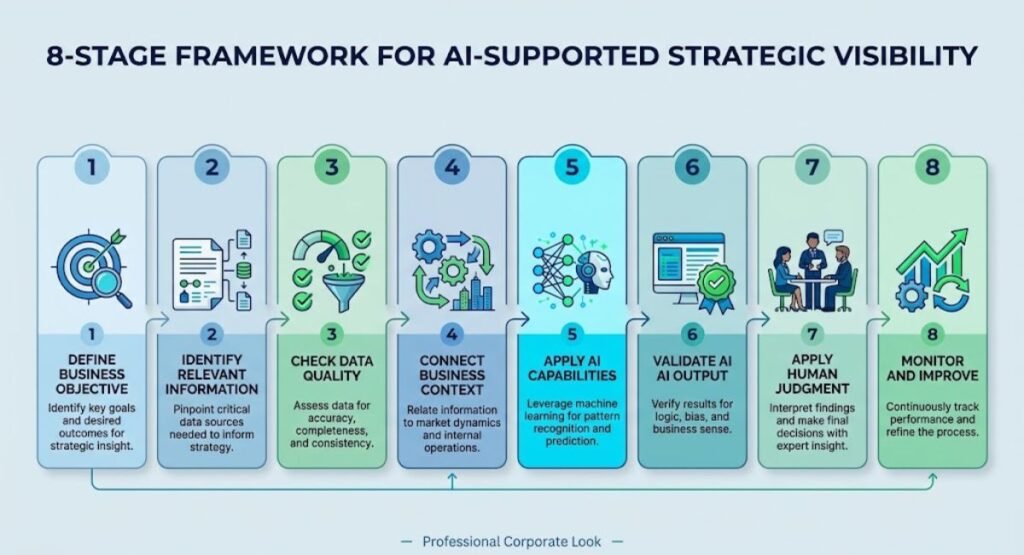
Step 1: Define the Business Objective
Start with the decision or business problem.
Do not begin by asking, “Where can we use AI?”
Instead ask:
“What business decision would benefit from better information or visibility?”
This keeps the AI initiative connected to a real business requirement.
Step 2: Identify Relevant Information
Determine what information is required to understand the problem.
This might include:
- Internal data
- Customer information
- Operational records
- Financial information
- Project information
- Market conditions
- Business rules
Only relevant information should be included.
Step 3: Check Data Quality
Review whether the information is:
- Accurate
- Current
- Complete
- Consistent
- Properly structured
- Appropriately accessible
Poor information can produce poor analysis regardless of how advanced the AI system is.
Step 4: Connect the Context
Relate information to:
- Business goals
- Processes
- Stakeholders
- Constraints
- Risks
- Priorities
This is where raw information begins to become meaningful business context.
Step 5: Apply Appropriate AI Capabilities
Depending on the use case, AI may assist with:
- Summarization
- Classification
- Pattern identification
- Information retrieval
- Scenario analysis
- Document analysis
- Trend exploration
The technology should match the problem rather than being selected simply because AI is available.
Step 6: Validate AI Output
Check important AI-generated conclusions against reliable business information.
Ask:
- Is the source information correct?
- Is anything missing?
- Did the AI misunderstand the context?
- Are the assumptions reasonable?
- Does the conclusion make business sense?
Step 7: Apply Human Judgment
People should evaluate the strategic significance of the information.
This includes considering:
- Risk
- Business priorities
- Ethics
- Accountability
- Financial consequences
- Customer impact
- Long-term implications
Step 8: Monitor and Improve
Business context changes.
Customers change. Markets change. Processes change. Strategies change.
An AI system that relies on outdated context can gradually become less useful. Businesses should therefore review their information, assumptions, workflows, and governance over time.
AI Insights vs Human Decisions
A useful principle is:

AI can support the analysis; people remain responsible for the decision.
| AI Can Help With | Humans Should Evaluate |
| Pattern identification | Business significance |
| Information synthesis | Strategic priorities |
| Data organization | Context and consequences |
| Scenario analysis | Risk tolerance |
| Trend detection | Final decisions |
| Information retrieval | Ethics and accountability |
This distinction is especially important when decisions affect customers, employees, finances, compliance, or other high-impact areas.
Common Challenges and Limitations
AI business context is not automatically reliable.
Organizations also need to consider software security when connecting business information with AI systems.
Several problems can reduce strategic visibility.
Poor Data Quality
Incorrect or incomplete information can produce misleading outputs.
Missing Context
A model may analyze the available information correctly while still missing an important business fact.
Outdated Information
Old policies, customer records, market information, or operational data can lead to conclusions that no longer reflect current conditions.
Ambiguous Objectives
If the business objective is unclear, AI may provide technically relevant information that does not answer the actual business question.
AI Hallucinations
Generative AI systems can produce information that sounds convincing but is incorrect.
Important claims therefore require appropriate verification.
Security and Privacy
Business information can contain sensitive or confidential data. Organizations need appropriate controls for access, handling, storage, and use.
Lack of Human Oversight
An organization can create additional risk when people accept AI recommendations without understanding their assumptions or limitations.
Responsible AI practices therefore need to be part of the overall business process, not added only after an AI system is deployed.
Common Mistakes to Avoid
1. Starting With the Technology
Choosing an AI tool before defining the business problem can lead to unnecessary complexity.
2. Assuming More Data Means Better Context
More information is not automatically more useful. Relevant, accurate, and timely context matters more than volume alone.
3. Ignoring Business Processes
AI insights become less useful when they are disconnected from the workflows where decisions actually happen.
4. Treating AI Output as Fact
AI-generated information should be evaluated according to the importance and risk of the decision.
5. Forgetting Strategic Objectives
A technically impressive AI system can still provide limited value if it does not support a meaningful business objective.
6. Neglecting Governance
Access, privacy, accountability, monitoring, and validation should be considered as part of implementation.
How to Improve AI Business Context Over Time
Organizations can improve strategic visibility gradually rather than attempting to connect every system at once.
A practical approach is to start with one important business problem.
For example:
Business problem → Required information → Context → AI analysis → Human validation → Decision → Measurement
After the workflow proves useful, the organization can expand it to additional processes.
It is also useful to document important business definitions. Different departments may use the same term differently, and inconsistent definitions can reduce the usefulness of analytics.
Clear ownership is equally important. Someone should understand where important information comes from, who maintains it, who can access it, and who is accountable for decisions based on it.
Conclusion
AI business context and strategic visibility are closely connected because useful AI analysis depends on understanding more than isolated data points. When information is connected to business goals, customers, processes, priorities, risks, and constraints, AI can help organizations explore patterns and relationships that support clearer decision-making. The real value is not simply producing more AI-generated information but creating a more meaningful view of the business.
Organizations should therefore begin with a clear business problem, establish the relevant context, check information quality, apply appropriate AI capabilities, and validate important outputs before acting on them. Strategic visibility should strengthen human decision-making rather than replace it, with governance, accountability, privacy, and ongoing review built into the process.
(FAQs)
1. What is AI business context?
AI business context is the organizational information and circumstances AI needs to interpret business data meaningfully.
2. What does strategic visibility mean in business?
Strategic visibility means having connected, relevant information that helps decision-makers understand important business conditions and relationships.
3. How does AI improve business visibility?
AI can help organize information, identify patterns, summarize complex data, and connect signals that deserve further investigation.
4. Why does AI need business context?
AI needs relevant business context because the same data point can have different meanings depending on organizational goals, processes, constraints, and circumstances.
5. Can AI replace human business decisions?
AI can support analysis and decision preparation, but important business decisions still require appropriate human judgment, accountability, and validation.