
Have you ever noticed how a speaker’s voice naturally rises and falls, how a piece of music seems to reach a satisfying ending, or how a company follows a regular schedule for meetings? These patterns are all connected to the idea of cadence. Although the word may sound technical, its basic concept is easy to understand when you look at how it is used in different situations.
The meaning of cadence can change depending on the context. It may describe the rhythm and flow of speech, the ending of a musical phrase, the pattern of sentences in writing, the rate of pedaling in cycling, or the regular timing of activities in business. This guide explains what cadence means, how it is used, how it differs from rhythm, and provides simple examples to make the concept clear.
What Does Cadence Mean?
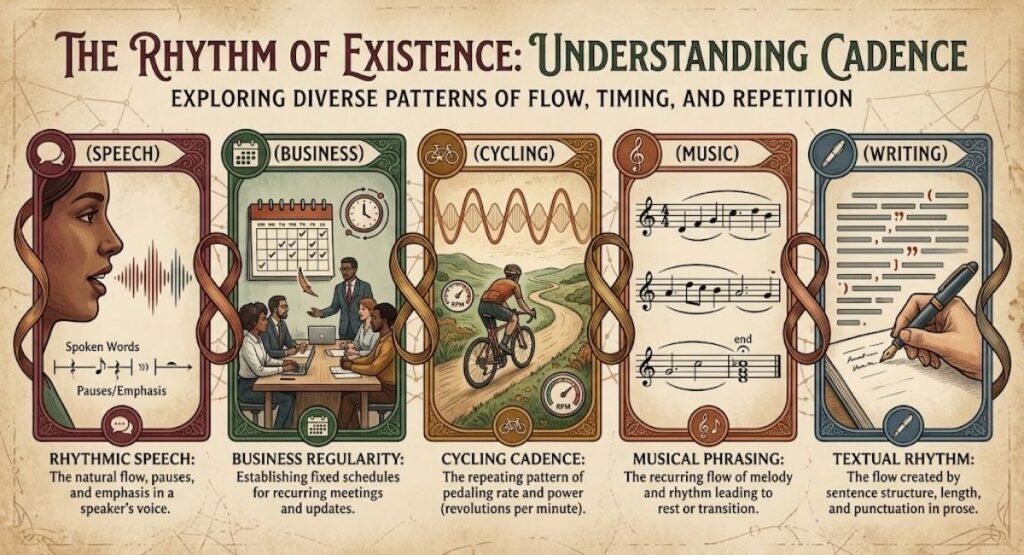
Cadence generally refers to a particular rhythm, flow, pattern, or sequence in which something happens, sounds, or moves. The term is commonly associated with timing and movement, but its exact meaning depends on the subject. For example, a speaker can have a steady cadence, while a business can establish a weekly cadence for recurring meetings.
In simple terms, cadence describes how something flows or occurs in a recognizable pattern. It can involve speed, pauses, repetition, timing, or a feeling of completion. Because the term is used in several fields, looking at the context is the best way to understand its precise meaning.
Cadence Meaning in Different Contexts
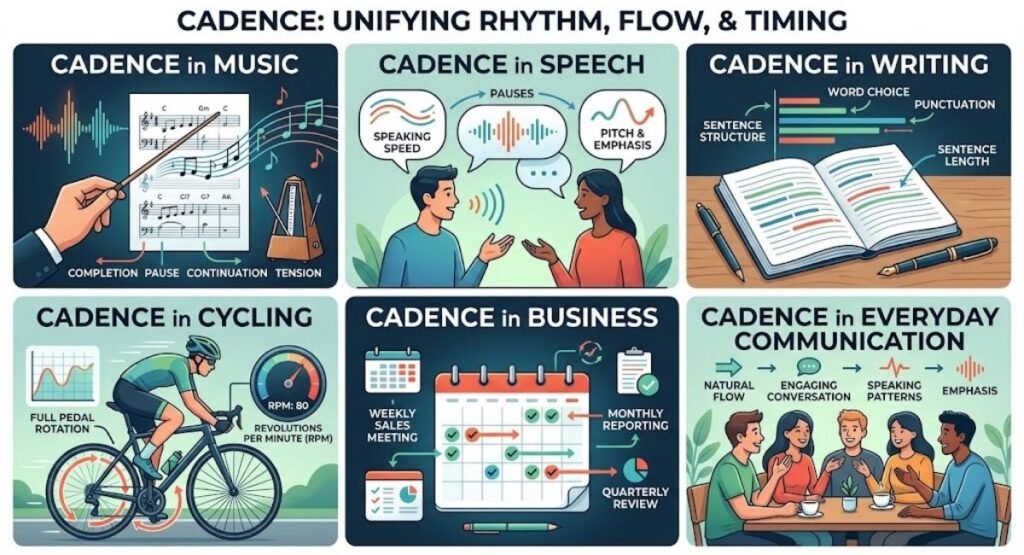
The word cadence appears in many areas, including music, communication, writing, sports, and business. While each field uses it differently, the basic idea remains connected to rhythm, flow, timing, or regularity.
Cadence in Music
In music, cadence refers to a sequence of notes or chords that occurs at the end of a musical phrase or section. It can create a feeling of completion, pause, continuation, or tension.
Musicians use different types of cadences to shape the structure of a composition. A strong cadence may make a musical passage feel complete, while another type may leave the listener expecting the music to continue.
Cadence in Speech
In speech, cadence describes the rhythm and flow of spoken language. It can be affected by speaking speed, pauses, pitch, emphasis, and changes in tone.
A speaker with an effective cadence does not necessarily speak at the same speed throughout a presentation. Instead, they may slow down for an important point, pause between ideas, or change their emphasis to make the message easier to follow.
Cadence in Writing
In writing, cadence refers to the rhythm and flow created by sentence structure, word choice, punctuation, and sentence length.
For example, short sentences can create a quick and energetic feeling, while longer sentences may create a slower and more reflective flow. Writers can vary these patterns to make their content more natural and engaging.
Cadence in Cycling
In cycling, cadence has a specific technical meaning. It refers to the number of times a cyclist completes a full pedal rotation in one minute.
Cycling cadence is measured in revolutions per minute (RPM). For example, if a cyclist completes 80 pedal rotations in one minute, their cadence is 80 RPM. Cyclists can monitor cadence as one way to understand their pedaling pattern and effort.
Cadence in Business
In business, cadence usually refers to the regular timing or frequency of recurring activities. Teams may establish a cadence for meetings, reports, reviews, planning sessions, or other processes.
For example, a company might have a weekly sales meeting cadence and a monthly reporting cadence. This creates a predictable pattern that helps team members know when recurring activities will take place.
For teams working with technology and security processes, a consistent business cadence can also support regular software reviews and security activities.
Cadence in Everyday Communication
Cadence can also describe the natural flow of everyday conversation. A person’s conversational cadence may include changes in speaking speed, pauses, tone, pitch, and emphasis.
These elements can influence how natural or engaging a conversation sounds. A balanced cadence can make communication easier to follow and help speakers emphasize important ideas.
Simple Examples of Cadence
The following table shows how cadence can be used in different contexts:
| Context | Example | Meaning |
| Music | The song ends with a strong cadence. | A musical progression creates a sense of resolution. |
| Speech | Her speaking cadence was calm and steady. | The rhythm and flow of her speech. |
| Writing | The author’s cadence made the story engaging. | The rhythm created by sentence structure. |
| Cycling | The cyclist maintained a steady cadence. | The rate of pedal rotations. |
| Business | The team follows a weekly meeting cadence. | A predictable meeting schedule. |
These examples show that cadence can have different practical meanings. The context determines whether it mainly refers to musical resolution, speaking rhythm, writing flow, physical movement, or the frequency of an activity.
Cadence vs. Rhythm
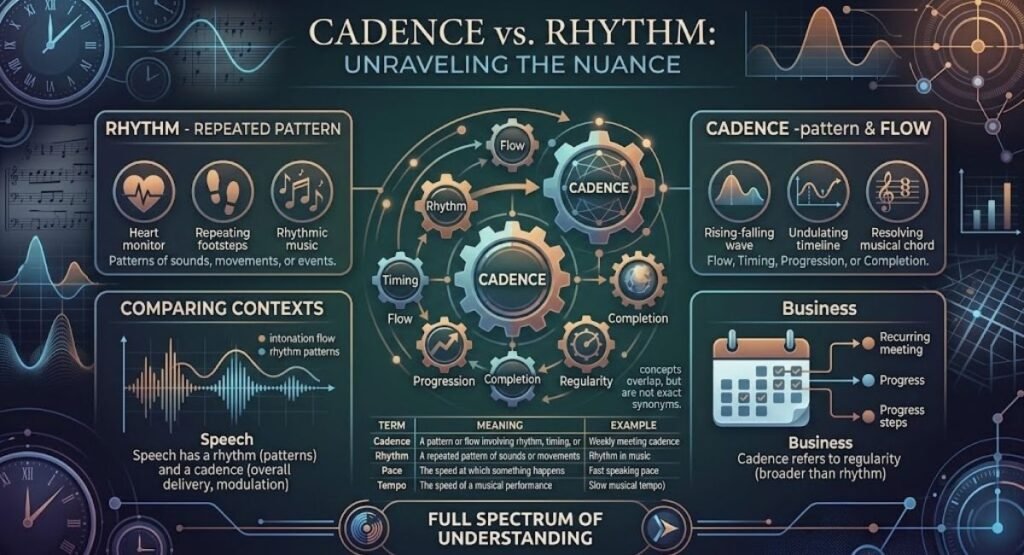
Cadence and rhythm are closely related terms, but they should not always be treated as exact synonyms. Rhythm generally refers to a repeated pattern of sounds, movements, or events. Cadence can describe rhythm as well, but it may also emphasize flow, timing, progression, or completion.
For example, speech has a rhythm because sounds and stresses follow patterns, while its cadence can describe the overall way the speaker’s delivery moves and changes. In business, cadence can refer to how regularly an activity occurs, which gives the word a meaning that is broader than rhythm.
| Term | Meaning | Example |
| Cadence | A pattern or flow involving rhythm, timing, or regularity | Weekly meeting cadence |
| Rhythm | A repeated pattern of sounds or movements | Rhythm in music |
| Pace | The speed at which something happens | Fast speaking pace |
| Tempo | The speed of a musical performance | Slow musical tempo |
Why Is Cadence Important?
Cadence can influence how people experience speech, writing, music, physical activity, and recurring processes. In communication, a suitable cadence can make ideas easier to understand and help listeners recognize important points.
In business, a predictable cadence can make recurring activities easier to organize. Regular meetings, reports, reviews, and planning sessions give teams a consistent structure. In cycling, cadence provides a useful way to describe the rate at which a rider turns the pedals.
A consistent workplace cadence can also support employee development by creating regular opportunities for assessments, feedback, and skills reviews.
How to Identify Cadence
You can identify cadence by paying attention to patterns in rhythm, timing, flow, or frequency.
- Listen for repeated patterns: Notice recurring sounds, pauses, or changes.
- Observe the pace: Determine whether something moves quickly, slowly, or at different speeds.
- Look at sentence structure: In writing, compare sentence lengths and arrangements.
- Notice pauses and endings: These can reveal cadence in speech and music.
- Check frequency: In business, look at how often a recurring activity occurs.
- Consider the context: The subject usually determines the exact meaning of cadence.
Common Types of Cadence
Cadence can take different forms depending on the field in which it is used.
Musical Cadence
A musical cadence is a progression of notes or chords that helps bring a phrase toward a pause, continuation, or resolution.
Speech Cadence
Speech cadence is the rhythm and movement of spoken language, influenced by pauses, pitch, emphasis, and speaking speed.
Writing Cadence
Writing cadence is the flow created by sentence length, punctuation, vocabulary, and sentence structure.
Business Cadence
Business cadence describes the predictable timing of recurring activities such as meetings, reports, reviews, and planning sessions.
Cycling Cadence
Cycling cadence is the number of pedal revolutions completed in one minute and is generally expressed in RPM.
Examples of Cadence in Sentences
Here are some simple examples showing different uses of the word:
- The speaker maintained a steady cadence during the presentation.
- The poem has a gentle cadence that creates a peaceful feeling.
- Our team follows a weekly cadence for project reviews.
- The cyclist increased her cadence while climbing the hill.
- The writer used short sentences to create a faster cadence.
- The final musical cadence gave the piece a feeling of completion.
Each example uses the word differently, but all relate to a recognizable pattern, flow, timing, or rhythm.
Common Mistakes About Cadence
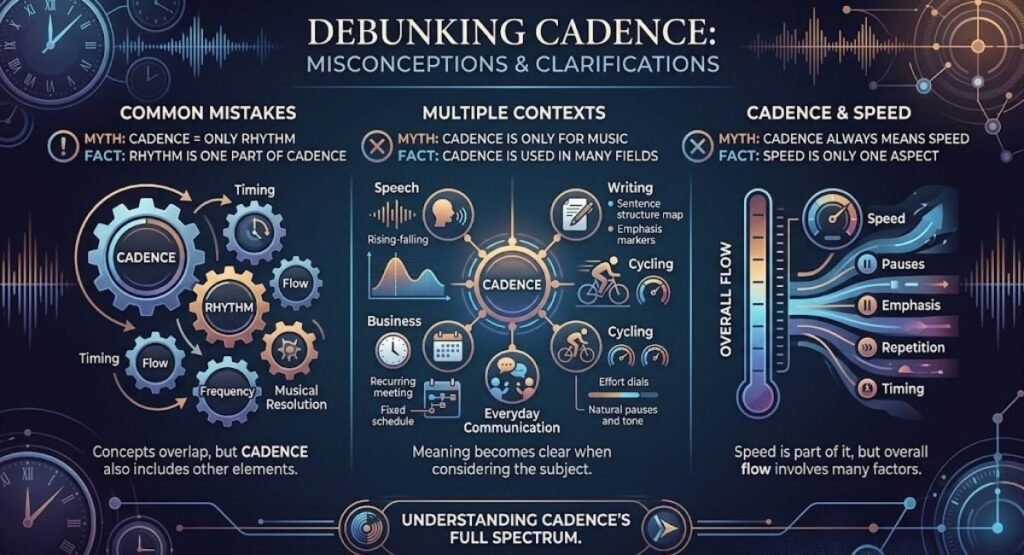
One common mistake is assuming that cadence always means the same thing as rhythm. Although the two concepts overlap, cadence can also refer to timing, flow, frequency, or musical resolution depending on the context.
Another mistake is thinking that cadence is used only in music. The word is also relevant to speech, writing, cycling, business, and everyday communication. Its meaning becomes clear when you consider the subject being discussed.
It is also incorrect to assume that cadence always means speed. Speed can be part of cadence, but cadence may also involve pauses, emphasis, repetition, timing, and overall flow.
How to Improve Your Cadence
Improving cadence depends on the activity. To improve your speaking cadence, practice changing your pace naturally, using purposeful pauses, and emphasizing important words. Reading text aloud can help you notice whether your delivery sounds too fast, too slow, or repetitive.
For writing, try combining different sentence lengths and structures. Avoid giving every sentence the same pattern. In business, create clear schedules for recurring activities so team members understand when meetings, reviews, reports, or planning sessions will occur.
Conclusion
The meaning of cadence depends on the context, but it generally relates to rhythm, flow, timing, or a recurring pattern. In music, it can help bring a phrase toward resolution; in speech and writing, it shapes the flow of language; in cycling, it measures pedal rotations; and in business, it describes the regular timing of activities.
Understanding cadence becomes much easier when you focus on how the term is being used. Whether you are talking about a speaker’s delivery, a writer’s style, a musical phrase, a cyclist’s pedaling, or a company’s schedule, cadence describes an important pattern in the way something moves, sounds, or occurs.
FAQs
1. What does cadence mean?
Cadence refers to the rhythm, flow, timing, or recurring pattern of something.
2. What does cadence mean in music?
In music, cadence is a sequence of notes or chords that creates a sense of pause, continuation, or resolution.
3. What does cadence mean in speech?
In speech, cadence describes the rhythm, pace, pauses, pitch, and flow of spoken language.
4. What does cadence mean in business?
In business, cadence refers to the regular timing or frequency of recurring activities such as meetings and reports.
5. What does cadence mean in cycling?
In cycling, cadence means the number of pedal revolutions completed by a cyclist per minute. You focus on how the term is being used. Whether you are talking about a speaker’s delivery, a writer’s style, a musical phrase, a cyclist’s pedaling, or a company’s schedule, cadence describes an important pattern in the way something moves, sounds, or occurs.