
Starting a project management career can be difficult when you have the knowledge and motivation but do not yet have years of project leadership experience. The Certified Associate in Project Management (CAPM) is designed for people who want to build formal project management knowledge without first meeting the experience requirements associated with advanced certifications.
CAPM is offered by Project Management Institute (PMI). The certification covers project management fundamentals, predictive approaches, agile methods, and business analysis. PMI currently states that no project management experience is required for CAPM eligibility.
But earning a certification should not be treated as the goal by itself. The more useful question is whether CAPM fits your career stage, what you actually need to learn, and how you can apply that knowledge at work.
This guide explains the certification, eligibility requirements, exam structure, preparation strategy, career applications, CAPM vs. PMP, common mistakes, and what to do after certification.
What Is the Certified Associate in Project Management?
The Certified Associate in Project Management (CAPM) is a PMI certification that validates foundational project management knowledge and skills.
It is particularly relevant to people entering project management, moving into project-based work, or seeking to formalize knowledge gained through education or workplace experience.
Unlike a certification that focuses only on one project management method, the current CAPM exam covers several ways of working. PMI describes CAPM as covering predictive project management, agile principles, and business analysis, alongside foundational concepts.
What Does CAPM Demonstrate?
A CAPM credential can demonstrate that you understand concepts such as:
- Project life cycles
- Project roles and responsibilities
- Stakeholder engagement
- Scope and requirements
- Scheduling
- Risk and issue management
- Communication
- Predictive project management
- Agile approaches
- Business analysis
- Project documentation
- Team-based project work
However, there is an important distinction:
CAPM demonstrates knowledge; it does not automatically demonstrate years of project leadership experience.
That distinction matters when evaluating jobs or deciding whether CAPM is the right certification for you.
A Simple Example
Imagine a company is implementing a new customer-management system.
A project team must determine:
- What the business needs
- Who the stakeholders are
- What the project will deliver
- How work will be scheduled
- What risks could affect the project
- How requirements will be managed
- How the team will communicate
- Whether a predictive, agile, or another approach is appropriate
CAPM knowledge helps a beginner understand the language, processes, and thinking behind those activities.
Who Should Consider CAPM?
CAPM is especially relevant to people who are at the beginning of their project management journey.
You may want to consider it if you are:
- A student or recent graduate
- Changing careers
- Working as a project coordinator
- Working as a project administrator
- Supporting project teams
- Working in operations and moving toward project work
- A team member who wants formal project management knowledge
- Interested in project management but lacking professional project leadership experience
PMI specifically describes CAPM as requiring no prior project management experience, which makes it different from experience-based certifications such as PMP.
Is CAPM Right for You?
CAPM may be a good fit if most of these statements describe you:
- I am relatively new to project management.
- I want structured project management education.
- I want to understand both predictive and agile approaches.
- I want a recognized professional credential.
- I am prepared to study rather than rely on memorization.
- I want to apply project management concepts in real work.
- I may eventually pursue a more advanced certification.
If you already have substantial experience leading projects, you should also evaluate whether you qualify for an advanced certification instead of automatically starting with CAPM.
CAPM Certification Requirements
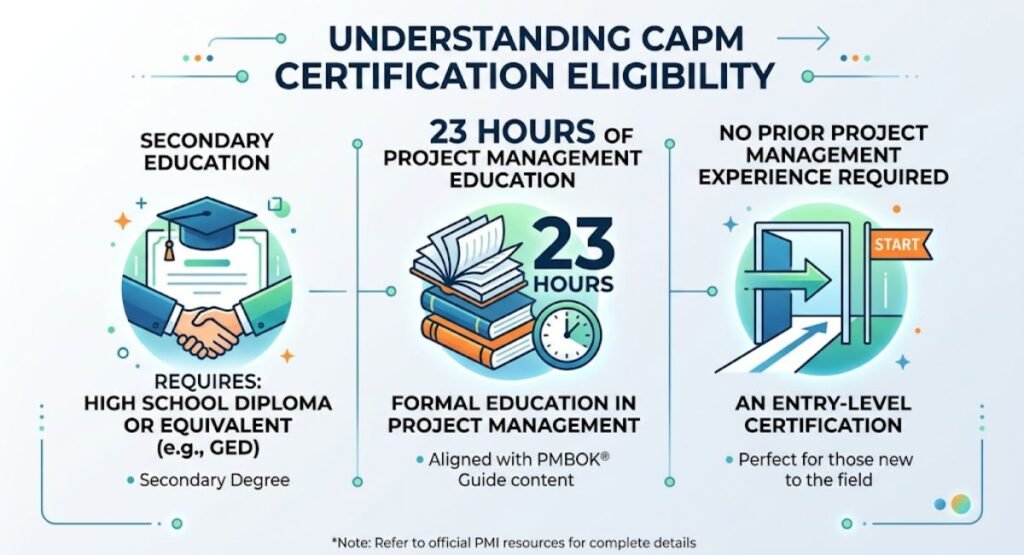
One of the reasons CAPM attracts beginners is that project management experience is not required.
According to PMI’s current certification information, candidates need a secondary degree or global equivalent, must be at least 18 years old, and need at least 23 hours of project management education completed before taking the examination.
| Requirement | Current CAPM Requirement |
| Education | Secondary degree, such as a high school diploma, GED, or global equivalent |
| Age | At least 18 years old |
| Project management education | At least 23 hours before the exam |
| Project management experience | Not required |
| Certification provider | PMI |
The 23-Hour Education Requirement
The 23-hour requirement is important because simply deciding to take the CAPM exam does not satisfy the education requirement.
PMI offers an official CAPM Exam Prep Course that fulfills the 23 hours needed for the application.
If you use another education provider, make sure the training satisfies the applicable PMI requirement before relying on it for your application.
Do You Need Project Management Experience?
No.
This is one of the biggest differences between CAPM and experience-focused project management certifications.
You can pursue CAPM without having previously worked as a project manager. That makes it potentially useful for people who are trying to enter the profession rather than validate an established project leadership career.
How to Apply for CAPM Certification
The application process is easier when you prepare your information before starting.
Step 1: Check Your Eligibility
Confirm that you meet the education, age, and project management education requirements.
Step 2: Complete the Required Education
Complete the required 23 hours of project management education before taking the exam.
Step 3: Create or Access Your PMI Account
You need a PMI account to begin the certification process.
Step 4: Prepare Your Application Information
Have your academic education and project management education information available.
PMI recommends entering the required education information carefully during the application process.
Step 5: Submit the Application
Complete and submit your CAPM application.
Step 6: Wait for Acceptance
Once your application is accepted, you can move forward with payment and exam scheduling.
Step 7: Pay and Schedule the Exam
PMI currently lists the CAPM exam price as $225 for members and $300 for non-members. Fees and applicable taxes or regional charges can change, so candidates should verify the amount on PMI immediately before payment.
Step 8: Schedule Your Examination
PMI currently indicates that candidates can take the exam at a Pearson VUE testing center or securely online.
Step 9: Prepare Properly
Do not treat application approval as evidence that you are ready for the exam. Preparation remains essential.
Step 10: Take the Exam
Once you are adequately prepared, take the examination and follow the current exam-day requirements provided by PMI.
CAPM Exam Format
The current CAPM examination contains 150 questions and provides 180 minutes to complete the exam. PMI states that 15 questions are unscored pretest questions, leaving 135 scored questions.
| Exam Feature | Current Information |
| Questions | 150 |
| Exam time | 180 minutes |
| Unscored pretest questions | 15 |
| Scored questions | 135 |
| Exam delivery | Testing center or online |
| Experience required | No |
| Languages | Multiple languages are available |
The examination is not simply a test of terminology. The content reflects different project environments and approaches.
That means understanding why a particular approach is appropriate is more useful than memorizing isolated definitions.
Is There a Public CAPM Passing Score?
Do not rely on websites claiming that you must achieve a specific universal percentage unless that figure is supported by current PMI documentation.
PMI’s exam content outline explains that its scoring model is periodically reviewed by scoring experts to maintain a valid assessment of knowledge and skills.
CAPM Exam Content and Domains

The current CAPM examination is divided into four major domains.
| Domain | Percentage |
| Project Management Fundamentals and Core Concepts | 36% |
| Predictive, Plan-Based Methodologies | 17% |
| Agile Frameworks/Methodologies | 20% |
| Business Analysis Frameworks | 27% |
| Total | 100% |
PMI’s Exam Content Outline confirms these four domains and notes that predictive, adaptive, and business analysis principles are incorporated across the examination rather than being isolated into completely separate approaches.
1. Project Management Fundamentals and Core Concepts — 36%
This is the largest domain.
You should understand foundational ideas such as:
- Projects and operations
- Project life cycles
- Project environments
- Roles and responsibilities
- Stakeholders
- Project constraints
- Planning concepts
- Project success
- Basic project terminology
The key is to understand how these concepts affect real project decisions.
2. Predictive, Plan-Based Methodologies — 17%
Predictive approaches generally involve planning significant parts of the work before execution.
You should understand concepts related to:
- Scope planning
- Scheduling
- Work planning
- Dependencies
- Baselines
- Project documentation
- Monitoring and controlling work
- Managing changes
A simple example is a construction project where significant design and planning work must occur before physical construction begins.
3. Agile Frameworks and Methodologies — 20%
Agile approaches emphasize adaptability, feedback, collaboration, and incremental delivery.
You should understand concepts such as:
- Iterative work
- Incremental delivery
- Backlogs
- Prioritization
- Customer feedback
- Team collaboration
- Adaptation
- Agile roles and events
For example, a software team may deliver a small product increment, gather feedback, and then adjust the next iteration.
4. Business Analysis Frameworks — 27%
Business analysis represents a substantial part of the CAPM exam, so beginners should not ignore it.
You should understand:
- Requirements
- Stakeholder needs
- Business problems
- Requirements gathering
- Requirements prioritization
- Validation
- Product outcomes
- Communication with stakeholders
This domain helps connect project work to the actual problem the organization is trying to solve.
What You Actually Need to Learn for CAPM
A strong CAPM preparation strategy goes beyond memorizing definitions.
A useful project-management practice is distinguishing potential risks from issues that have already occurred.
Think of your learning as a connected system.
Project Fundamentals
Understand what makes a project different from routine operations and how project work creates a temporary path toward a defined outcome.
Stakeholders
Learn how to identify stakeholders, understand their interests, communicate appropriately, and manage their involvement.
Scope
Understand what belongs inside the project and what does not.
Schedule
Learn how activities, dependencies, milestones, and timelines work together.
Cost
Understand basic project cost concepts and how financial considerations influence decisions.
Quality
Learn why quality should be built into project work rather than treated only as a final inspection.
Risk
Understand the difference between a risk and an issue.
A risk is a potential future event or condition; an issue is something that has already happened and requires attention.
Communication
Understand why the right information must reach the right stakeholder at the right time.
Agile
Learn how agile teams work with changing requirements, feedback, prioritization, and incremental delivery.
Business Analysis
Understand how requirements connect stakeholder needs to the solution being developed.
How to Prepare for the CAPM Exam
A useful preparation strategy should answer one question:
Can I explain and apply the concept, or can I only recognize the definition?
If you can only memorize a definition, your preparation is incomplete.
Step 1: Start With the Exam Content Outline
Use the current PMI Exam Content Outline as your study map.
It tells you what the examination is designed to assess and prevents you from spending excessive time on topics that are outside the intended scope.
Step 2: Complete Your Required Education
Make sure you complete the required project management education before the examination.
Step 3: Build Your Fundamentals
Learn project terminology, roles, stakeholders, life cycles, planning, and core concepts.
Step 4: Study Predictive Approaches
Understand how planned project work is structured and controlled.
Step 5: Study Agile Approaches
Do not leave agile until the end. It represents a significant portion of the exam.
Step 6: Give Business Analysis Serious Attention
With 27% of the exam associated with business analysis, ignoring this domain can leave a major gap in your preparation.
Step 7: Practice Scenario-Based Questions
When answering a question, ask:
- What is happening?
- What is the project trying to achieve?
- Who is affected?
- What information is available?
- What approach is being used?
- What should happen next?
Step 8: Review Your Wrong Answers
Do not simply count your score.
For every incorrect question, determine why your answer was wrong.
Step 9: Take Full Practice Exams
Use practice exams to improve:
- timing
- concentration
- question interpretation
- decision-making
- knowledge retention
Step 10: Prepare for Exam Day
Avoid learning completely new topics immediately before the exam.
Use the final stage to review weak areas, key concepts, and question-solving strategy.
A Practical 6-Week CAPM Study Plan

| Week | Main Focus | Goal |
| Week 1 | Fundamentals | Build a strong foundation |
| Week 2 | Predictive | Understand structured planning |
| Week 3 | Agile | Learn adaptive and iterative approaches |
| Week 4 | Business Analysis | Understand requirements and stakeholder needs |
| Week 5 | Practice | Identify and correct weak areas |
| Week 6 | Mock Exams | Improve readiness and timing |
This is a framework rather than a guarantee. Your study time should depend on your existing knowledge, learning speed, educational background, and available time.
CAPM Through a Real-World Example

Consider a company that wants to launch a new internal software platform.
The project team cannot simply start building the system without understanding the problem.
Stakeholders
The team identifies employees, managers, IT staff, executives, and other groups affected by the system.
Requirements
The team determines what users actually need from the platform.
Scope
The team establishes what the first release will include and what will remain outside the project.
Schedule
Activities are organized according to dependencies and delivery targets.
Risks
The team considers potential problems such as technical integration, security concerns, limited resources, or user resistance.
Communication
Different stakeholders receive information based on what they need to know and when they need it.
Agile or Predictive Approach
If requirements are stable and significant planning must happen upfront, a predictive approach may be appropriate.
If requirements are expected to evolve through frequent user feedback, an agile approach may be more suitable.
Business Analysis
The team continually connects the proposed solution to the underlying business need.
This is the type of thinking that makes project management knowledge useful beyond an exam.
CAPM vs PMP: Which Certification Is Better?

CAPM and PMP are not simply two versions of the same certification.
They are aimed at different career stages.
| Factor | CAPM | PMP |
| Primary audience | Entry-level and aspiring project professionals | Experienced project leaders |
| Project leadership experience | Not required | Required |
| Main purpose | Demonstrate foundational knowledge | Validate professional project leadership |
| Career stage | Early career or career transition | Experienced professional |
| Education/training | 23 hours of project management education | Requirements depend on the applicable eligibility path |
| Best use | Building a project management foundation | Demonstrating established project leadership experience |
PMI’s current PMP eligibility framework requires professional project leadership experience alongside the applicable education/training pathway, making PMP fundamentally different from CAPM.
Which Should You Choose?
Choose CAPM when:
- You are new to project management.
- You do not yet have the required project leadership experience for PMP.
- You want structured foundational knowledge.
- You are transitioning into project-based work.
Consider PMP when:
- You already have substantial project leadership experience.
- You meet PMI’s current eligibility requirements.
- Your career requires a more advanced project management credential.
CAPM can support a future project management career, but it should not be treated as an automatic or guaranteed route to PMP.
Is CAPM Worth It?
There is no universal answer.
When the certification matches your career stage, and you actually use the knowledge.
CAPM May Be Valuable If You:
- Are starting project management from zero
- Want structured learning
- Need a recognized credential
- Are changing careers
- Work on project teams
- Want to demonstrate foundational project management knowledge
- Want to build toward future professional development
CAPM May Not Be the Best Choice If You:
- Already have extensive project leadership experience
- Are pursuing a credential without a clear career objective
- Expect the certification alone to guarantee a job
- Expect an automatic salary increase
- Have not considered whether project management is relevant to your intended career
The important point is that a certification is a career tool, not a career guarantee.
Your practical experience, communication ability, technical knowledge, problem-solving skills, and ability to work with teams also matter.
What Jobs Can CAPM Help Prepare You For?
CAPM knowledge can be relevant to several project-support and early-career positions.
Potential roles include:
- Project Coordinator
- Project Administrator
- Project Analyst
- Assistant Project Manager
- Project Support Specialist
- Junior project management positions
PMI also lists roles such as Assistant Project Manager, Project Administrator, Project Analyst, and Project Coordinator among potential career paths associated with CAPM.
However, job titles and requirements vary considerably by employer.
A CAPM credential does not mean that someone automatically qualifies for every project manager position.
What Employers May Still Look For
Depending on the role, employers may want:
- Communication skills
- Organization
- Documentation ability
- Spreadsheet or project software skills
- Industry knowledge
- Problem-solving
- Team collaboration
- Scheduling experience
- Risk awareness
- Relevant work experience
That is why the best strategy is to combine certification with practical evidence of your abilities.
CAPM Skills You Can Apply at Work
The value of CAPM does not have to stop at the examination.
Planning
Use structured planning to clarify activities, responsibilities, dependencies, and expected outcomes.
Task Tracking
Help teams monitor work and identify delays before they become larger problems.
Risk Identification
Recognize potential problems early and help the team decide how to respond.
Stakeholder Communication
Provide stakeholders with relevant information instead of overwhelming everyone with the same level of detail.
Requirements Gathering
Help clarify what users or customers actually need.
Scheduling
Understand how activities and dependencies affect project timelines.
Documentation
Maintain clear records of decisions, requirements, risks, issues, and project information.
Issue Management
Help teams distinguish between potential risks and problems that have already occurred.
Project Reporting
Present project information in a way that helps decision-makers understand progress and concerns.
Agile Teamwork
Support iterative work, feedback, prioritization, and collaboration when an agile approach is being used.
Common CAPM Preparation Mistakes
1. Memorizing Without Understanding
Memorization can help with terminology, but it is not a substitute for understanding how concepts work together.
Better approach: Ask yourself how the concept would appear in an actual project.
2. Ignoring Agile
Some beginners focus heavily on traditional project management and leave agile for later.
Better approach: Study agile as a core part of the examination.
3. Ignoring Business Analysis
Business analysis represents 27% of the current CAPM exam content.
Better approach: Study requirements, stakeholder needs, prioritization, and solution validation carefully.
4. Using Outdated Study Material
Certification requirements and exam structures can change.
Better approach: Check current PMI information before relying on an old guide.
5. Using Only One Study Resource
One resource may explain a topic well but leave gaps elsewhere.
Better approach: Combine authoritative material with structured learning and practice.
6. Avoiding Practice Questions
Reading alone does not show whether you can apply knowledge.
Better approach: Use practice questions and analyze every mistake.
7. Studying Without a Schedule
Unstructured studying often leads to inconsistent preparation.
Better approach: Create weekly objectives and track your weak areas.
8. Confusing Predictive and Agile Approaches
Beginners sometimes treat all projects as though they follow the same process.
Better approach: Learn why different project environments require different approaches.
9. Focusing Only on Definitions
Knowing what a stakeholder or risk is does not necessarily mean you know how to handle one.
Better approach: Convert definitions into real-world examples.
10. Assuming Certification Guarantees Employment
A certification can strengthen your profile, but it cannot guarantee a job.
Better approach: Combine CAPM with practical skills, experience, networking, and a targeted job search.
CAPM Certification Cost and Fees
PMI currently lists the CAPM exam fee as:
- PMI member: $225
- Non-member: $300
These figures should not be treated as a permanent worldwide price because certification costs can be affected by membership, location, taxes, currency, and future PMI pricing changes.
Before paying, verify the current amount directly through PMI.
The total cost of pursuing CAPM can also include:
- Study materials
- Preparation courses
- Practice exams
- PMI membership, if selected
- Retake costs, if applicable
- Other applicable charges
The cheapest preparation option is not necessarily the best option. The right resource is one that helps you understand the exam content and prepare effectively.
How to Maintain Your CAPM Certification
Passing the exam is not the final step.
PMI currently requires CAPM holders to earn 15 Professional Development Units (PDUs) during each three-year cycle to maintain the certification. PMI states that at least 9 of those PDUs must be Education PDUs, while up to 6 can come from Giving Back activities.
CAPM holders to earn at least 2 PDUs in each area of the PMI Talent Triangle.
The three areas are:
- Ways of Working
- Power Skills
- Business Acumen
This continuing-development model encourages certification holders to keep learning rather than treating certification as a one-time achievement.
What Should You Do After CAPM?
Once you earn the certification, focus on turning knowledge into evidence.
1. Apply What You Learned
Look for opportunities to use project planning, communication, risk, requirements, or scheduling skills in your workplace.
2. Build Project Experience
Participate in projects even if your job title does not contain the words “project manager.”
3. Document Your Contributions
Keep track of the project work you supported, the problems you helped solve, and the outcomes you contributed to.
4. Improve Communication Skills
Project professionals spend significant time communicating with teams, stakeholders, customers, and management.
5. Learn Project Tools
Develop practical skills with tools used for:
- Scheduling
- Task management
- Documentation
- Collaboration
- Reporting
- Risk tracking
6. Continue Learning Agile and Predictive Methods
Do not assume that earning CAPM means your learning is finished.
7. Build a Professional Portfolio Where Appropriate
Where confidentiality permits, document your project contributions in a professional format.
8. Consider Future Certifications Based on Experience
Your next certification should reflect your actual career stage rather than simply being the next item on a checklist.
Should You Get CAPM?
Use this simple decision framework.
CAPM may make sense if:
You are new to project management
Build foundational knowledge and evaluate CAPM.
You have limited project experience but want to move into the field
CAPM can provide structured learning and a recognized credential.
Substantial project leadership experience
Review the current PMP eligibility requirements before automatically choosing CAPM.
You only want a certificate without intending to use project management skills
First, clarify your career objective.
The best certification is not necessarily the most advanced one. It is the one that matches your current experience, career direction, and learning needs.
(FAQs)
1. What is the Certified Associate in Project Management?
CAPM is a PMI certification that validates foundational project management knowledge and requires no prior project management experience.
2. Is CAPM suitable for beginners?
Yes, CAPM is designed to support people entering project management because prior project management experience is not required.
3. Do you need project management experience for CAPM?
No, PMI currently lists CAPM as a certification with no project management experience requirement.
4. How difficult is the CAPM exam?
Its difficulty depends on your preparation, but understanding concepts and practicing application is more useful than memorizing terminology alone.
5. Is CAPM worth getting?
CAPM can be worthwhile when it matches your career stage, and you use the knowledge to build practical project management skills.
Conclusion
The Certified Associate in Project Management can be a practical starting point for people who want to enter project management without first having years of project leadership experience. Its current exam covers fundamentals, predictive methods, agile approaches, and business analysis, so preparation should focus on understanding how project concepts work together rather than memorizing isolated terms.
If you are considering CAPM, start by checking the current PMI eligibility requirements, completing the required project management education, and studying directly from the current exam content outline. Then connect your certification preparation with real workplace skills such as planning, communication, requirements management, risk awareness, and teamwork. That combination is more valuable for a long-term project management career than the credential alone.