
The Directorate of Staff Development (DSD) is an important name in the history of teacher professional development in Punjab, Pakistan. It oversaw the professional training and capacity building of teachers and education personnel under the School Education Department. Today, however, readers should note an important institutional change: the former DSD was renamed the Quaid-e-Azam Academy for Educational Development (QAED) as Punjab reorganized its teacher-training system.
This distinction matters because many older documents, research papers, job announcements, and educational resources still use the term Directorate of Staff Development. At the same time, more recent material refers to QAED. This guide explains the history, role, professional-development activities, training approaches, and continuing relevance of DSD while making the DSD-to-QAED transition clear.
What Is the Directorate of Staff Development?
The Directorate of Staff Development was a provincial education institution connected with the professional development of school teachers and other education personnel in Punjab.
Historical sources describe DSD as an apex institution involved in teacher professional development, including pre-service and in-service training and broader capacity-building activities. The Punjab government’s attached-departments listing also identifies the Directorate of Staff Development under the School Education Department.
The institution’s work covered more than classroom workshops. Its activities included professional training, teacher support, mentoring, training management, and quality-related functions.
Why Does the Name Still Appear Online?
The term remains common because a large amount of educational material was produced during the DSD period.
You may find references to DSD in:
- Teacher-training documents
- Academic research
- Professional-development frameworks
- Government notifications
- Training guides
- Historical education reports
- Job announcements
- Research about Punjab’s education reforms
Therefore, someone searching for Directorate of Staff Development Punjab may encounter both historical DSD material and newer references to QAED.
Directorate of Staff Development and QAED: What Changed?

One of the most important facts to understand is that DSD is not simply another name for a completely separate organization.
Punjab’s teacher-training system underwent institutional changes, and the former DSD was transformed into the Quaid-e-Azam Academy for Educational Development (QAED). An evaluation of Punjab’s education-sector program specifically describes QAED as formerly known as the Directorate of Staff Development.
A project document concerning the 2017–19 teacher-training program also describes the transformation of DSD into QAED and identifies the objective of providing need-based in-service training to public-school teachers and head teachers.
| Aspect | Directorate of Staff Development | QAED |
| Institutional period | Earlier institutional model | Subsequent institutional model |
| Main area | Teacher and education-sector professional development | Teacher and education-sector professional development |
| Punjab education connection | School Education Department | School Education Department |
| Training focus | Teacher training, CPD and capacity building | Professional development and training |
| Current relevance | Mainly historical and legacy references | More relevant in newer documentation |
This table provides a simplified comparison. Specific programs and responsibilities changed over time, so readers should check the relevant period when interpreting older documents.
History of the Directorate of Staff Development
The history of staff development in Punjab is connected with the province’s longer effort to establish organized teacher-training institutions.
Historical material shows that teacher-training institutions went through several administrative and organizational changes before the modern professional-development structure emerged. One documented institutional history describes the Regional Education Extension Centre being reorganized as the Directorate of Staff Development, with responsibilities that included administration of teacher-training institutions and in-service training.
Over time, DSD developed a stronger focus on professional development and teacher training.
Development of Professional Training
The institution became associated with programs designed to support teachers after they entered the profession.
This distinction is important:
Pre-service training prepares people before they enter teaching.
In-service training supports professionals who are already working in schools.
DSD became particularly associated with the latter area.
The Continuous Professional Development Approach
The Directorate also became associated with Continuous Professional Development (CPD).
Research concerning DSD describes CPD as a structured approach involving teacher development, mentoring, training, and professional support. One study examining DSD’s mentoring program looked at District Teacher Educators and their support for primary school teachers.
Professional development can also support long-term career progression by helping employees build relevant skills, gain experience, and prepare for greater responsibilities.
Main Functions of the Directorate of Staff Development
The exact functions changed across different periods, but historical evidence shows several recurring areas.
Teacher Professional Development
Teacher development formed a central part of DSD’s work.
Professional development can help teachers strengthen areas such as:
- Teaching methods
- Classroom management
- Assessment
- Lesson planning
- Subject knowledge
- Student engagement
- Professional reflection
The purpose of professional development is not simply to attend a workshop. Effective development connects learning with actual professional practice.
In-Service Teacher Training
DSD was associated with in-service training for public-school teachers.
This model allowed working teachers to receive additional training without leaving the profession permanently.
Training could address new teaching requirements, professional competencies, curriculum implementation, or specific education initiatives.
Mentoring and Professional Support
Professional development can become more practical when teachers receive support after formal training.
Historical DSD programs included District Teacher Educators and mentoring-related activities. Research examining the DSD mentoring program evaluated professional progress among primary school teachers and gathered views from teachers and school heads.
This illustrates an important principle:
Training introduces knowledge, while mentoring can help professionals apply that knowledge.
Training and Capacity Building
DSD also worked within a broader capacity-building framework.
Capacity building can include:
- Knowledge development
- Practical skills
- Leadership abilities
- Training delivery
- Professional support
- Monitoring
- Evaluation
This broader approach recognizes that improving education requires more than a single training session.
Before planning a training program, organizations can use competence assessment to identify skill gaps and determine which areas require further development.
Who Benefited From Staff Development Programs?
The main focus was connected with education professionals, particularly school teachers.
Historical sources also document training for school heads and education managers. A study of leadership development in Pakistan describes DSD training for heads of primary, high, and higher-secondary schools as well as district-level education officers.
Potential groups included:
| Group | Development Focus |
| Teachers | Teaching and classroom practices |
| Head teachers | School leadership |
| Education managers | Administration and management |
| Teacher educators | Training and professional support |
| Education officers | Education management and implementation |
The exact target group depended on the program and period.
Continuous Professional Development Through DSD

One of the most significant concepts associated with DSD is Continuous Professional Development.
Professional certifications can provide another structured way to develop career-related knowledge and demonstrate commitment to continuous learning, such as CAPM certification for people interested in project management.
CPD recognizes that teachers continue learning after completing their initial qualifications.
A professional-development cycle can be represented as:
Identify Need → Learn → Practice → Receive Feedback → Reflect → Improve
This approach differs from a one-time training model.
Why Continuous Development Matters
Education changes over time.
Teachers may need to respond to:
- New curricula
- New assessment methods
- Digital learning tools
- Changing classroom needs
- New educational policies
- Different learner requirements
Continuous development gives teachers opportunities to update their knowledge and skills.
Research on teacher professional development in Punjab has also examined peer networking and collaborative learning as ways teachers can reflect on practice and learn from one another. One such initiative was conducted in partnership with QAED, formerly DSD.
District Teacher Educators and Local Support
A notable feature of the historical DSD model was the use of district and cluster-level structures.
Older recruitment material describes District Teacher Educators (DTEs) as responsible for training, mentoring, professional development, and whole-school improvement within their assigned clusters.
This approach attempted to bring professional support closer to schools rather than relying entirely on centralized training.
Why Local Support Matters
A teacher working in a school may face challenges that a general workshop cannot fully address.
Local professional support can provide opportunities to:
- Discuss practical problems
- Observe teaching practices
- Receive feedback
- Share experiences
- Adapt training to local conditions
This makes the connection between training and classroom practice stronger.
How a Staff Development Program Can Work

Although not every program followed the same process, a useful professional-development framework can be understood through six stages.
1. Identify Training Needs
Start by identifying what teachers or education professionals need to learn.
Possible sources include:
- Teacher feedback
- Classroom observations
- Performance information
- Curriculum changes
- Professional assessments
2. Design the Training
Training designers then select:
- Learning objectives
- Content
- Activities
- Materials
- Assessment methods
3. Deliver the Program
Training can take different forms, including:
- Workshops
- Courses
- Coaching
- Mentoring
- Online learning
- Peer learning
4. Practice New Skills
Teachers need opportunities to apply what they learn.
For example, a teacher who learns a new assessment technique should have an opportunity to use that technique in an actual classroom.
5. Evaluate Learning
Evaluation can examine whether participants understood the training and developed the intended skills.
6. Follow Up
Follow-up helps determine whether participants actually apply new knowledge in their professional environment.
Measuring the Effectiveness of Staff Development
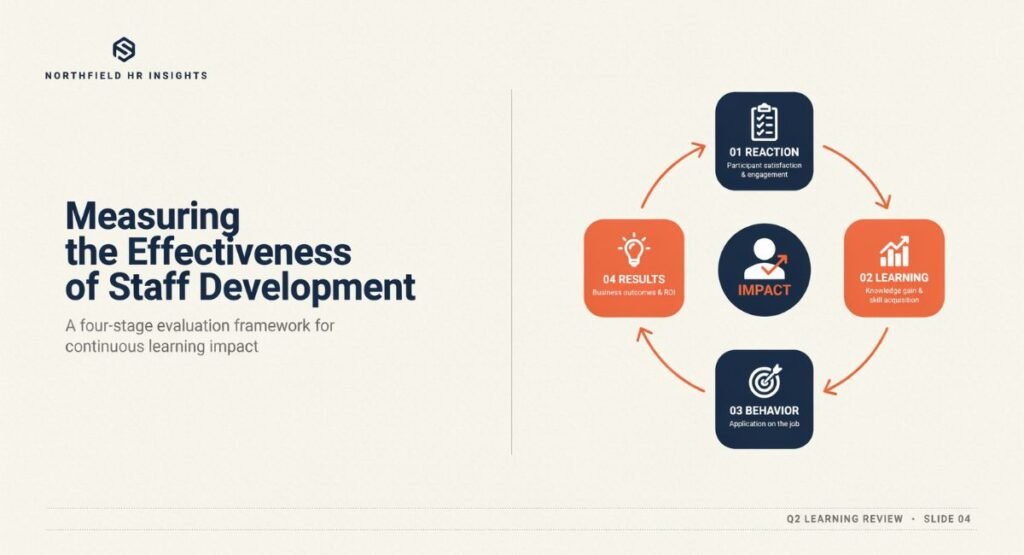
Training attendance alone does not tell us whether a professional-development program worked.
A stronger evaluation framework can examine four levels.
| Level | Question |
| Participation | Did professionals attend and complete the program? |
| Learning | What knowledge or skills did they gain? |
| Application | Did they use the new skills in practice? |
| Longer-term effects | What evidence exists of changes associated with the intervention? |
This framework should be treated as an analytical approach rather than an official DSD measurement system.
A university study specifically examined the effectiveness of Promotion Linked Training (PLT) conducted through DSD and used the Kirkpatrick model to evaluate training effectiveness.
That research provides a useful example of how researchers can move beyond attendance figures and examine training outcomes.
Case Study: Teacher Mentoring and Professional Support
Research into DSD’s mentoring program provides a useful historical case study.
The study examined the impact of District Teacher Educator mentoring support on primary school teachers’ professional progress. Researchers collected information from teachers and school heads and analyzed the results using quantitative methods. The study reported that primary school teachers expressed satisfaction with their professional progress, while the participating CTSC heads were less satisfied with the program’s impact.
This case study highlights an important lesson:
Different Stakeholders Can Experience the Same Program Differently
Teachers may perceive professional support positively while administrators identify different challenges.
For this reason, a strong evaluation should collect feedback from multiple groups rather than relying on a single perspective.
Research and Evidence About DSD
Academic and development-sector research provides additional insight into DSD’s historical role.
An evaluation of the Punjab Education Sector Programme examined support provided to QAED, formerly DSD, particularly in relation to teacher professional development. The evaluation used qualitative methods and examined system and policy strengthening related to teacher development.
Research has also examined DSD’s quality-of-teaching and learning practices, including its relationship with the provincial School Education Department and education-sector partners.
These sources demonstrate why readers should view DSD through both an institutional and research perspective.
Promotion-Linked Training
Another important historical area associated with DSD was Promotion-Linked Training (PLT).
Research describes PLT as a form of in-service training connected with professional advancement for teachers and education officers. A study of DSD’s PLT examined its effectiveness using the Kirkpatrick evaluation model.
Training connected with leadership development can focus on areas such as:
- School management
- Leadership practices
- Decision-making
- Professional responsibilities
- Education administration
The exact rules and eligibility requirements depended on the relevant government policy and period.
DSD’s Transition to QAED
The transition from DSD to QAED represents an important stage in Punjab’s education-sector reforms.
A teacher-training project document states that the DSD model was transformed into QAED as part of a revised approach to teacher training. The plan emphasized school-based, teacher-focused, and need-based professional development.
Later sources consistently describe QAED as the successor or new institutional form associated with the former DSD.
This means that people researching DSD should not automatically assume that an old DSD program remains active today.
A Practical Research Tip
When you find a DSD document online, check:
- Publication date
- Institution name
- Program period
- Relevant government notification
- Whether QAED replaced or modified the program
This simple verification step can prevent outdated information from being presented as current.
QAED and Modern Professional Development
The transition did not eliminate the need for teacher development. Instead, professional development continued under the newer institutional structure.
For example, the Punjab Information Technology Board has described a QAED training platform designed to facilitate professional training. Its listed training areas have included school-based CPD, leadership and management courses, early childhood education, and promotion-linked training.
PITB has also reported online professional-development courses under the CPD framework, including an initiative aimed at more than 188,000 primary school teachers across Punjab.
These examples show how teacher development has increasingly incorporated digital delivery alongside conventional training.
Digital Transformation in Staff Development

Modern professional development can use technology to increase access to learning resources.
Digital approaches can include:
- Online courses
- Learning-management systems
- Digital training materials
- Video lessons
- Online assessments
- Mobile applications
- Virtual professional communities
The QAED training application developed with PITB demonstrates this transition toward digital access to professional training.
Benefits of Digital Learning
Digital training can make professional development more flexible.
Teachers may be able to:
- Access learning materials remotely
- Complete selected activities online
- Review training resources repeatedly
- Participate without traveling for every session
However, technology does not automatically make training effective. Course quality, teacher engagement, practical application, and follow-up still matter.
Challenges in Staff Development
Professional-development systems can face several practical challenges.
Relevance
Training should address real professional needs.
A generic workshop may have limited value if participants cannot connect the content to their daily responsibilities.
Follow-Up
Participants often need opportunities to apply new skills after training.
Follow-up can include:
- Mentoring
- Coaching
- Classroom observation
- Peer discussion
- Additional learning resources
Measuring Impact
Counting participants is relatively easy.
Measuring changes in professional practice is more difficult.
A meaningful evaluation should therefore look beyond attendance and examine learning, application, and evidence of change.
Reaching a Large Workforce
Punjab has a large public-school workforce, making large-scale professional development a complex undertaking. QAED’s own training platform has described its focus on serving a very large population of teachers and education personnel.
Large-scale programs require effective coordination, training infrastructure, digital systems, monitoring, and local support.
A Practical Framework for Understanding Staff Development
For readers who want a simple way to evaluate any professional-development program, Templorix can use the following TIME framework:
T: Training Participation
Did the intended professionals receive the training?
I: Improvement in Knowledge
Did participants demonstrate new knowledge?
M: Mastery of Skills
Can participants demonstrate the skills in realistic situations?
E: Evidence of Application
Is there evidence that participants use the new skills in their professional environment?
This is an original analytical framework for this article, not an official DSD or QAED methodology.
It can help readers think critically about professional-development results.
Directorate of Staff Development vs. General Staff Training
The two concepts may sound similar, but they are not necessarily identical.
| Feature | Directorate-Level Professional Development | General Staff Training |
| Scope | Education-system focused | Organization-specific |
| Audience | Education professionals | Employees or staff |
| Objective | Professional and institutional development | Specific workplace skills |
| Approach | Structured development programs | Courses, workshops, or instruction |
| Follow-up | May include mentoring or monitoring | Depends on the organization |
The important distinction is scope and institutional purpose.
Why the Directorate of Staff Development Still Matters
Although DSD belongs largely to the historical development of Punjab’s teacher-training system, the term remains relevant for several reasons.
Historical Research
Researchers studying education reforms may encounter DSD repeatedly.
Teacher-Training Research
Academic studies continue to reference DSD when examining professional development in Punjab.
Older Documents
Government and institutional documents may use the former name.
Understanding QAED
Knowing DSD’s history helps readers understand how Punjab’s professional-development institutions evolved toward QAED.
How to Research DSD Information Correctly
If you are researching the Directorate of Staff Development for academic, professional, or educational purposes, follow these steps.
Step 1: Check the Date
Determine when the document was published.
Step 2: Identify the Institution
Check whether the document refers to:
- DSD
- QAED
- Another education institution
Step 3: Verify the Program
Confirm whether the referenced training program is historical or currently active.
Step 4: Check Official Sources
Prioritize government departments and official institutional documents.
Step 5: Compare With Research
Academic studies and independent evaluations can provide useful context.
This approach reduces the risk of confusing historical information with current institutional arrangements.
About the Author
Zain UL Abideen is an SEO specialist and content researcher who focuses on creating clear, well-structured guides on education, technology, business, and professional development. Through research-based content, he aims to make complex topics easier to understand while maintaining accuracy, readability, and practical value for readers.
Conclusion
The Directorate of Staff Development played an important historical role in the development of teacher professional development in Punjab. Its work was associated with in-service training, continuous professional development, mentoring, teacher education, and capacity building. Research and historical records show that its activities extended beyond classroom workshops into district-level professional support and education management.
The most important point for modern readers is the institution’s transition to Quaid-e-Azam Academy for Educational Development (QAED). Therefore, DSD should generally be understood as part of the historical development of Punjab’s professional-development system, while current information should be verified through newer QAED and School Education Department sources. Understanding this transition makes it easier to interpret older training documents, academic research, and references to teacher development in Punjab accurately.
(FAQs)
What is the Directorate of Staff Development?
The Directorate of Staff Development was a Punjab education institution associated with teacher professional development, training, mentoring, and capacity-building activities.
Is the Directorate of Staff Development still called DSD?
The former DSD was transformed into the Quaid-e-Azam Academy for Educational Development (QAED) as Punjab revised its professional-development structure.
What was the main purpose of DSD?
Its historical role centered on professional development and training of teachers and other education personnel within Punjab’s school education system.
What was Continuous Professional Development in DSD?
Continuous Professional Development, or CPD, refers to ongoing professional learning rather than a single training event. DSD was associated with CPD activities involving training, mentoring, and professional support.
Where can I find information about current teacher training in Punjab?
For current programs, readers should check the latest information from Punjab’s School Education Department and QAED rather than relying only on older DSD documents.